








Knee Replacement Surgery Cost in India: City-Wise Guide
Have you been waking up each morning with knee pain so intense that even walking to the bathroom feels difficult? Have you already tried medicines, physiotherapy, or injections yet nothing seems to...

Have you been waking up each morning with knee pain so intense that even walking to the bathroom feels difficult? Have you already tried medicines, physiotherapy, or injections yet nothing seems to provide lasting relief despite seeking joint pain treatment India options?
Table Of Content
- What is Knee Replacement Surgery?
- Why Knee Replacement Surgery Cost Varies in India
- Knee Replacement Surgery Cost in India — City-Wise Breakdown
- Government vs Private Hospital Cost Comparison
- What is Included in the Surgery Cost?
- Hidden Costs Patients Often Miss
- Does Health Insurance Cover Knee Replacement in India?
- What is typically covered
- What is often not covered or limited
- Important steps to follow
- Types of Knee Replacement — Which One Do You Need?
- On implants specifically
- How to Choose the Right Hospital and Surgeon
- What to look for in a hospital
- What to look for in a surgeon
- Questions to Ask Before Confirming Your Surgery
- Risks and Complications You Should Know
- Recovery Timeline — What to Expect Week by Week
- Life After Knee Replacement Surgery
- Tips to Reduce Knee Replacement Surgery Cost Without Compromising Quality
- Frequently Asked Questions
- Dr Curo is With You Every Step
If your doctor has recommended knee replacement surgery, it is natural to feel both hopeful that there is a solution and concerned about the cost, the right hospital to choose, and whether recovery will truly restore your quality of life.
You are not alone in facing this decision. Every year, hundreds of thousands of people across India undergo knee replacement surgery, and one of the first questions patients and families ask is: how much will it cost?
The honest answer is that knee replacement surgery cost in India can vary significantly. However, with the right guidance and clear information, you can make a confident decision without overspending or compromising on the quality of care.
What is Knee Replacement Surgery?
Knee replacement surgery medically known as knee arthroplasty is a procedure in which the damaged or worn-out surfaces of the knee joint are removed and replaced with artificial implants made of metal alloys, high-grade plastics, and polymers.
The goal is simple: to eliminate pain, restore movement, and give you back the ability to walk, climb stairs, and live independently without constant suffering.
Knee replacement is typically recommended when:
- Severe arthritis has destroyed the knee joint cartilage
- Chronic knee pain interferes significantly with daily life
- Swelling and stiffness in the knee do not respond to medicines or physiotherapy
- The knee is visibly deformed bowed inward or outward
- You cannot sleep through the night because of knee pain
- Non-surgical treatments have failed over a period of months or years
It is one of the most commonly performed and most successful surgeries in the world with over 90 percent of patients reporting significant improvement in pain and mobility.
At Dr Curo, we connect you with experienced orthopaedic surgeons who assess your condition thoroughly before recommending surgery because the decision to operate is never taken lightly.
Why Knee Replacement Surgery Cost Varies in India
Many patients are confused when they receive quotes from different hospitals that differ by lakhs of rupees for what seems like the same surgery. This confusion is completely valid and completely explainable.
Here is why knee replacement surgery cost in India varies so significantly:
Type of implant used — The implant is the single biggest cost driver. Basic cemented implants cost far less than premium uncemented, mobile-bearing, or gender-specific implants. Implant costs alone can range from ₹50,000 to ₹3,00,000 or more.
Type of surgery — Total knee replacement, partial (unicompartmental) knee replacement, and bilateral (both knees at once) replacement all carry different costs.
Technology used — Computer-assisted navigation surgery and robotic knee replacement offer greater precision but cost significantly more than conventional surgery.
City and hospital tier — A top-tier private hospital in Mumbai charges more than an equally competent hospital in Bhopal or Coimbatore. Infrastructure, real estate, and operational costs differ city to city.
Surgeon’s experience — A senior orthopaedic surgeon with 20 years of knee replacement experience commands higher fees and often delivers better outcomes, especially in complex cases.
Length of hospital stay — Complications, slower recovery, or patient preference for longer monitoring all affect the final bill.
Post-operative physiotherapy and rehabilitation — Some hospitals include this in the package; others charge separately.
Understanding these variables helps you compare quotes meaningfully not just look at the headline number.

Knee Replacement Surgery Cost in India — City-Wise Breakdown
Here is a comprehensive city-wise guide to knee replacement surgery cost in India for private hospitals. These are indicative ranges covering the full spectrum from basic to premium implants and facilities:
| City | Unilateral (One Knee) | Bilateral (Both Knees) |
| Delhi / NCR | ₹1,50,000 – ₹4,50,000 | ₹2,75,000 – ₹8,00,000 |
| Mumbai | ₹1,75,000 – ₹5,00,000 | ₹3,25,000 – ₹9,00,000 |
| Bangalore | ₹1,50,000 – ₹4,75,000 | ₹2,75,000 – ₹8,50,000 |
| Chennai | ₹1,25,000 – ₹4,25,000 | ₹2,50,000 – ₹7,75,000 |
| Hyderabad | ₹1,25,000 – ₹4,00,000 | ₹2,25,000 – ₹7,25,000 |
| Pune | ₹1,25,000 – ₹3,75,000 | ₹2,25,000 – ₹6,75,000 |
| Kolkata | ₹1,00,000 – ₹3,50,000 | ₹1,90,000 – ₹6,25,000 |
| Ahmedabad | ₹1,00,000 – ₹3,25,000 | ₹1,90,000 – ₹5,75,000 |
| Jaipur | ₹90,000 – ₹3,00,000 | ₹1,75,000 – ₹5,50,000 |
| Lucknow | ₹90,000 – ₹2,75,000 | ₹1,70,000 – ₹5,00,000 |
| Bhopal | ₹85,000 – ₹2,50,000 | ₹1,60,000 – ₹4,50,000 |
| Nagpur | ₹80,000 – ₹2,50,000 | ₹1,50,000 – ₹4,50,000 |
| Coimbatore | ₹90,000 – ₹2,75,000 | ₹1,70,000 – ₹5,00,000 |
| Chandigarh | ₹1,00,000 – ₹3,00,000 | ₹1,90,000 – ₹5,50,000 |
| Indore | ₹85,000 – ₹2,50,000 | ₹1,60,000 – ₹4,50,000 |
Important note: These ranges are for private hospitals. Government hospitals and trust hospitals offer the same surgery at considerably lower costs. Ayushman Bharat beneficiaries can access knee replacement at empanelled hospitals at zero cost. Always ask for a written, itemised estimate before signing any admission papers.
At Dr Curo, we help you get accurate, transparent cost estimates from verified hospitals in your city so there are no surprises on discharge day.
Government vs Private Hospital Cost Comparison
Choosing between a government and private hospital is one of the most significant decisions families face. Here is an honest, side-by-side comparison:
| Factor | Government Hospital | Private Hospital |
| Cost | ₹20,000 – ₹80,000 | ₹80,000 – ₹5,00,000 |
| Waiting Time | Weeks to months | Within days |
| Implant Quality | Standard government-approved | Range from basic to premium |
| Surgeon Experience | Excellent at premier institutes | Excellent at leading hospitals |
| Infrastructure | Strong at AIIMS, SGPGI, etc. | Strong across top private chains |
| Room Comfort | Basic to moderate | Moderate to luxury |
| Physiotherapy Support | Available but limited | Comprehensive and structured |
| Post-discharge Follow-up | Good but less personalised | More structured and accessible |
Premier government institutions like AIIMS New Delhi, PGIMER Chandigarh, SGPGI Lucknow, and NIMHANS Bangalore deliver outcomes that match the best private hospitals at a fraction of the cost. The primary trade-off is waiting time, not surgical quality.
At Dr Curo, we evaluate both options honestly based on your urgency, condition severity, and financial situation so you never feel pressured into one direction.
What is Included in the Surgery Cost?
Before comparing hospital quotes, you must know what a standard knee replacement package should include. A complete package typically covers:
- Pre-surgery consultation and assessment by the orthopaedic surgeon
- All pre-operative diagnostic tests – X-rays, MRI, blood panel, ECG, lung function
- Anaesthesia charges
- Operation theatre charges
- The knee implant itself
- Surgeon’s and assistant surgeon’s fees
- ICU or HDU monitoring usually 1 to 2 days
- Hospital ward stay typically 5 to 7 days
- Nursing care, dressings, and monitoring
- Basic in-hospital medicines and IV fluids
- Initial physiotherapy sessions in the hospital
- One or two post-discharge follow-up visits
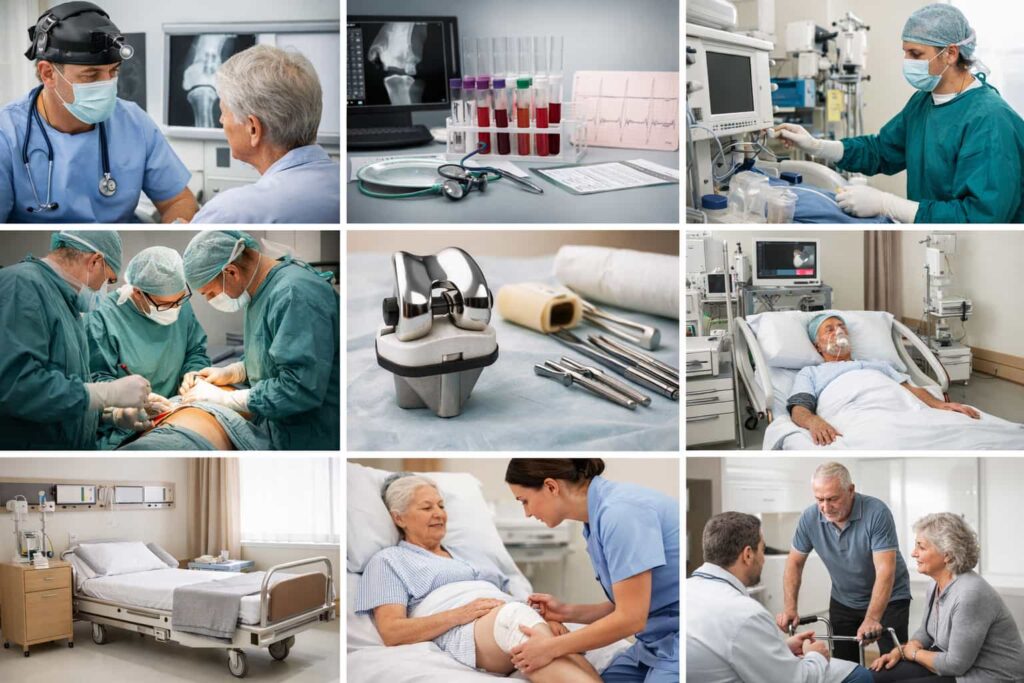
Always ask for a written, itemised package quote and confirm exactly which items are included and which will be billed separately.
Hidden Costs Patients Often Miss
The figure quoted at the time of admission is often not the figure on the discharge bill. Here is what commonly gets added on:
Implant upgrades — Many hospitals quote the cost with a basic implant. If you or your surgeon decide to upgrade to a premium or imported implant during planning, the cost difference can be ₹50,000 to ₹2,00,000 or more.
Pre-surgery specialist consultations — If you have diabetes, heart disease, or kidney issues, you will need clearance from additional specialists each visit adds to the cost.
Extended hospital stay — A wound that heals slowly, a minor infection, or slower-than-expected mobility recovery can extend your stay by several days, adding significantly to room and nursing charges.
Physiotherapy after discharge — Physiotherapy is not optional after knee replacement it determines how well you recover. Most hospitals do not include post-discharge physiotherapy in the surgery package.
Blood transfusion — Knee replacement can involve blood loss. If a transfusion is needed, this adds to the cost.
Medicines at home — Post-surgery medicines including blood clot prevention injections, pain management, and antibiotics typically cost ₹5,000 to ₹15,000 for the first month alone.
Mobility aids — A walker, crutches, knee brace, and raised toilet seat are often needed at home. These are rarely included in hospital packages.
Travel, accommodation, and food — For patients travelling from smaller towns to metro hospitals, family logistics add meaningfully to the total expense.
Planning your budget with a realistic buffer of 20 to 30 percent above the quoted cost is always wise.
Does Health Insurance Cover Knee Replacement in India?
Yes health insurance does cover knee replacement surgery in India in most cases. But the details matter enormously.
What is typically covered:
- Surgery charges including surgeon and anaesthesia fees
- Implant cost — up to the policy’s sub-limit
- Hospital room and ICU charges
- In-hospital medicines and consumables
- Pre and post-hospitalisation expenses usually 30 to 60 days
What is often not covered or limited:
- Implant cost above the policy sub-limit many older policies cap implant coverage at ₹50,000 to ₹1,00,000, which may not cover a premium implant
- Pre-existing condition waiting period most policies have a waiting period of 2 to 4 years for joint replacement
- Post-discharge physiotherapy usually not covered
- Non-medical expenses like food, attendant charges, toiletries
- Robotic surgery premium some policies do not cover the additional cost of robotic-assisted procedures
Important steps to follow:
- Choose a hospital in your insurer’s cashless network to avoid large upfront payments
- Inform your insurance company in advance and get pre-authorisation for planned surgery
- Specifically ask your insurer about the implant sub-limit this is the most common source of surprises
- Keep all original documents: discharge summary, bills, implant sticker, prescription records
If you are eligible for Ayushman Bharat PM-JAY, knee replacement surgery at empanelled hospitals is fully covered with no out-of-pocket cost for qualifying families.
At Dr Curo, we help patients navigate their insurance carefully so coverage is maximised and surprises are minimised.
Types of Knee Replacement — Which One Do You Need?
Not every patient needs the same surgery. The type of knee replacement recommended depends on the extent and pattern of damage in your knee.
| Type | What it Involves | Best For | Approximate Cost Range |
| Total Knee Replacement (TKR) | All three compartments of the knee are replaced | Severe arthritis affecting the whole knee | ₹80,000 – ₹5,00,000 |
| Partial / Unicompartmental Replacement | Only the damaged compartment is replaced | Arthritis limited to one part of the knee | ₹1,00,000 – ₹4,00,000 |
| Bilateral Knee Replacement | Both knees replaced in one surgery | Severe arthritis in both knees | ₹1,50,000 – ₹9,00,000 |
| Revision Knee Replacement | Replacing a previously implanted artificial knee | Failed or worn-out previous implant | ₹2,00,000 – ₹7,00,000 |
| Robotic-Assisted Knee Replacement | Robot-guided precision surgery | Patients wanting maximum implant accuracy | ₹2,50,000 – ₹6,00,000 |
On implants specifically:
- Cemented implants — Fixed to bone using surgical cement. Most commonly used. Highly reliable and cost-effective.
- Uncemented implants — Designed to allow bone to grow into the implant surface. Often preferred for younger, more active patients. More expensive.
- Mobile-bearing implants — The plastic component can rotate slightly, mimicking more natural knee movement. Premium cost.
- Gender-specific implants — Designed specifically for female knee anatomy. Premium pricing.
- Oxinium implants — Made from an oxidised zirconium alloy, more resistant to wear. Suited for younger and more active patients. Highest cost category.
Your orthopaedic surgeon will recommend the most appropriate implant type based on your age, activity level, bone quality, and budget. At Dr Curo, our surgeons are transparent about implant options explaining the trade-offs between cost and expected longevity clearly.
How to Choose the Right Hospital and Surgeon
Knee replacement surgery cost in India matters but it should never be the only deciding factor. Choosing the right surgeon and hospital is what truly determines your outcome.
What to look for in a hospital:
NABH accreditation — This is your assurance that the hospital meets standardised safety and quality benchmarks.
Dedicated joint replacement programme — Hospitals with a specialised orthopaedic and joint replacement department not just a general surgery wing offer better coordinated care.
Volume of knee replacements performed — Studies consistently show that surgeons and hospitals performing higher volumes of knee replacements have lower complication rates and better outcomes. Ask how many procedures they perform per year.
Availability of rehabilitation services — Physiotherapy starting within 24 hours of surgery is standard in good hospitals. Confirm this before choosing.
Infection control standards — Post-operative joint infection is a rare but serious complication. Ask about the hospital’s joint replacement infection rate.
What to look for in a surgeon:
- Specific fellowship or training in joint replacement surgery
- Years of experience performing knee replacements, not just general orthopaedic surgery
- Willingness to discuss all implant options and their costs openly
- Clearly explains what to expect before, during, and after surgery
- Encourages questions and never rushes the consultation
- Comfortable with you seeking a second opinion
At Dr Curo, every orthopaedic surgeon in our network has been evaluated for qualifications, experience, patient outcomes, and communication so you get the best possible match for your needs.
Questions to Ask Before Confirming Your Surgery
Going to your surgical consultation fully prepared changes the entire experience. Here are the questions that matter most:
- Is knee replacement surgery definitely necessary for me at this stage?
- Do I need a total replacement or would a partial replacement work?
- What type of implant do you recommend and why?
- What does that implant cost, and what are the alternatives?
- How many knee replacements have you performed in the last year?
- What is your personal complication and revision rate?
- Will you perform the surgery yourself, or will a colleague assist or lead?
- Is robotic-assisted surgery available, and is it worth the extra cost in my case?
- What is the all-inclusive cost and what is not included?
- How long will I be in hospital, and when can I walk independently?
- What physiotherapy will I receive in hospital, and what happens after discharge?
- When can I expect to return to normal daily activities?
A surgeon who answers these questions patiently and completely is a surgeon worth trusting.
Risks and Complications You Should Know
Knee replacement surgery is one of the safest and most successful elective surgeries in medicine. But like all major procedures, it is not without risk. Being informed means being prepared.
Possible risks and complications include:
- Blood clots — Deep vein thrombosis is the most common complication. Blood-thinning medicines and early movement after surgery significantly reduce this risk.
- Infection — Joint infection is rare but serious, occurring in less than 1 percent of cases. It may require a revision surgery if it occurs.
- Implant loosening — Over many years, the implant can loosen from the bone, requiring revision surgery. High-quality implants and good surgical technique reduce this risk.
- Stiffness — If physiotherapy is not followed diligently, the knee can become stiff and limit movement.
- Nerve or blood vessel injury — Very rare but possible during surgery.
- Persistent pain — A small percentage of patients continue to experience pain after surgery, most commonly due to unrealistic expectations or incomplete rehabilitation.
- Anaesthesia reactions — Rare, but pre-operative assessment significantly minimises this risk.
The vast majority of patients more than 90 percent experience dramatic improvement in pain and mobility with no serious complications. Choosing an experienced surgeon at a well-equipped hospital is the single best way to reduce risk.
At Dr Curo, the orthopaedic surgeons we work with take a thorough, cautious approach to patient selection and surgical planning prioritising your safety above everything else.
Recovery Timeline — What to Expect Week by Week
One of the most common questions patients ask is: when will I feel normal again? Here is a realistic, week-by-week picture of recovery:
| Recovery Stage | Timeframe |
| Surgery and ICU / HDU monitoring | Day 0 to Day 2 |
| Standing and first steps with support | Day 1 to Day 2 |
| Walking short distances with walker | Day 3 to Day 5 |
| Hospital discharge | Day 5 to Day 7 |
| Walking indoors independently with walker | Week 2 to Week 3 |
| Climbing stairs with support | Week 3 to Week 4 |
| Driving (automatic vehicle) | Week 6 to Week 8 |
| Walking outdoors without walker | Week 6 to Week 10 |
| Return to desk work or light duties | Week 6 to Week 8 |
| Full recovery — pain-free daily life | 3 to 6 months |
The single most important factor in how fast and completely you recover is how consistently you follow your physiotherapy programme. Patients who do their exercises diligently even when it is uncomfortable recover significantly faster than those who do not.
Pain and swelling in the first few weeks are completely normal and do not mean something is wrong. They are part of the healing process.
Life After Knee Replacement Surgery
Knee replacement surgery is genuinely life-changing for most patients. The transformation from waking up in pain every day to walking, travelling, and living independently is profound.
Here is what life after surgery looks like for most patients:
- Dramatic reduction or complete elimination of knee pain within 3 to 6 months
- Ability to walk, climb stairs, travel, and do daily activities without assistance
- Improved sleep quality no more waking up from knee pain at night
- Better mood and mental wellbeing as mobility and independence return
- Long-term medicines are usually minimal most patients only need painkillers occasionally, if at all
- Regular follow-up with your orthopaedic surgeon every 6 to 12 months for the first few years, then annually
- The implant typically lasts 15 to 25 years many patients never need a revision

What to avoid after knee replacement:
- High-impact activities like running, jumping, or contact sports
- Sitting cross-legged or squatting deeply in the early months
- Significant weight gain every extra kilogram puts additional stress on the implant
- Ignoring pain or swelling that seems unusual always report it early
Maintaining a healthy weight, staying active with low-impact exercise like walking and swimming, and attending follow-up appointments are the three most important things you can do to protect your new knee for decades.
Tips to Reduce Knee Replacement Surgery Cost Without Compromising Quality
Managing the financial side of knee replacement surgery wisely does not mean settling for less. Here is how to reduce cost without reducing care:
Consider government premier institutes — AIIMS, PGIMER, SGPGI, and similar institutions perform thousands of knee replacements every year with excellent outcomes at a fraction of private hospital costs.
Use your health insurance fully — Understand your policy before admission. Ask specifically about the implant sub-limit, waiting period status, and cashless hospital network. Request pre-authorisation well in advance.
Explore Ayushman Bharat PM-JAY — Eligible families can get knee replacement at empanelled hospitals completely free of charge. Check your eligibility before assuming surgery is unaffordable.
Choose wisely between implant types — A good quality cemented implant from a reputed manufacturer delivers excellent long-term outcomes. An expensive premium implant is not always necessary. Discuss this honestly with your surgeon.
Consider Tier 2 city hospitals — Many cities like Coimbatore, Jaipur, Nagpur, and Bhopal have excellent orthopaedic hospitals with experienced surgeons at significantly lower costs than metros.
Ask about package rates — Many hospitals offer all-inclusive surgery packages that are more affordable than itemised billing. Always ask.
Compare at least two or three hospitals — Get written, itemised estimates. Compare line by line not just the total figure.
Get a second opinion before agreeing to surgery — Confirm that replacement is truly needed and that you have exhausted appropriate non-surgical options. This protects both your health and your finances.
At Dr Curo, we help you find the right balance of quality and cost with honest guidance at every step.

Frequently Asked Questions
Q1. What is the average knee replacement surgery cost in India? The average cost of knee replacement surgery in a private hospital in India ranges from ₹1,00,000 to ₹3,50,000 per knee, depending on the city, hospital, implant type, and surgeon. Government hospitals offer the same surgery at ₹20,000 to ₹80,000.
Q2. Is knee replacement surgery covered under health insurance in India? Yes, most health insurance policies cover knee replacement surgery. However, a waiting period of 2 to 4 years for pre-existing conditions typically applies. Always confirm your policy’s implant sub-limit, as this varies significantly between plans.
Q3. How long does a knee replacement implant last? Modern knee implants last 15 to 25 years in most patients. Longevity depends on activity level, body weight, implant quality, and surgical technique. Younger and more active patients may need a revision surgery after 15 to 20 years.
Q4. At what age is knee replacement surgery recommended? Knee replacement is most commonly performed in patients between 60 and 80 years of age. However, it can be recommended for younger patients with severe arthritis. For patients under 55, surgeons often try to delay surgery as long as possible to avoid the need for revision later.
Q5. Is bilateral knee replacement safe to do in one surgery? Yes bilateral simultaneous knee replacement is performed safely and regularly in India. It reduces total recovery time and overall cost. However, it involves a longer surgery and slightly higher short-term risk. Your surgeon will assess your fitness for this option.
Q6. What is robotic knee replacement surgery? Is it worth the cost? Robotic-assisted knee replacement uses computer-guided robotic arms to place the implant with greater precision. It is particularly beneficial for patients with complex anatomy or specific alignment concerns. The premium is typically ₹50,000 to ₹1,50,000 above conventional surgery. Whether it is worth it depends on your specific case discuss this openly with your surgeon.
Q7. How soon can I walk after knee replacement surgery? Most patients stand and take their first steps with support within 24 hours of surgery. Walking independently with a walker typically begins within 3 to 5 days. Walking without support indoors generally happens between weeks 4 and 8, depending on individual progress.
Q8. How do I find the best knee replacement surgeon near me in India? Look for specific fellowship training in joint replacement, years of experience, volume of knee replacements performed, transparent communication about implants and costs, and strong patient reviews. Dr Curo connects you with verified, experienced orthopaedic surgeons across India matched to your city, condition, and budget.
Dr Curo is With You Every Step
Living with severe knee pain is draining not only physically, but emotionally as well. It can take away your independence, disturb your sleep, prevent you from enjoying daily activities, and gradually impact your overall quality of life, even when you have been exploring different knee pain treatment India options.
When done correctly, knee replacement surgery has the potential to restore mobility and bring life back to normal. Understanding knee replacement surgery cost in India in a clear and transparent way is the first step toward making this decision with confidence rather than fear.
At Dr Curo, we focus on clarity and trust. Instead of vague estimates or complex medical language, we provide honest guidance, connect you with verified specialists, and ensure the process is centered around your needs not hospital profits.
Whether you are evaluating treatment options, comparing hospitals, managing insurance, or searching for a surgeon you can rely on we are here to support you at every step of the journey.
Dr Curo — Expert Care. The Right Doctor. A Healthier You.








No Comment! Be the first one.