







IVF vs ICSI: Key Differences Explained
Have you been trying to conceive for months or even years and now find yourself sitting with a fertility specialist who mentions IVF and ICSI together, leaving you more confused than before,...
Have you been trying to conceive for months or even years and now find yourself sitting with a fertility specialist who mentions IVF and ICSI together, leaving you more confused than before, especially while exploring IVF treatment in India ?
Table Of Content
- IVF vs ICSI Difference — Side-by-Side Comparison
- How is IVF Performed — Step by Step
- How is ICSI Performed — Step by Step
- Who Should Choose IVF?
- Who Should Choose ICSI?
- Success Rates — IVF vs ICSI in India
- IVF vs ICSI Cost in India
- Emotional Journey of Fertility Treatment
- Risks and Side Effects You Should Know
- What Happens if the First Cycle Fails?
- Lifestyle Factors That Affect IVF and ICSI Success
- Questions to Ask Your Fertility Specialist
- Warning Signs You Should See a Fertility Specialist Now
- Frequently Asked Questions
- Dr Curo is With You Every Step
You are not alone. For many couples, these terms are entirely new. And when you are already carrying the emotional weight of fertility challenges, trying to understand complex medical language can feel overwhelming.
Here is what you should know right from the start: both IVF and ICSI are well-established, highly effective fertility treatments that have helped millions of couples worldwide achieve their dream of parenthood. The difference between them is specific and important and when explained clearly, it is much easier to understand than it first seems.
IVF vs ICSI Difference — Side-by-Side Comparison
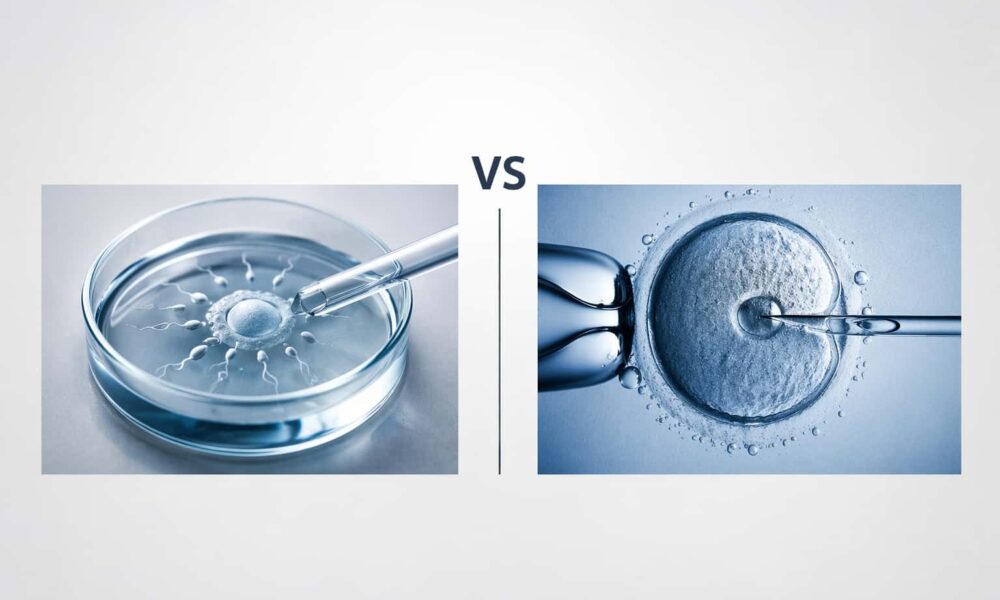
Here is a clear, simple comparison of the IVF vs ICSI difference across the most important parameters:
| Parameter | IVF | ICSI |
| Fertilisation Method | Sperm placed near egg in a dish | Single sperm injected directly into egg |
| Best For | Unexplained infertility, blocked tubes, ovulation issues | Male factor infertility, low sperm count, previous IVF failure |
| Sperm Requirement | Needs healthy sperm in adequate numbers | Works even with very few or abnormal sperm |
| Laboratory Skill Required | Standard embryology skills | Highly specialised microinjection expertise |
| Fertilisation Rate | Good — around 60 to 70 percent | Higher — around 70 to 85 percent |
| Embryo Quality | Comparable | Comparable |
| Pregnancy Success Rate | Similar when patient selection is right | Similar when patient selection is right |
| Cost | Slightly lower | Slightly higher due to technique |
| Risk of Damage to Egg | Minimal | Very small risk during injection |
| Used When Sperm is Surgically Retrieved | Not ideal | Essential |
The IVF vs ICSI difference is not about which one is better overall it is about which one is right for your specific situation.
How is IVF Performed — Step by Step
Understanding the IVF process helps reduce anxiety and helps you know what to expect at each stage.
Step 1 — Ovarian Stimulation The woman takes hormone injections for 10 to 14 days to stimulate the ovaries to produce multiple mature eggs, rather than the single egg produced in a natural cycle. This is monitored carefully with ultrasound scans and blood tests.
Step 2 — Egg Retrieval Once the eggs are mature, a minor procedure called egg retrieval or oocyte pickup is performed under sedation. A thin needle guided by ultrasound is used to collect the eggs from the ovaries. This typically takes 20 to 30 minutes.
Step 3 — Sperm Collection On the same day as egg retrieval, the male partner provides a semen sample. In cases where sperm cannot be produced naturally, surgical sperm retrieval procedures like TESA or PESA are used.
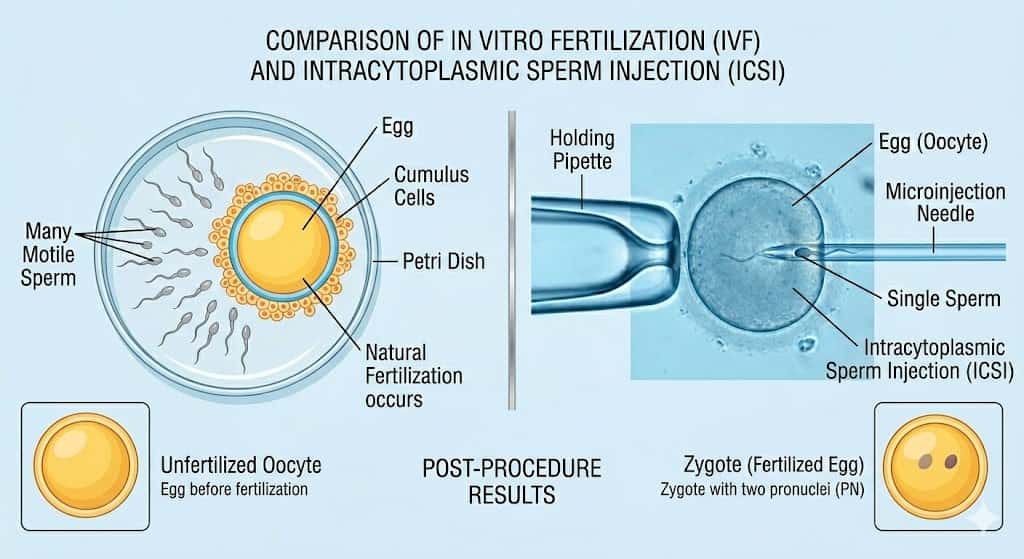
Step 4 — Conventional Fertilisation The collected eggs are placed in a laboratory dish along with a carefully prepared concentration of sperm. The sperm and eggs are left together in controlled conditions overnight. The embryologist checks the next day to see which eggs have been successfully fertilised.
Step 5 — Embryo Development Fertilised eggs become embryos. They are monitored in the laboratory for 3 to 5 days. The embryologist assesses their quality and development. The best quality embryo or embryos are selected for transfer.
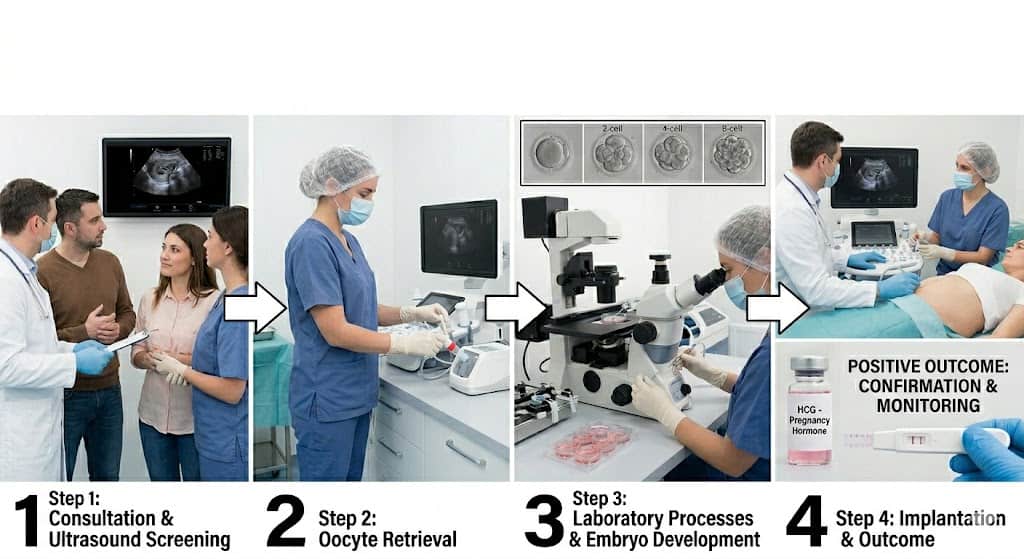
Step 6 — Embryo Transfer The selected embryo is transferred into the woman’s uterus using a thin, soft catheter — a procedure that is usually painless and takes just a few minutes. No anaesthesia is required.
Step 7 — The Two-Week Wait After embryo transfer, the woman waits approximately two weeks before taking a pregnancy test. This is often the most emotionally difficult part of the entire process.
How is ICSI Performed — Step by Step
ICSI follows the same overall process as IVF with one critical difference at the fertilisation stage.
Steps 1 to 3 — Ovarian stimulation, egg retrieval, and sperm collection are identical to the IVF process described above.
Step 4 — Sperm Selection and Preparation In ICSI, a single sperm is carefully selected by the embryologist under high-powered microscopy. The sperm chosen must show the best morphology the right shape and structure and ideally good motility as well.
Step 5 — Microinjection Using an incredibly fine glass needle called a micropipette, the embryologist immobilises the selected sperm and injects it directly into the cytoplasm the centre of a mature egg. This process is repeated for each mature egg collected.
Step 6 — Fertilisation Check The injected eggs are checked the following day for signs of successful fertilisation — the appearance of two distinct nuclei inside the egg.
Steps 7 and 8 — Embryo development, selection, transfer, and the two-week wait proceed identically to standard IVF.
The difference is entirely in how fertilisation is achieved and that difference matters enormously for certain patients.
Who Should Choose IVF?
Standard IVF without ICSI is appropriate in these situations:
Fallopian tube blockage — When the tubes are blocked or damaged, eggs cannot travel naturally to meet sperm. IVF bypasses the tubes entirely.
Ovulation disorders — Conditions like PCOS that prevent regular ovulation respond well to IVF with ovarian stimulation.
Unexplained infertility — When all tests come back normal but pregnancy has not occurred, IVF gives the process a structured, controlled environment.
Endometriosis — Moderate to severe endometriosis can interfere with natural conception, and IVF offers a reliable alternative route.
Previous failed intrauterine insemination (IUI) — If multiple IUI cycles have not resulted in pregnancy, IVF is typically the next step.
Normal sperm parameters — When the male partner’s sperm count, motility, and morphology are all within normal range, conventional IVF fertilisation is usually sufficient.
Genetic testing of embryos — When preimplantation genetic testing is needed, IVF or ICSI is required to create embryos that can be biopsied and tested.
Who Should Choose ICSI?
ICSI is specifically recommended and in some cases essential in these situations:
Low sperm count (oligospermia) — When the total sperm count is too low for conventional IVF to reliably achieve fertilisation.
Poor sperm motility (asthenospermia) — When sperm cannot swim effectively enough to penetrate an egg independently.
Abnormal sperm shape (teratospermia) — When a high proportion of sperm have structural defects that would prevent natural fertilisation.
Zero sperm in ejaculate (azoospermia) — When sperm must be surgically retrieved from the testis or epididymis using procedures like TESA, PESA, or Micro TESE surgically retrieved sperm must always be used with ICSI.
Previous IVF cycle with poor fertilisation — If a previous conventional IVF cycle produced eggs but few or no fertilised embryos, ICSI is recommended for the next cycle.
Frozen sperm being used — Sperm that has been frozen and thawed sometimes has reduced function, making ICSI preferable.
Using donor sperm — Many fertility clinics recommend ICSI when using donor sperm for greater certainty of fertilisation.
Older sperm or eggs — When age-related decline in gamete function is a concern, ICSI reduces the risk of fertilisation failure.
Success Rates — IVF vs ICSI in India
Success rates in fertility treatment are always quoted as percentages and always need context. They depend on the woman’s age, the underlying diagnosis, egg and sperm quality, embryo quality, and the skill of the fertility clinic.
Here is a realistic overview of success rates in India:
| Age Group | IVF Success Rate (per cycle) | ICSI Success Rate (per cycle) |
| Under 35 years | 40 – 50 percent | 45 – 55 percent |
| 35 to 37 years | 30 – 40 percent | 35 – 45 percent |
| 38 to 40 years | 20 – 30 percent | 25 – 35 percent |
| 41 to 42 years | 10 – 20 percent | 15 – 22 percent |
| Above 42 years | 5 – 10 percent | 8 – 12 percent |
Important points to understand about these numbers:
These are per-cycle success rates meaning the chance of a live birth from a single complete treatment cycle. Many couples need more than one cycle to achieve pregnancy.
ICSI does not automatically guarantee higher pregnancy rates than IVF. In patients with normal sperm, studies show that ICSI offers no significant advantage over conventional IVF in terms of final pregnancy outcomes.
ICSI does significantly improve fertilisation rates in patients with male factor infertility but fertilisation rate and pregnancy rate are not the same thing.
The single most important factor affecting success is the woman’s age specifically the age and quality of her eggs.
Choosing a clinic with transparent, audited success rate data is critically important. At Dr Curo, we only recommend fertility clinics that report their outcomes honestly.
IVF vs ICSI Cost in India
Understanding the cost difference between IVF and ICSI helps you plan financially without surprises.
| Treatment Component | IVF | ICSI |
| Base Treatment Cost | ₹80,000 – ₹1,50,000 | ₹1,00,000 – ₹2,00,000 |
| Hormone Injections | ₹30,000 – ₹80,000 | ₹30,000 – ₹80,000 |
| Egg Retrieval Procedure | ₹15,000 – ₹30,000 | ₹15,000 – ₹30,000 |
| Embryo Transfer | ₹10,000 – ₹20,000 | ₹10,000 – ₹20,000 |
| Lab and Monitoring Charges | ₹15,000 – ₹30,000 | ₹15,000 – ₹30,000 |
| ICSI Microinjection Charge | Not applicable | ₹15,000 – ₹40,000 |
| Total Approximate Cost | ₹1,50,000 – ₹3,00,000 | ₹1,75,000 – ₹3,75,000 |
Additional costs that may apply:
- Preimplantation Genetic Testing (PGT) — ₹30,000 to ₹80,000 per cycle
- Embryo freezing and storage — ₹20,000 to ₹50,000 per year
- Frozen embryo transfer (FET) cycle — ₹30,000 to ₹60,000
- Surgical sperm retrieval (TESA / PESA / MicroTESE) — ₹15,000 to ₹60,000
- Donor eggs — ₹50,000 to ₹1,50,000 additional
City-wise approximate total cost range:
| City | IVF (Total Cycle) | ICSI (Total Cycle) |
| Delhi / NCR | ₹1,50,000 – ₹3,00,000 | ₹1,75,000 – ₹3,75,000 |
| Mumbai | ₹1,75,000 – ₹3,50,000 | ₹2,00,000 – ₹4,25,000 |
| Bangalore | ₹1,50,000 – ₹3,25,000 | ₹1,75,000 – ₹4,00,000 |
| Chennai | ₹1,25,000 – ₹3,00,000 | ₹1,50,000 – ₹3,75,000 |
| Hyderabad | ₹1,25,000 – ₹2,75,000 | ₹1,50,000 – ₹3,50,000 |
| Pune | ₹1,25,000 – ₹2,75,000 | ₹1,50,000 – ₹3,50,000 |
| Kolkata | ₹1,00,000 – ₹2,50,000 | ₹1,25,000 – ₹3,25,000 |
| Jaipur | ₹90,000 – ₹2,25,000 | ₹1,10,000 – ₹3,00,000 |
| Lucknow | ₹90,000 – ₹2,00,000 | ₹1,10,000 – ₹2,75,000 |
At Dr Curo, we help you get transparent, itemised cost estimates from verified fertility clinics so you know exactly what you are paying for before you begin.
Emotional Journey of Fertility Treatment
Fertility treatment is not just a medical journey. It is one of the most emotionally intense experiences a couple can go through and it deserves to be acknowledged honestly.
What many couples experience during IVF or ICSI:
The process begins with hope sometimes the first real hope felt after months or years of trying naturally. That hope is precious, and it is also fragile.
Hormone injections cause physical discomfort and significant mood fluctuations. Many women describe feeling simultaneously determined and completely overwhelmed.
The two-week wait between embryo transfer and the pregnancy test is described by almost every patient as the most psychologically difficult part of the process longer than any two weeks they have ever lived through.
If a cycle fails, the grief is real and deep. It is the loss of something genuinely longed for. Many couples need time and sometimes professional support to process this before deciding on next steps.
Male partners often feel helpless, unsure how to support, and sometimes carry guilt especially when the diagnosis involves male factor infertility.

What helps:
- Talking to each other honestly rather than protecting each other from your own fears
- Connecting with others who have been through the same journey online communities and support groups
- Setting boundaries around how much information you share with family and friends you are not obligated to update everyone
- Giving yourself permission to feel whatever you feel hope, fear, grief, and joy are all valid
- Speaking with a counsellor who specialises in fertility this is not a sign of weakness, it is a sign of wisdom
At Dr Curo, we believe that emotional support is not separate from medical care it is part of it.
Risks and Side Effects You Should Know
IVF and ICSI are safe procedures, but like all medical treatments, they carry some risks. Being informed means being prepared not frightened.
Ovarian Hyperstimulation Syndrome (OHSS) The most significant risk of IVF and ICSI. The ovaries over-respond to stimulation hormones, causing swelling, bloating, and in severe cases, fluid accumulation in the abdomen. Mild OHSS is common and manageable. Severe OHSS is rare occurring in less than 2 percent of cycles and requires medical attention. Women with PCOS are at higher risk.
Multiple pregnancy Transferring more than one embryo increases the chance of twins or triplets. Multiple pregnancies carry higher risks for both mother and babies including premature birth and low birth weight. Single embryo transfer is increasingly recommended to reduce this risk.
Egg retrieval complications Very rarely, the egg retrieval procedure can cause bleeding, infection, or injury to surrounding structures. The risk is very low when performed by an experienced team.
Emotional and psychological impact As described above — this is a real and significant aspect of the process that deserves equal attention.
ICSI-specific considerations There is a very small risk of egg damage during the microinjection process — estimated at 1 to 3 percent of injected eggs. Overall, ICSI is safe and does not significantly increase the risk of birth defects beyond the background population rate.
Medication side effects Hormone injections commonly cause bloating, mood changes, headaches, and injection site discomfort. These are temporary and manageable.
At Dr Curo, every fertility specialist we work with ensures patients understand all risks fully and have a plan in place to manage them.
What Happens if the First Cycle Fails?
A failed IVF or ICSI cycle is heart breaking. But it is not the end of the road and it carries valuable information.
Here is what typically happens next:
Review and analysis — A good fertility specialist will review every aspect of the failed cycle: how many eggs were retrieved, fertilisation rates, embryo quality, endometrial response, and transfer details.
Understanding why — Sometimes the reason is clear poor fertilisation suggests switching from IVF to ICSI, or vice versa. Sometimes the answer requires more investigation.
Frozen embryo transfer — If good quality embryos were frozen from the first cycle, a frozen embryo transfer cycle is the logical next step at a fraction of the cost of a full cycle.
Protocol adjustments — Stimulation protocols may be adjusted based on how your ovaries responded. Trigger timing, endometrial preparation, and transfer technique may all be refined.
Additional investigations — Tests like ERA (Endometrial Receptivity Array), immunological screening, or sperm DNA fragmentation testing may be recommended to identify hidden factors.
Considering donor eggs or sperm — In cases where egg or sperm quality is the identified barrier, donor options may be discussed sensitively.
The cumulative success rate — across multiple cycles is significantly higher than the per-cycle rate. Many couples who did not succeed in cycle one go on to have successful pregnancies in cycles two or three.
At Dr Curo, we ensure you have a fertility specialist who reviews failures thoroughly, communicates honestly, and plans the next step with care and clarity.
Lifestyle Factors That Affect IVF and ICSI Success
The decisions you make before and during your treatment cycle genuinely affect your outcomes. Here is what the evidence shows:
Body weight — Being significantly overweight or underweight affects hormone balance, egg quality, and implantation rates. Reaching a healthy weight before starting treatment improves success rates meaningfully.
Smoking — Smoking damages egg quality, reduces ovarian reserve, and significantly reduces IVF and ICSI success rates. Both partners should quit completely at least three months before beginning treatment.
Alcohol — Even moderate alcohol consumption is associated with lower IVF success rates. Avoiding alcohol entirely during treatment is the safest approach.
Stress — While stress alone does not cause infertility, extreme psychological stress during a cycle can affect hormone balance. Finding ways to manage stress yoga, meditation, walking, therapy supports better outcomes.

Diet — A Mediterranean-style diet rich in vegetables, fruits, whole grains, lean proteins, and healthy fats is associated with better fertility outcomes. Ultra-processed foods, excessive sugar, and trans fats are best avoided.
Exercise — Light to moderate exercise is beneficial. Intense, high-impact exercise is best avoided during stimulation and after embryo transfer.
Sleep — Sleep is when most hormonal repair and regulation occurs. Getting 7 to 8 hours of quality sleep every night supports both egg quality and implantation.
Supplements — Folic acid, vitamin D, and CoQ10 are commonly recommended by fertility specialists. Always discuss supplements with your doctor before starting not every supplement is appropriate for every patient.
Questions to Ask Your Fertility Specialist
Going into your consultation with the right questions makes an enormous difference. Here are the ones that matter most:
- Based on my test results, do you recommend IVF or ICSI and why specifically?
- What is the likely cause of our difficulty conceiving?
- How many eggs do you expect to retrieve based on my ovarian reserve?
- What is your clinic’s live birth rate per cycle for my age group?
- How many embryos would you recommend transferring?
- Do you have an elective single embryo transfer policy?
- What happens to extra embryos can they be frozen?
- Do you recommend any additional tests before we begin?
- What lifestyle changes should we make before starting?
- How many cycles would you recommend trying before considering other options?
- What is the all-inclusive cost per cycle and what is not included?
- Do you offer any support or counselling during the process?
A fertility specialist who welcomes these questions and answers them without rushing is a specialist worth trusting.
Warning Signs You Should See a Fertility Specialist Now
Many couples wait too long before seeking help. Here are the signs that it is time to consult a fertility specialist without further delay:
- You have been trying to conceive for 12 months with no success and you are under 35
- You have been trying for 6 months with no success and you are 35 or older
- You have irregular or absent periods
- You have been diagnosed with PCOS, endometriosis, or uterine fibroids
- You have had two or more miscarriages
- Your partner has previously been told he has a low sperm count or abnormal sperm
- You have had a history of pelvic infections or pelvic surgery
- You have had chemotherapy or radiation in the past
- You are considering delaying pregnancy and want to understand egg freezing options
Early consultation does not commit you to treatment. It gives you information and information is the most powerful tool you have.
At Dr Curo, connecting with a fertility specialist is straightforward, supportive, and completely confidential.
Frequently Asked Questions
Q1. What is the main IVF vs ICSI difference? The key difference is how fertilisation happens. In IVF, eggs and sperm are placed together in a lab dish and fertilisation occurs naturally. In ICSI, a single sperm is injected directly into a single egg by an embryologist. ICSI is used when sperm quality or quantity is a concern.
Q2. Is ICSI more successful than IVF? Not necessarily. ICSI has a higher fertilisation rate than conventional IVF in cases of male factor infertility. But when patient selection is appropriate, final pregnancy and live birth rates are similar between the two. ICSI is not automatically better it is better for the right patient.
Q3. Is ICSI painful? ICSI involves no additional discomfort for the patient compared to standard IVF. The microinjection is performed in the laboratory on the egg the patient is under sedation during egg retrieval and does not experience the procedure.
Q4. Can ICSI cause birth defects? Large studies have not found a significant increase in birth defect rates with ICSI compared to natural conception. There may be a very slightly elevated risk linked to the underlying male infertility itself not the ICSI procedure but overall, ICSI babies are born healthy at rates comparable to the general population.
Q5. How many IVF or ICSI cycles are usually needed? Many couples achieve pregnancy in one or two cycles. However, some require three or more. Cumulative success rates across three cycles are significantly higher than single-cycle rates. Your fertility specialist will discuss realistic expectations based on your specific situation.
Q6. Can I choose IVF or ICSI myself? Your fertility specialist will recommend one based on your investigations particularly semen analysis results. In some clinics, ICSI is offered by default to all patients. However, for patients with normal sperm, conventional IVF is equally effective and should be discussed as an option.
Q7. Is IVF or ICSI covered by health insurance in India? Coverage varies widely. Some group health policies include fertility treatment; most individual policies do not. A small number of state government schemes cover IVF for specific populations. Always check your specific policy before assuming coverage.
Q8. How do I find the best IVF or ICSI clinic near me in India? Look for ICMR-registered clinics, transparent success rate reporting, experienced embryologists, modern laboratory infrastructure, and a doctor who takes time to understand your specific situation. Dr Curo connects you with verified, experienced fertility specialists across India matched to your city and needs.
Dr Curo is With You Every Step
The journey to parenthood when it does not happen naturally can feel isolating, exhausting, and at times, deeply heart breaking. The medical choices can seem overwhelming, and the emotional burden often feels heavier than most people can truly understand, especially when you are still trying to figure out what is IVF treatment and how it fits into your path.
But one thing is certain: you do not have to go through this alone.
Understanding the difference between IVF and ICSI is an important first step. Finding the right fertility specialist someone who explains your unique situation clearly, listens to your concerns, and creates a treatment plan tailored specifically to you is the step that can truly change everything.
Dr Curo — Expert Care. The Right Doctor. A Healthier, Happier You.





No Comment! Be the first one.