







Indian Diabetes Diet Chart: What to Eat & Avoid — Complete Guide
When someone is diagnosed with diabetes or prediabetes, one of the very first questions they ask is “What should I be eating?” In the context of diabetes treatment India, this question becomes even...
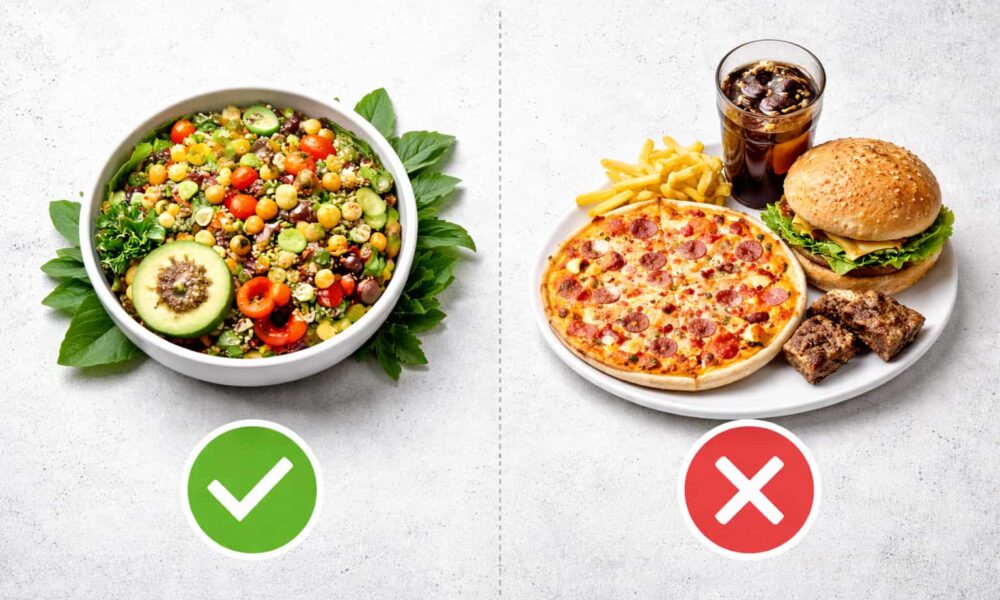
When someone is diagnosed with diabetes or prediabetes, one of the very first questions they ask is “What should I be eating?” In the context of diabetes treatment India, this question becomes even more important, especially in a country where food is deeply cultural, social, and emotional.
Table Of Content
- What Is a Diabetes Diet — And Why Does It Matter for Indians Specifically?
- How Food Affects Blood Sugar — The Core Principle
- The Glycaemic Index — The Most Important Concept in Diabetes Nutrition
- Diabetes Diet Chart India — What to Eat
- 1. Vegetables — The Foundation of Every Meal
- 2. Legumes and Pulses — India’s Best-Kept Diabetes Secret
- 3. Whole Grains and Smart Carbohydrate Choices
- 4. Protein — The Blood Sugar Stabiliser
- 5. Healthy Fats — Often Misunderstood, Always Important
- 6. Indian Herbs, Spices, and Traditional Remedies With Evidence
- Diabetes Diet Chart India — What to Avoid or Limit
- Foods That Directly Spike Blood Sugar
- Fruits to Limit — The Indian Diabetes Fruit Question
- Sample Diabetes Diet Chart India — Full Day Meal Plan
- The Post-Meal Walk — The Single Most Powerful Daily Habit
- Key Eating Habits That Are Just as Important as Food Choices
- Special Dietary Situations in Indian Diabetes Management
- Fasting — Navratri, Ramadan, Ekadashi
- Eating Out and Social Occasions
- Vegetarian and Vegan Diabetics
- Foods That Are Commonly Misunderstood in Diabetes
- How Dr Curo Approaches Diabetes Nutrition
- Frequently Asked Questions
- Dr Curo Is With You Every Step
The good news is that managing your diet as part of diabetes treatment India does not mean giving up everything you love. It means understanding which foods raise blood sugar, which help stabilise it, and how to create a practical Indian meal plan that keeps your glucose levels in a healthy range without making every meal feel restrictive or clinical.
What Is a Diabetes Diet — And Why Does It Matter for Indians Specifically?
A diabetes diet is not a punishment. It is a strategic approach to eating that keeps blood sugar levels stable, reduces glucose spikes after meals, and improves the body’s sensitivity to insulin over time.
For Indians, this matters more than for many other populations and the evidence is sobering. Indians are genetically more prone to developing Type 2 diabetes at a younger age and at lower body weights compared to Western populations. The traditional Indian diet while rich in nutrition is also heavily carbohydrate-dependent. White rice, roti made from refined wheat, sugary chai, and deep-fried snacks are daily staples for millions of Indians. These foods, consumed in typical quantities, create significant and sustained blood sugar challenges in people with insulin resistance or diabetes.
Understanding the diabetes diet chart India means understanding not just what to eat but why certain traditional foods need to be modified, substituted, or consumed differently to protect long-term metabolic health.
How Food Affects Blood Sugar — The Core Principle
Before understanding what to eat and avoid, it helps to understand the basic mechanism at work.
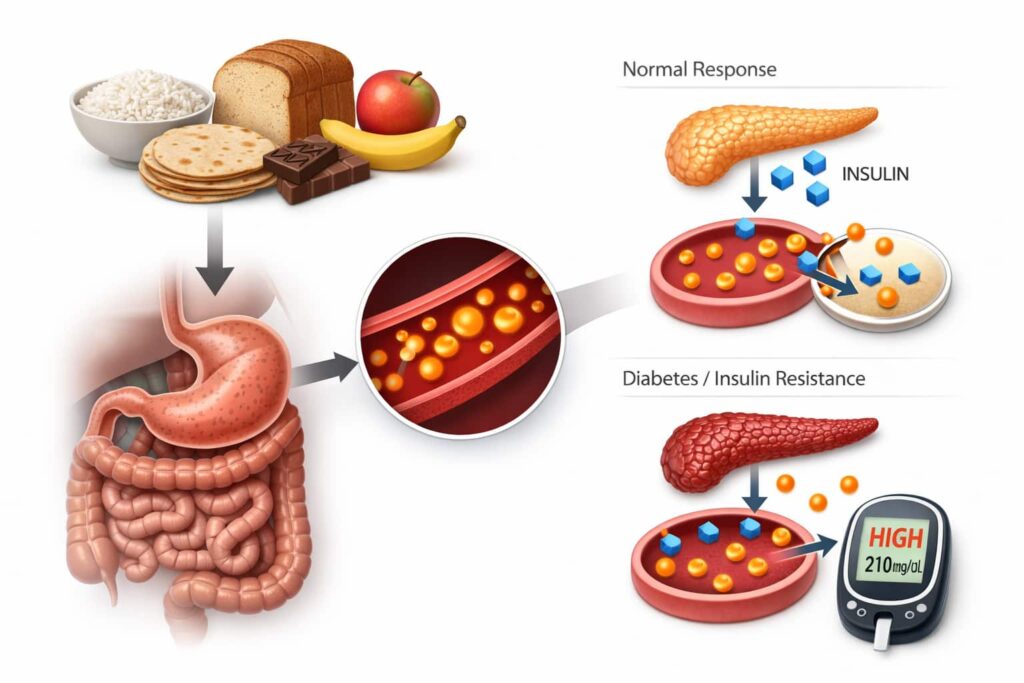
When you eat carbohydrates rice, roti, bread, sweets, fruit your digestive system breaks them down into glucose, which enters the bloodstream. In response, the pancreas releases insulin to move glucose into cells for energy. In a person with diabetes or insulin resistance, this system is impaired either insulin is not produced in sufficient quantities, or the body’s cells do not respond to it efficiently. The result is elevated blood glucose that remains high for longer than it should.
The Glycaemic Index — The Most Important Concept in Diabetes Nutrition
The Glycaemic Index, or GI, measures how quickly a food raises blood sugar compared to pure glucose. Foods with a high GI are digested rapidly and cause sharp glucose spikes. Foods with a low or medium GI are digested more slowly, producing a gentler and more manageable rise in blood sugar.
| GI Category | GI Range | Examples |
| Low GI | Below 55 | Oats, lentils, chickpeas, barley, most vegetables |
| Medium GI | 56 to 69 | Brown rice, whole wheat roti, sweet potato |
| High GI | 70 and above | White rice, white bread, maida, sugar, fruit juice |
For Indians following a diabetes diet chart, shifting the majority of carbohydrate intake from high GI to low and medium GI foods is the single most impactful dietary change possible.
Diabetes Diet Chart India — What to Eat
1. Vegetables — The Foundation of Every Meal
Non-starchy vegetables are the safest, most blood sugar-friendly food group available. They are high in fibre, low in carbohydrates, and rich in vitamins and minerals that support metabolic health.
| Vegetable | Why It Helps |
| Bitter gourd — karela | Strong evidence for blood sugar reduction — contains charantin and plant insulin |
| Fenugreek leaves — methi | Slows carbohydrate absorption — lowers post-meal glucose |
| Spinach — palak | Rich in magnesium — deficiency is directly linked to insulin resistance |
| Broccoli | High fibre — very low carbohydrate impact |
| Cauliflower — gobhi | Excellent low-carb substitute for rice and potato dishes |
| Drumstick — moringa | Anti-inflammatory — shown to reduce fasting blood sugar |
| Ridge gourd — tori | Very low GI — excellent daily vegetable for diabetics |
| Bottle gourd — lauki | Low calorie, high water content — minimal blood sugar impact |
| Tomato | Low GI — rich in lycopene and chromium |
| Cucumber | Near-zero blood sugar impact — excellent for snacking |
Aim to fill at least half your plate with vegetables at every meal. This is the simplest and most effective rule in any diabetes diet chart India.
2. Legumes and Pulses — India’s Best-Kept Diabetes Secret
India has an extraordinary tradition of pulse and legume consumption and this is genuinely good news for diabetics. Lentils, beans, and legumes are among the lowest GI foods available, rich in both fibre and protein, and deeply satisfying.
| Legume | GI | Why It Is Excellent for Diabetes |
| Moong dal | Very low | Light, easily digestible — minimal blood sugar impact |
| Masoor dal | Low | Rich in fibre — slow glucose release |
| Chana — chickpeas | Low | High protein and fibre — excellent blood sugar management |
| Rajma — kidney beans | Low | Very filling — reduces overall meal glucose impact |
| Black chana | Low | Rich in resistant starch — feeds gut bacteria beneficially |
| Lobia — black-eyed peas | Low | High fibre — slows digestion and glucose absorption |
Dal is one of the most powerful foods in a diabetes diet chart India. Eaten daily in appropriate quantities, legumes consistently improve long-term blood sugar control.
3. Whole Grains and Smart Carbohydrate Choices
Carbohydrates cannot and should not be eliminated from an Indian diet but they must be chosen wisely. The goal is to replace high GI refined grains with whole grain alternatives that digest more slowly.
| Better Choice | Replaces | Why It Is Better |
| Millets — bajra, jowar, ragi | White rice or maida | Very low GI — high fibre and mineral content |
| Brown rice | White rice | Slower digestion — retains bran and germ |
| Barley — jau | White rice | One of the lowest GI grains available |
| Whole wheat roti | Maida roti or paratha | Higher fibre — slower glucose release |
| Oats — plain, not instant | Cornflakes or sugary cereal | Beta-glucan fibre shown to lower blood sugar and cholesterol |
| Quinoa | White rice | High protein and fibre — low GI |
Ragi finger millet deserves special mention. It is one of the most blood sugar-friendly grains available, widely consumed in South India, and highly underutilised in the diabetes diet chart India conversation. Ragi roti, ragi porridge, and ragi dosa are excellent daily staples for diabetics.
4. Protein — The Blood Sugar Stabiliser
Protein does not raise blood sugar. It slows the absorption of carbohydrates when eaten together, improves satiety, and supports muscle mass which directly increases the body’s capacity to clear glucose from the bloodstream. Every meal should include a good source of protein.
| Protein Source | Notes for Diabetics |
| Eggs | Excellent — no blood sugar impact, highly satiating |
| Chicken — grilled or boiled | Lean protein — no carbohydrates |
| Fish — especially fatty fish | Omega-3 fats improve insulin sensitivity |
| Paneer | Good protein source — consume in moderation due to fat content |
| Tofu | Excellent plant protein — very low GI |
| Curd — plain, unsweetened | Contains probiotics — improves gut health and insulin sensitivity |
| Moong dal chilla | High protein — good breakfast option |
| Sprouts | High protein and fibre — excellent snack |
5. Healthy Fats — Often Misunderstood, Always Important
Healthy fats slow the absorption of glucose, reduce inflammation, and support cardiovascular health which is a major concern in diabetic patients. The fear of fat in a diabetes diet is outdated. The right fats are highly beneficial.
| Healthy Fat Source | How to Use It |
| Olive oil | Use for salads, light cooking, and tadka |
| Ghee — in small quantities | Traditional Indian fat better than refined vegetable oils |
| Mustard oil | Common in Indian cooking high in beneficial fatty acids |
| Walnuts | Daily handful one of the best blood sugar-supportive snacks |
| Flaxseeds — alsi | Add to roti dough or smoothies rich in omega-3 and fibre |
| Almonds | Excellent pre-meal snack reduces post-meal glucose spike |
| Avocado | Excellent but expensive — use when available |
6. Indian Herbs, Spices, and Traditional Remedies With Evidence
Indian traditional medicine has long used certain herbs and spices for blood sugar management and modern clinical research has validated many of these remedies.
| Ingredient | Evidence and Use |
| Fenugreek — methi seeds | Soak one teaspoon overnight drink the water every morning. Strong clinical evidence for lowering fasting blood sugar |
| Cinnamon — dalchini | Add to tea, milk, or oatmeal. Contains compounds that mimic insulin activity and lower fasting glucose |
| Bitter gourd — karela | Consume as vegetable, juice, or supplement. Multiple clinical trials support blood sugar reduction |
| Turmeric — haldi | Anti-inflammatory curcumin improves insulin sensitivity |
| Amla — Indian gooseberry | High chromium content improves insulin response. Consume fresh, as juice, or as supplement |
| Jamun seeds — powder | Traditional remedy with emerging evidence for blood sugar reduction |
| Neem leaves | Traditionally consumed on empty stomach some evidence for blood sugar reduction |
Diabetes Diet Chart India — What to Avoid or Limit
Foods That Directly Spike Blood Sugar
| Food | Why It Is Harmful | Better Alternative |
| White rice — in large quantities | Very high GI — causes rapid and significant glucose spikes | Brown rice, millets, or cauliflower rice |
| Maida — refined flour | Extremely high GI — found in paratha, puri, naan, biscuits | Whole wheat or besan alternatives |
| Sugar — white and brown | Raises blood glucose immediately | Stevia, small amounts of jaggery in moderation |
| Sugary drinks — cola, packaged juice | Liquid sugar absorbed instantly — worst possible blood sugar impact | Water, chaach, unsweetened herbal tea |
| Chai with sugar — multiple times daily | Repeated small glucose spikes throughout the day cause sustained high blood sugar | Unsweetened chai, green tea, or black coffee |
| Deep-fried snacks — samosa, pakoda, chips | High carbohydrate and trans fat — worsen insulin resistance | Roasted chana, sprouts, cucumber slices |
| Sweets — mithai, halwa, gulab jamun | Extremely high sugar and refined carbohydrate | Very small portions only on rare occasions |
| White bread and bakery products | High GI — hidden sugar and refined flour | Whole grain bread in small quantities |
| Instant noodles and packaged snacks | Refined carbohydrates with hidden sugar and sodium | Home-cooked alternatives |
| Fruit juice — even fresh | Fructose without fibre — absorbed as rapidly as sugar | Whole fruit in controlled portions |
Fruits to Limit — The Indian Diabetes Fruit Question
Fruit is not the enemy in diabetes but certain high-sugar fruits need to be consumed in controlled portions. The fibre in whole fruit slows absorption which is why whole fruit is always better than juice.
| Fruit | Guidance for Diabetics |
| Mango — aam | Limit to half a small mango — very high natural sugar |
| Banana — kela | Limit to half a small banana — medium to high GI |
| Grapes — angoor | Limit strictly — high fructose content |
| Chikoo — sapodilla | Very sweet — consume rarely and in small quantities |
| Lychee — litchi | High sugar — limit strictly |
| Watermelon — tarbuj | High GI despite moderate sugar content — limit portions |
| Fruit | Excellent for Diabetics |
| Jamun — Indian blackberry | Actively lowers blood sugar — one of the best fruits for diabetics |
| Guava — amrood | Low GI — high fibre — excellent blood sugar management |
| Apple — with skin | Low to medium GI — consume one small apple daily |
| Pear — nashpati | Low GI — good fibre content |
| Papaya — in moderation | Medium GI — rich in enzymes — consume a small bowl |
| Berries — strawberry, blueberry | Low GI — anti-inflammatory — excellent snack |
Sample Diabetes Diet Chart India — Full Day Meal Plan
This is a practical, realistic, and culturally appropriate daily meal plan for an Indian adult managing diabetes or prediabetes.
| Time | Meal | What to Have |
| 6:30 AM — On waking | Pre-breakfast | One teaspoon methi seeds soaked overnight — drink the water. One glass of plain water with amla juice or half a lemon |
| 7:30 AM — Breakfast | Main breakfast | Two ragi or whole wheat rotis with one bowl moong dal OR two eggs any style OR one bowl oats with nuts and seeds. Unsweetened chai or green tea |
| 10:30 AM — Mid-morning | Light snack | A small handful of walnuts or almonds OR one small guava or apple OR one bowl of plain roasted chana |
| 1:00 PM — Lunch | Main lunch | One cup brown rice or two whole wheat rotis. One bowl dal or rajma or chana. One bowl sabzi — non-starchy vegetable. One bowl plain curd. One bowl salad — cucumber, tomato, onion with lemon |
| 4:00 PM — Evening snack | Light snack | One bowl sprouts with lemon and salt OR cucumber with hummus OR one small bowl of makhana — fox nuts — dry roasted |
| 7:30 PM — Dinner | Main dinner | Two ragi or bajra rotis. One bowl dal or paneer sabzi. One bowl vegetable curry. Small bowl of salad. Walk for 15 minutes after dinner |
| 9:30 PM — Before bed | Optional | One small glass of warm turmeric milk unsweetened or with minimal jaggery |
The Post-Meal Walk — The Single Most Powerful Daily Habit
Research consistently shows that a 10 to 15-minute brisk walk within 30 minutes of eating reduces post-meal blood sugar spikes by up to 30 percent. This single daily habit applied consistently after every meal is one of the most impactful and free natural blood sugar interventions available to any diabetic patient in India.
You do not need a gym. You do not need equipment. You need to walk after every meal every single day.
Key Eating Habits That Are Just as Important as Food Choices
The diabetes diet chart India is not just about what you eat. How you eat matters enormously.
Eat vegetables and protein before carbohydrates the sequence of food consumption during a meal significantly affects how fast glucose enters the bloodstream. Starting a meal with salad, dal, or sabzi before rice or roti reduces post-meal glucose spikes meaningfully.
Eat slowly and chew thoroughly eating too fast bypasses satiety signals and leads to overconsumption. Slow eating reduces meal size naturally and improves glucose management.
Never skip meals especially breakfast. Skipping meals causes the liver to release stored glucose into the bloodstream as a compensatory response, raising fasting and pre-meal blood sugar.
Eat at consistent times every day the body’s circadian rhythm affects glucose metabolism. Irregular meal timing disrupts insulin secretion patterns and worsens blood sugar control.
Control portion sizes without calorie counting use the plate method. Half the plate as vegetables, one quarter as protein, one quarter as whole grain carbohydrates.
Stay hydrated dehydration directly concentrates blood glucose and raises readings. Drink 8 to 10 glasses of water daily. Avoid substituting water with sugary drinks, packaged juices, or excess chai.
Special Dietary Situations in Indian Diabetes Management
Fasting — Navratri, Ramadan, Ekadashi
Fasting is common in India across all religions and communities. For diabetics, fasting requires careful management.
During fasting periods, opt for foods like sabudana in small quantities, kuttu atta rotis, fruits, nuts, and dairy. Avoid long gaps between permitted eating windows without a source of protein or fat. Always consult your Dr Curo specialist before undertaking extended fasts medication adjustments may be necessary to prevent hypoglycaemia.
Eating Out and Social Occasions
Eating out does not have to mean abandoning your diabetes diet chart India entirely. Order tandoori or grilled over fried. Choose dal or sabzi over creamy curries. Ask for roti instead of naan. Eat a handful of nuts before attending events where the food options will be limited. Avoid dessert or take one small taste rather than a full serving.
Vegetarian and Vegan Diabetics
India has an enormous vegetarian population and vegetarian diabetes management is highly effective when protein intake is prioritised. Rely on dal, paneer, curd, eggs if permitted, and legumes to meet protein needs. Supplement with B12 and iron as guided by your Dr Curo specialist, as deficiencies are common in vegetarian diabetics and can worsen fatigue and metabolic health.
Foods That Are Commonly Misunderstood in Diabetes
Several foods cause unnecessary confusion in the diabetes diet chart India conversation.
Jaggery – gur is not safe for diabetics in regular quantities. It is less refined than white sugar and contains some minerals, but it raises blood sugar similarly. Small amounts occasionally are acceptable — it is not a sugar replacement.
Brown bread is not always a good choice. Most commercial brown bread in India is coloured white flour, not genuine whole wheat. Check that whole wheat flour is the first ingredient listed before purchasing.
Fruit is not freely available for diabetics. The fibre in whole fruit is protective but very sweet fruits in large portions still raise blood sugar significantly. Portion control matters even with healthy fruit.
Low-fat packaged products are often worse than full-fat versions. Manufacturers frequently add sugar to compensate for removed fat. Always check labels low-fat curd or yoghurt with added fruit flavouring is often higher in sugar than plain full-fat curd.
How Dr Curo Approaches Diabetes Nutrition
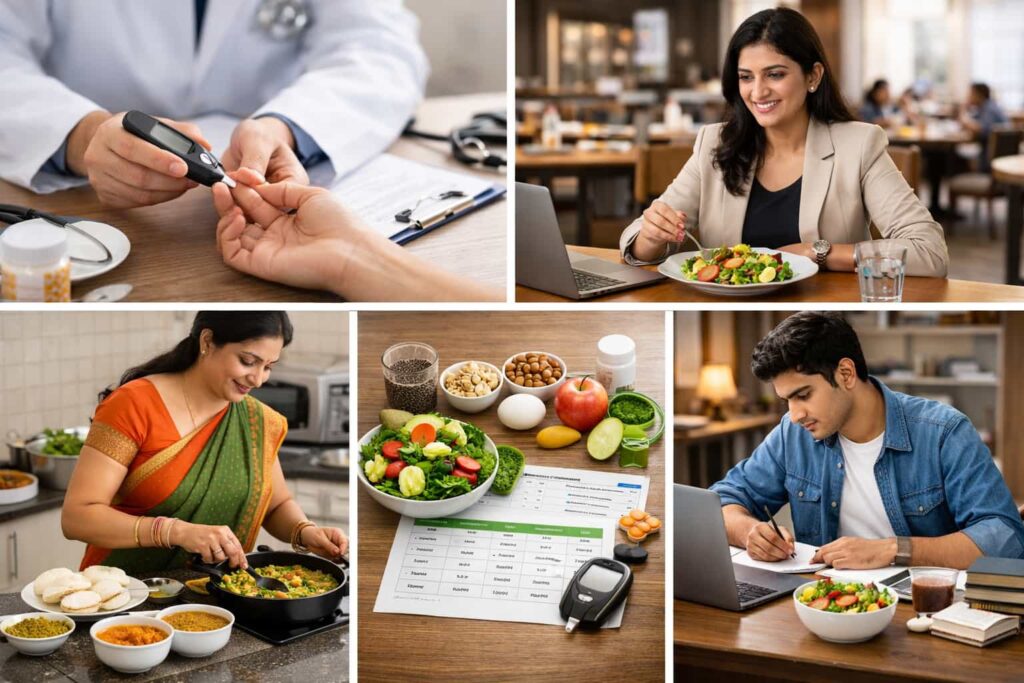
At Dr Curo, dietary guidance is never generic. A personalised diabetes diet chart India is developed for every patient based on their specific HbA1c, fasting glucose, metabolic profile, BMI, cultural food preferences, cooking habits, and lifestyle demands.
This means your meal plan will be designed around your actual daily life not a theoretical ideal that no one can realistically maintain. Whether you are a working professional in Mumbai eating out frequently, a homemaker in Chennai cooking traditional South Indian meals, or a student in Delhi managing budget and time constraints your diabetes diet plan should work for your life, not against it.
At Dr Curo, nutritional consultation is integrated into every diabetes management plan alongside blood testing, supplement protocols, exercise guidance, and medical treatment where necessary.
Frequently Asked Questions
Q1. Can I eat rice if I have diabetes? Yes in controlled portions and ideally as brown rice, red rice, or combined with plenty of dal, vegetables, and curd to slow absorption. White rice in large quantities is the problem, not rice itself. Switching to millets for at least two meals per day is an excellent strategy.
Q2. Is roti better than rice for diabetics? Whole wheat roti generally has a lower GI than white rice but the difference is smaller than most people believe. Ragi roti, bajra roti, or barley roti are significantly better than both regular wheat roti and white rice for blood sugar management.
Q3. How much fruit can a diabetic eat per day? Two to three small servings of low to medium GI fruit per day — such as one guava, one small apple, and a handful of jamun is appropriate for most diabetics. Avoid high-sugar fruits like mango, banana, and grapes in large portions.
Q4. Is jaggery safe for diabetics instead of sugar? Jaggery raises blood sugar similarly to white sugar and should not be consumed freely by diabetics. Small amounts less than one teaspoon per day are unlikely to cause significant harm for well-controlled diabetics, but it is not a safe sugar substitute.
Dr Curo Is With You Every Step
Understanding the diabetes diet chart in India is not about restriction it is about knowledge. When you clearly recognise diabetes symptoms in adults and understand which foods raise your blood sugar versus those that support it, every meal becomes an opportunity rather than a risk. This awareness plays a crucial role in effective type 2 diabetes treatment India.
The right diet combined with regular physical activity, quality sleep, stress management, and medical care when needed forms the foundation of successful type 2 diabetes treatment India. With this balanced approach, many individuals can take better control of their condition, manage diabetes symptoms in adults more effectively, reduce long-term complications, and live a full, active, and satisfying life.
Take the first step today. Your personalised diabetes diet plan begins with a conversation at Dr Curo.







No Comment! Be the first one.