







IVF for Low Sperm Count: Treatment Options, Success Rates & What to Expect
If you’ve been told your sperm count is low, remember this — you are far from alone, and there are still effective paths to parenthood. Male factor infertility affects millions of couples...
If you’ve been told your sperm count is low, remember this — you are far from alone, and there are still effective paths to parenthood. Male factor infertility affects millions of couples worldwide, but advances in modern fertility care, especially through IVF treatment in India, have made it possible for many men with even severely low sperm counts to successfully father biological children.
Table Of Content
- What Is Low Sperm Count?
- Can You Do IVF With Low Sperm Count?
- IVF for Low Sperm Count: How Does It Work?
- Step 1: Fertility Assessment & Diagnosis
- Step 2: Ovarian Stimulation (Female Partner)
- Step 3: Egg Retrieval
- Step 4: Sperm Collection or Surgical Sperm Retrieval
- Step 5: Fertilisation Using ICSI
- Step 6: Embryo Development
- Step 7: Embryo Transfer
- Step 8: Pregnancy Test
- Key IVF Techniques for Low Sperm Count
- 1. ICSI — Intracytoplasmic Sperm Injection
- 2. PICSI — Physiological ICSI
- 3. IMSI — Intracytoplasmic Morphologically Selected Sperm Injection
- 4. Surgical Sperm Retrieval Techniques
- Sperm DNA Fragmentation: The Hidden Factor
- IVF Success Rates With Low Sperm Count
- Lifestyle Changes That Support IVF Success in Men
- When to Consider IVF for Low Sperm Count
- Why Choose Dr Curo for IVF With Low Sperm Count?
- Frequently Asked Questions
- Low Sperm Count Is Not the End of Your Story
At Dr Curo, we believe that knowledge is the first step toward parenthood. In this comprehensive guide, we break down everything you need to know about IVF for low sperm count from diagnosis to treatment options to realistic success rates.
What Is Low Sperm Count?
Low sperm count, medically known as oligospermia, is a condition where a man’s semen contains fewer than 15 million sperm per millilitre. When the count drops below 5 million per ml, it is classified as severe oligospermia. Complete absence of sperm in the semen is called azoospermia.
The World Health Organisation (WHO) defines a normal sperm count as 15 million to 200 million per millilitre. Any reading below the lower threshold can significantly reduce the natural chances of conception.
Common causes of low sperm count include:
- Varicocele (enlarged veins in the scrotum)
- Hormonal imbalances (low testosterone, thyroid issues)
- Infections (mumps, sexually transmitted infections)
- Genetic conditions (Klinefelter syndrome, Y chromosome deletion)
- Lifestyle factors (smoking, alcohol, obesity, stress)
- Exposure to environmental toxins or heat
- Prior surgeries or injuries
- Certain medications and anabolic steroids
Can You Do IVF With Low Sperm Count?
Yes — absolutely. IVF (In Vitro Fertilisation) is one of the most effective fertility treatments for couples dealing with male factor infertility. Unlike natural conception, where sperm must swim through the cervix, uterus, and fallopian tube to reach the egg, IVF removes these barriers by fertilising the egg in a controlled laboratory setting.
Even men with very low or poor-quality sperm can achieve successful fertilisation through IVF particularly when combined with a technique called ICSI (Intracytoplasmic Sperm Injection), which we’ll cover in detail below.
IVF for Low Sperm Count: How Does It Work?
Here is a step-by-step overview of what the IVF process looks like for couples where the male partner has a low sperm count:
Step 1: Fertility Assessment & Diagnosis
At Dr Curo, we begin with a thorough evaluation of both partners. For the male partner, this typically includes:
- Semen analysis (sperm count, motility, morphology)
- Hormonal blood tests (FSH, LH, testosterone, prolactin)
- Genetic testing (if azoospermia or severe oligospermia is suspected)
- Scrotal ultrasound (to check for varicocele or blockages)
A complete picture helps us recommend the most appropriate IVF protocol.
Step 2: Ovarian Stimulation (Female Partner)
The female partner receives hormonal injections to stimulate her ovaries to produce multiple mature eggs. This phase typically lasts 10–14 days and is monitored via ultrasound scans and blood tests.
Step 3: Egg Retrieval
Once the follicles are mature, a minor surgical procedure (under sedation) is performed to retrieve the eggs from the ovaries. This is called ovum pick-up (OPU).
Step 4: Sperm Collection or Surgical Sperm Retrieval
The male partner provides a semen sample on the day of egg retrieval. In cases of severe oligospermia or azoospermia, sperm may be retrieved directly from the testis or epididymis using surgical procedures (more on this below).
Step 5: Fertilisation Using ICSI
This is where advanced technology makes the difference. In conventional IVF, sperm and eggs are placed together and fertilisation happens naturally in the dish. But when sperm count is low, ICSI is used — a single healthy sperm is selected and injected directly into a mature egg.
Step 6: Embryo Development
Fertilised eggs (now embryos) are cultured in the lab for 3–5 days. The embryologist monitors their development and selects the best-quality embryo(s) for transfer.
Step 7: Embryo Transfer
One or two of the best embryos are transferred into the uterus via a thin catheter. This is a quick, painless procedure. Any remaining high-quality embryos can be frozen for future cycles.
Step 8: Pregnancy Test
About 10–14 days after the embryo transfer, a blood test (beta-hCG) confirms whether the embryo has implanted successfully.
Key IVF Techniques for Low Sperm Count
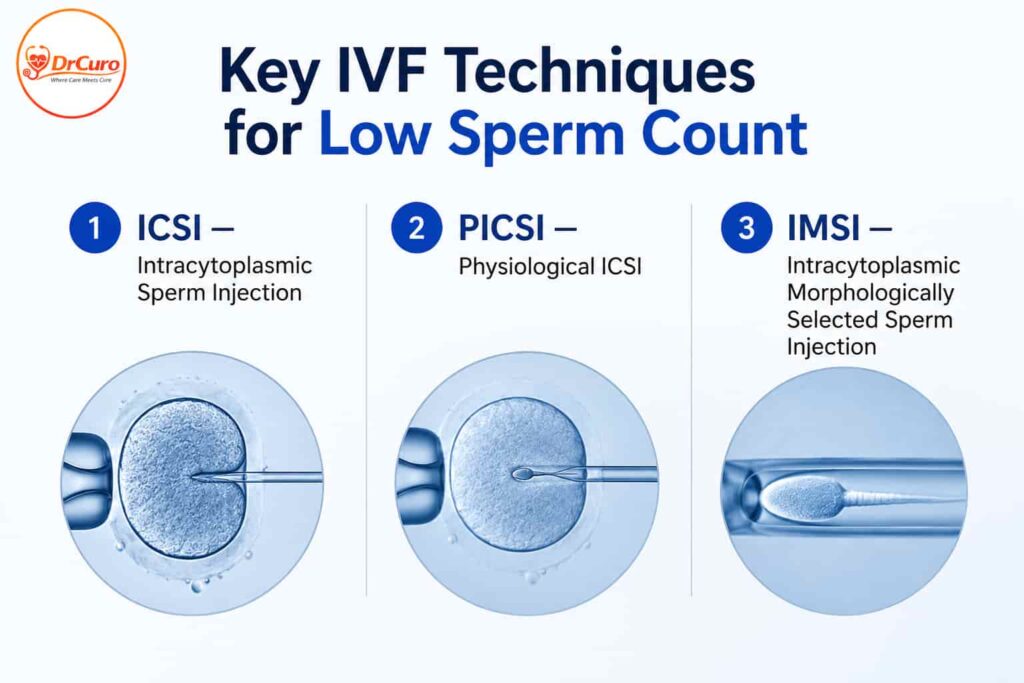
1. ICSI — Intracytoplasmic Sperm Injection
ICSI is the gold standard for IVF with low sperm count. It requires just one viable sperm per egg. The embryologist examines the semen sample under a high-powered microscope, selects the healthiest-looking sperm, and injects it directly into the egg.
ICSI has revolutionised male infertility treatment. Before ICSI, men with severe oligospermia or azoospermia had very few options. Today, fertilisation rates with ICSI are typically 60–80% even when sperm counts are critically low.
2. PICSI — Physiological ICSI
A more advanced version of ICSI, PICSI selects sperm based on their ability to bind to hyaluronic acid a natural component found in the outer layer of eggs. Sperm that binds well to hyaluronic acid are typically more mature and have less DNA damage.
PICSI is recommended when:
- There is a history of poor fertilisation with standard ICSI
- There is high sperm DNA fragmentation
- Recurrent embryo implantation failure has occurred
3. IMSI — Intracytoplasmic Morphologically Selected Sperm Injection
IMSI uses ultra-high magnification microscopy (over 6,000× compared to 200× in standard ICSI) to evaluate sperm morphology in extreme detail. This allows embryologists to identify and exclude sperm with structural defects in the nucleus defects invisible under standard ICSI magnification.
IMSI is particularly helpful in cases of:
- Severe male factor infertility
- Repeated IVF failures
- High rates of abnormal embryo development
At Dr Curo, we offer IMSI as part of our advanced male infertility protocol.
4. Surgical Sperm Retrieval Techniques
When there is no sperm in the ejaculate (azoospermia) or when sperm count is so low that ejaculated sperm cannot be used effectively, sperm can be retrieved directly from the reproductive tract through minor surgical procedures:
PESA (Percutaneous Epididymal Sperm Aspiration) Sperm are aspirated directly from the epididymis using a fine needle. Used in cases of obstructive azoospermia (where sperm are produced but cannot exit due to a blockage).
TESA (Testicular Sperm Aspiration) A fine needle is inserted into the testis to retrieve sperm tissue. Simple, minimally invasive, and performed under local anaesthesia.
TESE (Testicular Sperm Extraction) A small incision is made in the testis to retrieve testicular tissue. Used in cases of non-obstructive azoospermia, where sperm production is very limited.
Micro-TESE (Microsurgical Testicular Sperm Extraction) The most advanced sperm retrieval technique, Micro-TESE uses an operating microscope to identify and extract sperm-producing tubules within the testis with much greater precision than conventional TESE. It offers the highest sperm retrieval rates in men with non-obstructive azoospermia and is the preferred technique at Dr Curo for complex cases.
Sperm DNA Fragmentation: The Hidden Factor
One aspect often overlooked in standard fertility workups is sperm DNA fragmentation (SDF) damage within the genetic material of the sperm. Even when sperm count and motility appear normal, high DNA fragmentation can lead to:
- Failed fertilisation
- Poor embryo quality
- Recurrent miscarriage
- Failed IVF cycles
At Dr Curo, we routinely test for sperm DNA fragmentation using the DFI (DNA Fragmentation Index) test. A DFI below 15% is considered good; above 25–30% significantly impacts outcomes and requires targeted treatment before IVF proceeds.
Strategies to reduce DNA fragmentation include antioxidant therapy, lifestyle changes, and in some cases, using testicular sperm (which tends to have lower DNA damage than ejaculated sperm).
IVF Success Rates With Low Sperm Count
A common question at Dr Curo is: “What are our real chances?”
The honest answer is that IVF success with low sperm count depends on several interrelated factors:
| Factor | Impact on Success |
| Female partner’s age | The single most important factor |
| Egg quality and reserve (AMH) | High importance |
| Severity of male infertility | Moderate — largely overcome by ICSI |
| Sperm DNA fragmentation | Significant if elevated |
| Embryo quality | Very high importance |
| Number of IVF cycles | Cumulative success increases over multiple cycles |
| Clinic expertise | Critical |
Generally speaking, IVF with ICSI for male infertility achieves fertilisation rates of 60–80%, and live birth rates per cycle range from approximately:
- 40–50% for women under 35
- 30–40% for women aged 35–37
- 20–30% for women aged 38–40
- 10–15% for women over 40
With the right protocol, experienced embryologists, and advanced techniques like PICSI or IMSI where indicated, outcomes can be significantly improved.
Lifestyle Changes That Support IVF Success in Men
While IVF can work around low sperm count, optimising sperm health before treatment always improves the chances of success. Dr Curo’s fertility specialists recommend:
Diet & Nutrition
- Increase antioxidant-rich foods (berries, nuts, leafy greens, tomatoes)
- Eat zinc-rich foods (oysters, pumpkin seeds, lentils)
- Include omega-3 fatty acids (fatty fish, walnuts, flaxseed)
- Reduce processed foods, trans fats, and excessive sugar
Lifestyle Modifications
- Stop smoking completely smoking damages sperm DNA
- Limit alcohol to no more than 1–2 units per week
- Maintain a healthy BMI (obesity reduces testosterone and sperm quality)
- Avoid anabolic steroids and performance-enhancing drugs
- Wear loose-fitting underwear and avoid excessive heat to the groin
Supplements Clinically Shown to Help
- CoQ10 — improves sperm motility and energy production
- L-Carnitine — enhances sperm motility
- Vitamin C & E — powerful antioxidants that protect sperm DNA
- Folate & Zinc — support sperm production and DNA integrity
- Selenium — linked to improved sperm morphology
Always consult with a Dr Curo specialist before starting any supplementation regimen.
When to Consider IVF for Low Sperm Count
You should consider consulting a fertility specialist at Dr Curo if:
- Your semen analysis shows a count below 15 million/ml
- You have been trying to conceive naturally for 12 months (or 6 months if the female partner is over 35) without success
- You have a known genetic or structural cause of low sperm count
- Previous IUI (intrauterine insemination) has not worked
- You or your partner has other fertility factors in addition to low sperm count
Why Choose Dr Curo for IVF With Low Sperm Count?
At Dr Curo, we approach every fertility journey as unique. Our team of fertility specialists, andrologists, and embryologists work in close coordination to create a personalised treatment plan not a one-size-fits-all protocol.
What sets Dr Curo apart:
- Advanced embryology lab with the latest ICSI, PICSI, IMSI, and Micro-TESE capabilities
- Sperm DNA fragmentation testing as a standard part of our male fertility workup
- Transparent, evidence-based success rates — we believe in honest conversations
- End-to-end fertility care — from diagnosis through pregnancy and beyond
- Compassionate, judgment-free environment — we understand that this journey can be emotionally challenging
Frequently Asked Questions
Q: Can IVF work if my sperm count is extremely low (less than 1 million/ml)? Yes. With ICSI, even a very small number of motile sperm is enough for fertilisation. Our embryologists are skilled at identifying viable sperm even in the most challenging samples.
Q: What if no sperm are found in my ejaculate at all? Azoospermia does not necessarily mean the end of the road. Surgical sperm retrieval techniques like Micro-TESE can often retrieve sperm directly from the testis. Dr Curo has a dedicated andrological surgery team for this.
Q: How many IVF cycles might we need? This varies. Many couples conceive in the first or second cycle. Cumulative success rates improve significantly over 2–3 cycles. Dr Curo will give you a realistic estimate based on your individual parameters.
Q: Does low sperm count affect the baby’s health? Research shows that children born through ICSI are generally as healthy as those conceived naturally. There is a slightly increased chance of passing on genetic causes of male infertility to male children, which is why genetic counselling is offered at Dr Curo when appropriate.
Q: How long does the entire IVF process take? From the start of ovarian stimulation to the pregnancy test, one IVF cycle takes approximately 4–6 weeks.
Low Sperm Count Is Not the End of Your Story
A diagnosis of low sperm count can feel overwhelming but it is rarely a dead end. With the right diagnostic workup, the correct IVF protocol, and the latest advances in assisted reproduction, the majority of couples dealing with male factor infertility can achieve their dream of parenthood.
Dr Curo is here to walk you through every step with expertise, empathy, and absolute commitment to your success.






No Comment! Be the first one.