







IVF Treatment Without Surgery: Minimally Invasive Options – Complete Guide by Dr Curo
When most people hear “IVF,” they picture major surgeries, hospital stays, and complicated medical procedures. But fertility care has evolved significantly over the years. Today, IVF treatment in...
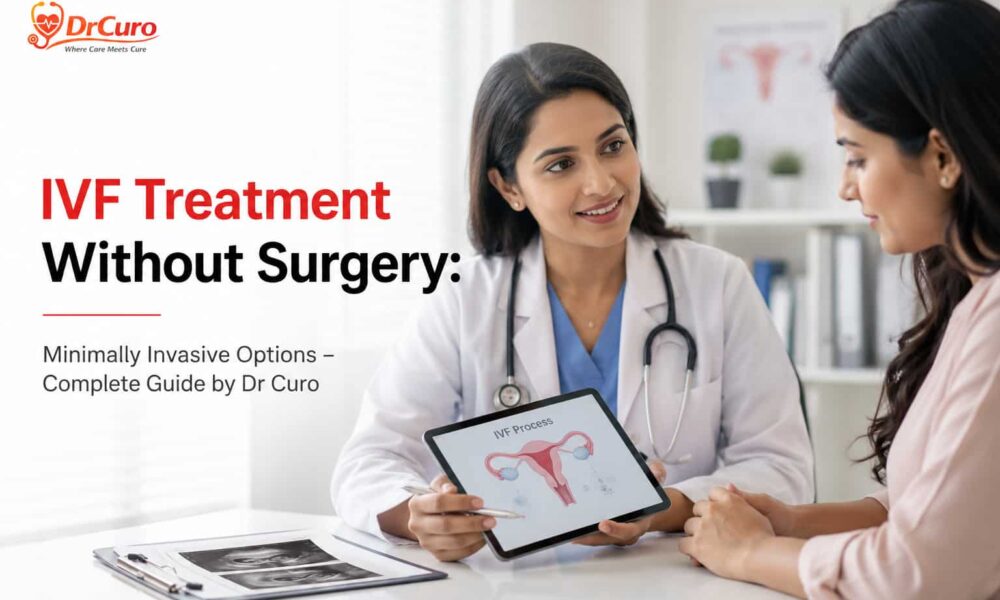
When most people hear “IVF,” they picture major surgeries, hospital stays, and complicated medical procedures. But fertility care has evolved significantly over the years. Today, IVF treatment in India is largely designed around minimally invasive techniques, making IVF treatment without surgery a safe, effective, and preferred option for millions of couples worldwide.
Table Of Content
- What Does “IVF Treatment Without Surgery” Actually Mean?
- Why Choose Minimally Invasive IVF? The Dr Curo Philosophy
- The Complete IVF Process Without Surgery — Step by Step
- Step 1: Pre-Treatment Consultation and Diagnosis
- Step 2: Ovarian Stimulation (Controlled Ovarian Hyperstimulation)
- Step 3: Trigger Shot
- Step 4: Egg Retrieval — Transvaginal Ultrasound-Guided Aspiration
- Step 5: Fertilisation in the Embryology Lab
- Step 6: Embryo Culture and Monitoring
- Step 7: Embryo Transfer — The Simplest Step
- Step 8: Luteal Phase Support and Pregnancy Test
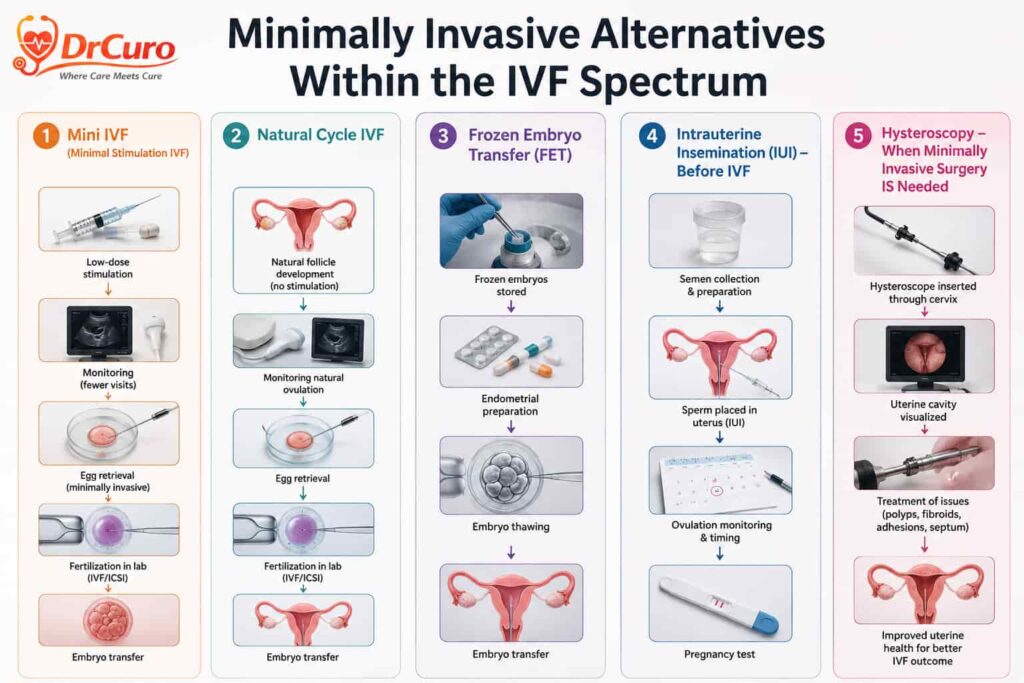
- Minimally Invasive Alternatives Within the IVF Spectrum
- 1. Mini IVF (Minimal Stimulation IVF)
- 2. Natural Cycle IVF
- 3. Frozen Embryo Transfer (FET)
- 4. Intrauterine Insemination (IUI) — Before IVF
- 5. Hysteroscopy — When Minimally Invasive Surgery IS Needed
- Who Is Eligible for IVF Without Surgery?
- Success Rates of Non-Surgical IVF at Dr Curo
- Common Myths About IVF Without Surgery — Busted by Dr Curo
- The Dr Curo Difference — Why Choose Us for Minimally Invasive IVF
- Frequently Asked Questions (FAQs)
- Your Journey to Parenthood Doesn’t Have to Be Surgical
At Dr Curo, we believe that your path to parenthood should be as comfortable, safe, and minimally invasive as possible. This comprehensive guide will walk you through everything you need to know about non-surgical and minimally invasive IVF options from how they work, who qualifies, what to expect, and why this approach is changing the future of fertility care.
What Does “IVF Treatment Without Surgery” Actually Mean?
Traditional fertility treatments sometimes involved surgical interventions laparoscopies, open egg retrievals, or complex uterine procedures. While surgery is still necessary in some specific cases, advances in reproductive medicine now allow doctors to perform most IVF steps with minimal or no surgical intervention.
IVF treatment without surgery refers to the complete IVF cycle from ovarian stimulation to egg retrieval, fertilization, embryo culture, and transfer performed using minimally invasive, ultrasound-guided, needle-based techniques that do not require general anaesthesia or surgical incisions.
In simple terms: no scalpel, no cuts, no operation theatre in most cases.
Why Choose Minimally Invasive IVF? The Dr Curo Philosophy
At Dr Curo, our fertility specialists follow a patient-first, minimal-intervention philosophy. Here’s why minimally invasive IVF is a smarter choice for most patients:
- Faster Recovery — Most patients resume normal activity within 24–48 hours
- Lower Risk of Complications — No surgical wounds, no risk of surgical infection
- Less Physical Stress — Reduced anaesthesia exposure and hospital stay
- Higher Comfort — Procedures done with mild sedation or local anaesthesia
- Cost-Effective — Avoiding surgery reduces overall treatment costs
- Emotionally Easier — Less fear and anxiety associated with the process
- Repeat-Friendly — Easier to undergo multiple cycles if needed
The Complete IVF Process Without Surgery — Step by Step
Understanding the process helps reduce fear. Here is how Dr Curo conducts IVF treatment without surgery from start to finish:
Step 1: Pre-Treatment Consultation and Diagnosis
Before any procedure begins, your Dr Curo fertility specialist will:
- Review your full medical and reproductive history
- Order blood tests to check hormone levels (FSH, LH, AMH, Estradiol)
- Conduct a transvaginal ultrasound to assess ovarian reserve and uterine health
- Evaluate the male partner’s semen analysis
- Rule out conditions requiring surgical correction (like severe endometriosis or fibroids blocking the uterus)
If no surgical condition is detected, you are eligible for non-surgical IVF.
Step 2: Ovarian Stimulation (Controlled Ovarian Hyperstimulation)
This phase involves daily hormone injections (gonadotropins) given subcutaneously under the skin, like an insulin shot. These injections stimulate your ovaries to produce multiple eggs in one cycle instead of the usual one.
At Dr Curo, our specialists:
- Customise your stimulation protocol based on your AMH levels and antral follicle count
- Monitor your progress through regular blood tests and ultrasounds every 2–3 days
- Adjust dosage in real time to minimise the risk of Ovarian Hyperstimulation Syndrome (OHSS)
Duration: 8–14 days Invasiveness: Subcutaneous injections only no surgery
Step 3: Trigger Shot
Once your follicles reach the ideal size (18–20mm), a trigger injection (hCG or GnRH agonist) is given to trigger the final maturation of eggs. Egg retrieval is then scheduled 34–36 hours later.
No surgery required at this stage.
Step 4: Egg Retrieval — Transvaginal Ultrasound-Guided Aspiration
This is the most critical non-surgical step. Instead of laparoscopic surgery, Dr Curo uses Transvaginal Oocyte Retrieval (TVOR) a minimally invasive, ultrasound-guided needle aspiration technique.
How it works:
- A thin needle is passed through the vaginal wall into each follicle
- The needle is guided by real-time transvaginal ultrasound
- Fluid from each follicle is aspirated and immediately sent to the embryologist
- Eggs are identified, assessed, and prepared for fertilisation
Anaesthesia: Light IV sedation (conscious sedation) or local anaesthesia no general anaesthesia needed in most cases Duration: 15–30 minutes Recovery: 1–4 hours of rest, then discharge on the same day Pain level: Mild cramping at most most patients describe it as period-like discomfort
There are no incisions, no stitches, and no hospital admission in most cases.
Step 5: Fertilisation in the Embryology Lab
The retrieved eggs are fertilised in the laboratory using one of two methods:
a) Conventional IVF (Insemination) Sperm are placed with eggs in a dish and fertilisation occurs naturally.
b) Intracytoplasmic Sperm Injection (ICSI) A single healthy sperm is injected directly into each mature egg. This is preferred when male factor infertility is present.
Both methods are entirely non-surgical laboratory procedures performed by experienced embryologists at Dr Curo.
Step 6: Embryo Culture and Monitoring
Fertilised eggs (now embryos) are cultured in a controlled incubator for 3–5 days. At Dr Curo, we use:
- Time-lapse imaging (EmbryoScope) — continuous, non-invasive monitoring of embryo development without disturbing them
- Blastocyst culture — culturing embryos to Day 5 for higher implantation rates
- Preimplantation Genetic Testing (PGT) — optional genetic screening using a small embryo biopsy to identify chromosomally normal embryos
This entire phase is conducted in the laboratory. No patient intervention required.
Step 7: Embryo Transfer — The Simplest Step
This is where a healthy embryo is placed into your uterus and it requires no surgery whatsoever.
How it works:
- You lie on an examination table (similar to a Pap smear)
- A thin, soft catheter is passed through the cervix into the uterus
- The embryo is gently deposited at the optimal location in the uterine cavity
- The entire procedure takes 5–10 minutes
- No anaesthesia is needed in most cases
- You can walk out of the clinic the same day
At Dr Curo, ultrasound guidance is used during transfer for precision placement, significantly improving success rates.
Step 8: Luteal Phase Support and Pregnancy Test
After the transfer:
- You will take progesterone supplements (vaginal or oral) for 10–14 days
- A blood beta-hCG test is done to confirm pregnancy
- Early ultrasound at 6–7 weeks confirms fetal heartbeat
No surgery involved at any point.
Minimally Invasive Alternatives Within the IVF Spectrum
At Dr Curo, depending on your diagnosis, our specialists may recommend these specific minimally invasive fertility treatments:
1. Mini IVF (Minimal Stimulation IVF)
Mini IVF uses lower doses of fertility medication to retrieve fewer but higher-quality eggs. It is ideal for:
- Women with low ovarian reserve
- Patients sensitive to high-dose hormones
- Those who want a more natural, gentle approach
- Budget-conscious patients
No surgery. Fewer injections. Shorter cycle.
2. Natural Cycle IVF
This approach involves no stimulation medication at all. The single egg produced naturally in your cycle is retrieved and fertilised. It is ideal for women who cannot tolerate hormonal stimulation.
Completely non-surgical and hormone-minimal.
3. Frozen Embryo Transfer (FET)
If you have previously frozen embryos, FET involves:
- Preparing the uterus with estrogen and progesterone
- Thawing the embryo
- Transferring it via catheter
No egg retrieval. No injections beyond hormones. No surgery.
4. Intrauterine Insemination (IUI) — Before IVF
For couples with mild fertility issues, Dr Curo may first recommend IUI a completely non-surgical procedure where washed sperm is placed directly into the uterus during ovulation.
While not technically IVF, IUI is a minimally invasive first-line treatment that avoids IVF entirely for eligible couples.
5. Hysteroscopy — When Minimally Invasive Surgery IS Needed
In some cases, uterine abnormalities (polyps, fibroids inside the cavity, adhesions) must be corrected before embryo transfer. At Dr Curo, we perform diagnostic and operative hysteroscopy a key-hole procedure using a thin telescope passed through the cervix with no external incisions.
This is considered minimally invasive, not traditional open surgery, and is performed as a day procedure.
Who Is Eligible for IVF Without Surgery?
Most women are eligible for non-surgical IVF. You are a strong candidate if:
- Your fallopian tubes are blocked but your uterus is normal (IVF bypasses tubes entirely)
- You have unexplained infertility
- You have mild-to-moderate PCOS
- You have low ovarian reserve
- Your partner has mild to moderate male factor infertility
- You are a single woman or same-sex couple using donor sperm or eggs
- You have had failed IUI cycles
You may need surgical evaluation first if:
- You have large fibroids distorting the uterine cavity
- You have severe endometriosis with ovarian cysts
- You have significant uterine adhesions (Asherman’s syndrome)
- You have a uterine septum requiring correction
Even in these cases, Dr Curo first attempts the least invasive approach hysteroscopy or laparoscopy before proceeding to IVF.
Success Rates of Non-Surgical IVF at Dr Curo
Success in IVF depends on multiple factors. At Dr Curo, our minimally invasive IVF protocols achieve results comparable to and in many cases better than conventional surgical approaches, because:
- Gentle protocols reduce stress on the ovaries and improve egg quality
- Ultrasound-guided retrieval and transfer improve precision
- Personalised stimulation protocols are tailored to each patient
- Advanced embryology (blastocyst culture + time-lapse monitoring) maximises embryo selection
General success rate benchmarks (per embryo transfer):
| Age Group | Approximate Success Rate |
| Under 35 | 50–60% |
| 35–37 | 40–50% |
| 38–40 | 30–40% |
| 41–42 | 20–30% |
| Above 42 | 10–20% (donor eggs improve this significantly) |
Note: Individual success rates vary based on diagnosis, embryo quality, and uterine receptivity. Dr Curo specialists provide personalised success estimates during consultation.
Common Myths About IVF Without Surgery — Busted by Dr Curo
Myth 1: IVF always requires surgery Fact: Modern IVF uses needle aspiration under ultrasound guidance. No surgical incision is made in standard IVF protocols.
Myth 2: Egg retrieval is very painful Fact: With conscious sedation and experienced hands, most patients feel mild discomfort at most. The procedure takes under 30 minutes.
Myth 3: IVF without surgery has lower success rates Fact: Minimally invasive techniques have equivalent or better outcomes because they are gentler on the body and allow for more precise procedures.
Myth 4: You need to be hospitalised for IVF Fact: At Dr Curo, the entire IVF cycle is conducted as an outpatient procedure. Most patients go home the same day after egg retrieval.
Myth 5: Mini IVF or Natural IVF is only for older women Fact: These are suitable for any patient profile depending on their hormone levels, ovarian reserve, and personal preferences.
The Dr Curo Difference — Why Choose Us for Minimally Invasive IVF
Dr Curo is built on a foundation of precision, compassion, and innovation. Here is what sets us apart:
- Expert Fertility Specialists with advanced training in reproductive endocrinology
- State-of-the-art Embryology Lab with time-lapse imaging and strict quality protocols
- Personalised Treatment Plans — no one-size-fits-all protocols
- Gentle Stimulation Protocols to protect your health and egg quality
- Real-time Ultrasound Guidance for all procedures
- Dedicated Counselling Support throughout your fertility journey
- Transparent Communication — honest success rate expectations, no false promises
- Affordable, Transparent Pricing with no hidden costs
At Dr Curo, your journey to parenthood begins with a conversation not a surgical form.
Frequently Asked Questions (FAQs)
Q1. Is IVF treatment without surgery as effective as traditional IVF? Yes. In standard IVF cases, the egg retrieval via transvaginal aspiration and embryo transfer via catheter achieves the same often better results as surgically intensive approaches because the body is under less stress.
Q2. How many days off work will I need? For egg retrieval, most patients take 1–2 days off. The embryo transfer requires no downtime. Overall, IVF without surgery allows you to remain largely functional throughout the cycle.
Q3. Is egg retrieval painful without surgery? With light sedation, most patients experience minimal discomfort. Some feel mild cramping for a few hours post-procedure. Painkillers are provided if needed.
Q4. Can I do IVF without surgery if I have PCOS? Yes. In fact, women with PCOS respond well to IVF. Dr Curo uses careful, low-dose stimulation protocols to prevent OHSS a known risk in PCOS patients.
Q5. What is the cost of IVF treatment without surgery at Dr Curo? Costs depend on the specific protocol, number of cycles, and add-ons like PGT or frozen transfer. Dr Curo provides detailed, transparent cost breakdowns during your first consultation with no hidden fees.
Q6. How do I know if I need surgery before IVF? Your Dr Curo specialist will assess this through ultrasound and blood tests during the initial consultation. Surgery is only recommended when a correctable structural issue is clearly affecting your chances of success.
Your Journey to Parenthood Doesn’t Have to Be Surgical
The biggest misconception about IVF is that it is a surgical, scary, and complicated procedure. The truth is: IVF treatment without surgery is today’s gold standard for most fertility patients. It is gentle, effective, outpatient-based, and designed to give you the best chance of success with the least physical burden.
At Dr Curo, we combine cutting-edge reproductive technology with a warm, personalised approach to care. Whether you are just starting your fertility journey or have been trying for years, our minimally invasive IVF protocols are designed with one goal: helping you bring your baby home.





No Comment! Be the first one.