








Egg Retrieval in IVF: What Happens During the Procedure?
Egg retrieval is the step in an IVF cycle where the plan you’ve been following for weeks the injections, the scans, the blood draws finally turns into something tangible. It’s also the...
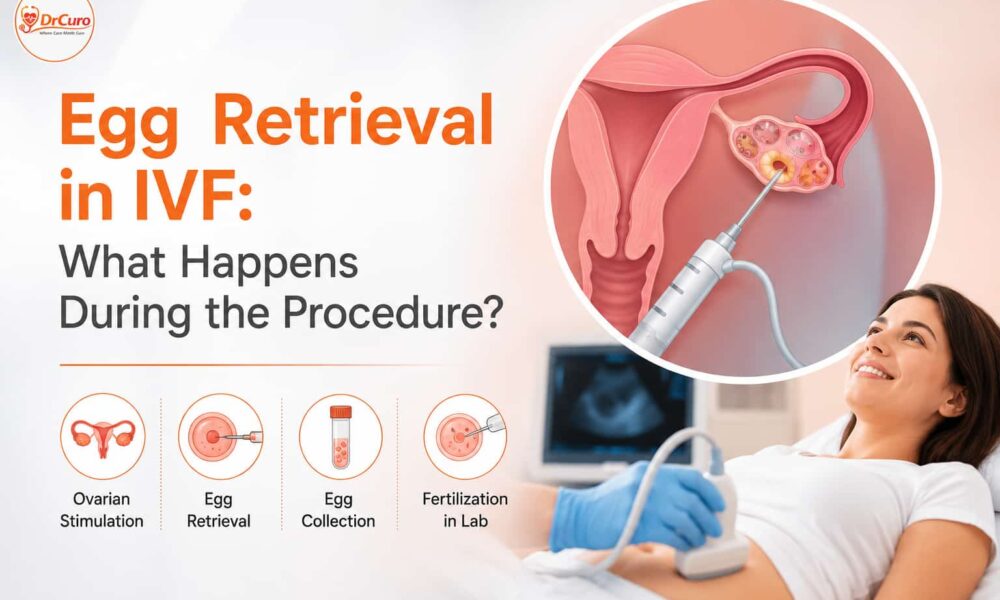
Egg retrieval is the step in an IVF cycle where the plan you’ve been following for weeks the injections, the scans, the blood draws finally turns into something tangible. It’s also the step most patients feel the most anxious about, mainly because it’s the first genuinely surgical part of the process. Everything before it happens through medication and monitoring; this is the first time a doctor is physically involved.
Table Of Content
- What Egg Retrieval Actually Involves
- Why This Step Carries So Much Weight in Fertility Care
- Who Typically Goes Through This Procedure
- The Weeks Before Retrieval: What Preparation Looks Like
- Inside the Procedure: What Happens Step by Step
- Does It Hurt?
- What Happens to the Eggs After They’re Collected
- How Many Retrieval Cycles Might Be Needed
- Recovering in the Days After
- What Actually Determines a Good Outcome
- Supporting Egg Quality Before Your Cycle
- Clearing Up a Few Misunderstandings
- The Emotional Weight of This Step
- What to Ask Before Choosing Where You’ll Be Treated
- Frequently Asked Questions
- Final Thoughts
That anxiety usually comes from not knowing what to expect rather than the procedure itself being especially difficult. Egg retrieval is short, well-established, and performed under sedation, but knowing the sequence of events in advance what happens before, during, and after makes a real difference in how prepared you feel walking in.
What Egg Retrieval Actually Involves
At its core, egg retrieval is a needle-guided procedure to collect the eggs that have matured inside the ovaries during a stimulated cycle. In a natural monthly cycle, the body typically releases just one egg. IVF changes that by using hormone medication to encourage several follicles to mature at once, giving the embryology team more eggs to work with and more chances at producing a viable embryo.
The eggs themselves aren’t visible or reachable without imaging. They sit inside fluid-filled follicles on the ovary, and a doctor uses real-time ultrasound to guide a thin needle through the vaginal wall into each follicle, drawing out the fluid that contains the egg. It’s classified as minor surgery, but there are no incisions, and most patients are home within a few hours.
Why This Step Carries So Much Weight in Fertility Care
Every stage of fertility care builds toward this moment. The medications, the scans, the timing all of it exists to get as many mature, healthy eggs into the lab as possible, because the eggs collected here directly determine how many embryos can be created. Fewer eggs doesn’t automatically mean a lower chance of success, but it does narrow the number of attempts available if the first embryo transfer doesn’t result in pregnancy. This is why doctors monitor the stimulation phase so closely the retrieval itself is quick, but the quality of what’s retrieved is shaped entirely by the weeks leading up to it.
Who Typically Goes Through This Procedure
Egg retrieval isn’t limited to standard IVF cycles. It comes up in several different situations:
- Couples pursuing IVF or ICSI due to infertility
- Women choosing to freeze eggs for future use, whether for medical or personal reasons
- Patients preparing for cancer treatment who want to preserve fertility beforehand
- Cases involving blocked fallopian tubes or severe male-factor infertility
- Women donating eggs to another intended parent
- Cycles using donor sperm where the woman’s own eggs are still being used
The reasons vary, but the procedure itself stays largely the same regardless of why it’s being done.
The Weeks Before Retrieval: What Preparation Looks Like
Retrieval day doesn’t happen in isolation it’s the endpoint of a carefully timed stimulation phase that usually runs eight to fourteen days. During this window:
- Daily hormone injections stimulate the ovaries to develop multiple follicles instead of the usual one
- Ultrasounds are repeated every few days to track follicle size and growth rate
- Blood tests measure hormone levels so the doctor can adjust medication dosages as needed
- Once follicles reach the right size, a trigger injection is given to finish maturing the eggs
- Retrieval is scheduled precisely usually 34 to 36 hours after the trigger shot, since timing this window correctly affects egg quality
- Patients are typically asked to stop eating and drinking several hours beforehand, since sedation is involved
| Phase | What’s Happening |
| Initial consultation | Baseline testing and cycle planning |
| Stimulation (Days 1–14) | Daily injections to grow multiple follicles |
| Monitoring visits | Ultrasounds and bloodwork every 2–3 days |
| Trigger shot | Final maturation signal, precisely timed |
| Retrieval | 34–36 hours after trigger |
Inside the Procedure: What Happens Step by Step
Check-in and prep. You arrive at the clinic, change into a gown, and a nurse checks vitals and places an IV line for sedation and fluids.
Sedation. Most clinics use light sedation or short-acting anesthesia. You won’t be fully conscious during the retrieval, and most patients describe waking up with little to no memory of the procedure itself.
Guided retrieval. Once sedated, the doctor inserts a thin ultrasound probe with an attached needle through the vaginal wall. Guided by live ultrasound imaging, the needle enters each follicle and gently draws out the fluid inside, which contains the egg. This is repeated follicle by follicle until all accessible ones have been drained.
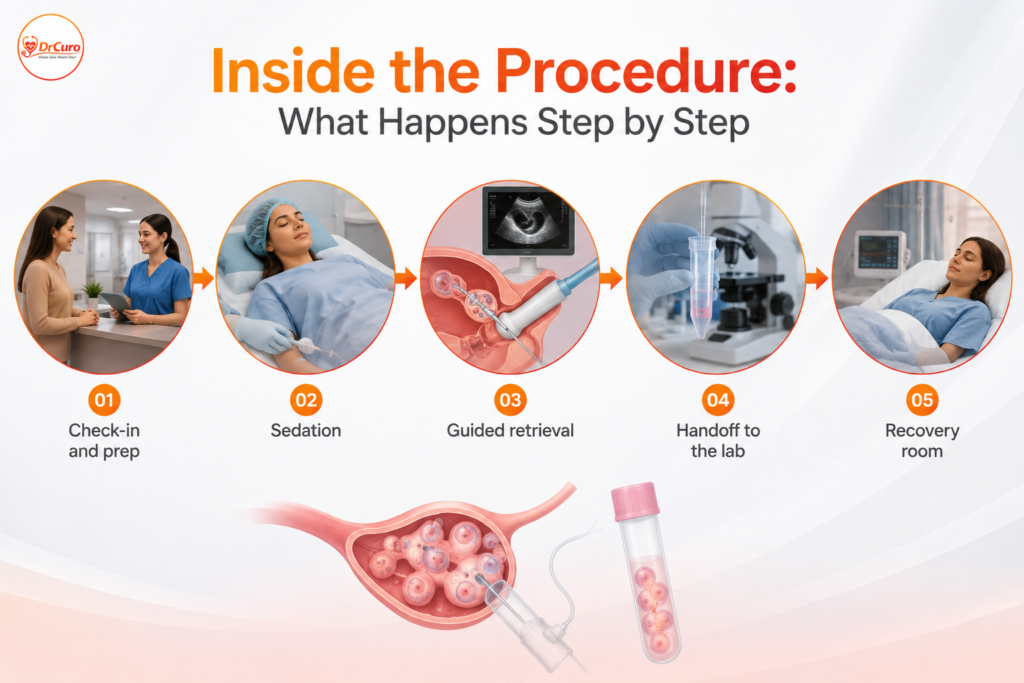
Handoff to the lab. The collected fluid goes straight to the embryology lab, where specialists examine it under a microscope to locate and isolate the actual eggs. Not every follicle yields a usable egg this is normal and doesn’t mean anything went wrong.
Recovery room. You’re moved to a recovery area for one to two hours while the sedation wears off and staff monitor your vitals before discharge.
| Stage | Typical Duration |
| Check-in and prep | 30–45 minutes |
| Sedation onset | 10–15 minutes |
| Retrieval itself | 20–30 minutes |
| Recovery monitoring | 1–2 hours |
| Total clinic time | Roughly 3–4 hours |
Because you’ll be sedated, you cannot drive yourself home arrange for someone to pick you up in advance.
Does It Hurt?
This is usually the first question patients ask, and reasonably so. Because sedation is used, there’s no pain during the retrieval itself. What follows afterward is closer to strong menstrual cramping a dull ache or pressure in the lower abdomen that tends to ease within a couple of days. Some bloating and light spotting are common as well. Sharp, escalating, or one-sided pain is not typical and should be reported to your clinic rather than waited out.
Symptoms that warrant a same-day call to your fertility team:
- Severe or worsening abdominal pain
- Heavy vaginal bleeding, more than light spotting
- Fever
- Difficulty breathing
- Persistent vomiting
- Rapid, unexplained weight gain or severe bloating
- Trouble urinating
These can signal complications like infection or ovarian hyperstimulation syndrome (OHSS), and neither should be self-managed at home.
What Happens to the Eggs After They’re Collected
Retrieval is only the halfway point of this stage the real work in the lab starts right after. Once the embryology team identifies which follicular fluid samples contain usable eggs, each egg is assessed for maturity before anything else happens. Only mature eggs can be fertilized; immature ones are set aside, since attempting fertilization on them rarely produces a viable embryo.
From there, fertilization happens one of two ways. In conventional IVF, eggs and sperm are placed together in a dish and left to fertilize naturally overnight. With ICSI (intracytoplasmic sperm injection), an embryologist injects a single sperm directly into each mature egg this is typically used when sperm quality or count is a concern, or when previous fertilization attempts with conventional IVF haven’t worked.
The following morning, the lab checks which eggs fertilized successfully. Not all of them will this is expected, not a sign of a failed cycle. Fertilized eggs are then monitored over the next three to six days as they divide and develop, with the embryology team assessing which ones are developing at a healthy pace and which aren’t. The healthiest-looking embryos are candidates for transfer or freezing; the rest are typically not used, since transferring a poorly developing embryo rarely results in a successful pregnancy anyway.
How Many Retrieval Cycles Might Be Needed
One retrieval cycle doesn’t always produce enough good-quality embryos for a successful pregnancy, and that’s a difficult reality many patients aren’t prepared for going in. Some patients get a strong embryo on the first cycle; others need two or three retrieval cycles before reaching that point, particularly if age or a diminished ovarian reserve is limiting how many eggs are collected each time.
This is why doctors often talk about IVF in terms of cumulative success across multiple cycles rather than a single attempt. It’s a hard conversation to have honestly, but going in with realistic expectations about the possibility of more than one retrieval tends to reduce the emotional toll if the first cycle doesn’t produce a transferable embryo.
Recovering in the Days After
Most women feel largely back to normal within one to three days, though this varies based on how many eggs were retrieved and how the body responds to the hormone load from stimulation. General guidance during recovery:
| Generally Fine | Best Avoided |
| Light walking | Strenuous exercise |
| Resting for the first 24 hours | Heavy lifting |
| Warm (not hot) compresses for cramping | Alcohol |
| Staying hydrated | Driving the same day |
| Light, nutrient-dense meals | Ignoring worsening pain |
Most patients can return to desk-based work within a day or two; physically demanding jobs may call for a bit more time off.
What Actually Determines a Good Outcome
There’s a common assumption that more eggs automatically means better odds it’s not that simple. Egg quality tends to matter more than raw quantity, since not every retrieved egg is mature enough to fertilize or capable of developing into a viable embryo. What genuinely influences the outcome:
- Age — egg quantity and quality both decline with age, most noticeably after the mid-thirties
- Ovarian reserve — measured beforehand through AMH levels and antral follicle counts, this estimates how many eggs are realistically available
- Underlying health conditions — thyroid disorders, PCOS, and metabolic issues can all affect how the ovaries respond to stimulation
- Lifestyle factors — smoking, high alcohol intake, poor sleep, and chronic stress are all linked to lower egg quality
- Response to stimulation medication — this varies by individual and isn’t something either the patient or doctor fully controls
| Eggs Retrieved | General Interpretation |
| Fewer than 5 | Lower response; success still possible depending on quality |
| 5–10 | Moderate response, reasonable embryo potential |
| 10–15 | Often considered a strong response |
| More than 15 | High yield, but closely monitored for OHSS risk |
Supporting Egg Quality Before Your Cycle
Age isn’t something you can change, but a few habits in the months leading up to stimulation may support a better response:
- Eating a balanced diet with adequate protein, healthy fats, and antioxidants
- Maintaining a stable, healthy body weight
- Moderate, regular exercise rather than intense training
- Prioritizing consistent sleep
- Cutting out smoking and limiting alcohol
- Managing stress through whatever actually works for you this varies person to person
- Taking supplements only if your fertility specialist has specifically recommended them
None of this guarantees a particular outcome, but it puts the body in a better position going into stimulation.
Clearing Up a Few Misunderstandings
A handful of assumptions about egg retrieval come up often enough to be worth addressing directly. It is not major surgery requiring days of hospitalization most patients are home the same day. It does not “use up” eggs that would otherwise be available later in life; the eggs collected are ones that would have been lost naturally in that cycle regardless. And a high egg count on its own doesn’t guarantee pregnancy plenty of successful IVF cycles happen with a modest number of well-developed eggs rather than a large but lower-quality batch.
The Emotional Weight of This Step
It’s worth naming directly: this part of IVF is stressful, and that’s a normal response to an uncertain process, not a sign anything is being handled wrong. The wait between retrieval and the fertilization report, and again between fertilization and transfer, tends to be one of the hardest emotional stretches of treatment. Leaning on a partner, a support group, or a counselor familiar with fertility treatment during this window helps more than trying to push through it alone.
Part of what makes this stretch hard is that so little of it is in your hands. You’ve done the injections, kept every appointment, followed every instruction and now the outcome depends on lab results you’re simply waiting to hear about. That loss of control catches a lot of patients off guard, even ones who felt prepared going in. A few things that patients often find genuinely help during this window:
- Planning something low-stakes and distracting for the days right after retrieval, rather than leaving the calendar empty to fill with worry
- Agreeing in advance with a partner on how and when you’ll check in on results, so you’re not each managing the anxiety differently
- Setting a boundary with well-meaning family or friends about how much day-to-day detail you want to share
- Reminding yourself that a lower-than-hoped-for egg count or fertilization rate is data for the next step, not a verdict on the whole journey
None of this makes the waiting easy, but having a plan for it tends to make it more bearable than facing it without one.
What to Ask Before Choosing Where You’ll Be Treated
Not every fertility clinic runs stimulation and retrieval cycles the same way, and the differences matter more than patients often realize going in. Before committing to a clinic for this stage of treatment, it’s worth asking directly:
- How many retrieval cycles does the embryology team handle in a typical month, and what’s their lab’s fertilization success rate?
- Who performs the retrieval the same doctor managing your monitoring appointments, or a rotating team?
- What’s the clinic’s protocol for reducing OHSS risk in patients who respond strongly to stimulation?
- Is ICSI available on-site, or does sperm sample handling get outsourced elsewhere?
- What happens to unused mature eggs or embryos are freezing and long-term storage handled in-house?
A clinic that answers these clearly and specifically, rather than in generic reassurances, is usually a good sign of how the rest of your cycle will be managed.
Frequently Asked Questions
Is egg retrieval painful?
No, not during the procedure itself, since sedation is used. Cramping and mild soreness afterward are common and usually resolve within a few days.
How soon can I go back to work?
Most patients return within one to two days for desk jobs; physically active roles may need more time.
Can I exercise right after?
Light walking is fine. Hold off on intense workouts or heavy lifting until your doctor clears you.
What if very few or no eggs are retrieved?
It happens occasionally. Your doctor will review the cycle and discuss adjustments for a future attempt if needed.
Do I need to stay overnight?
No — this is a same-day outpatient procedure for the vast majority of patients.
Final Thoughts
Egg retrieval tends to loom larger in a patient’s mind before it happens than it does in hindsight. It’s a short, closely monitored procedure with a well-understood recovery pattern, and most of the anxiety around it comes from unfamiliarity rather than the difficulty of the process itself. Knowing the timeline, what the numbers on your egg count mean, and what recovery should feel like takes a lot of that uncertainty off the table.
If you’re preparing for egg retrieval or want a clearer picture of what your own cycle might look like, Drcuro‘s fertility specialists can walk you through the process and answer questions specific to your situation before you ever reach retrieval day.




No Comment! Be the first one.