







PCOS Symptoms – The Hair Fall Connection Nobody Talks About Enough
Most women first hear the word PCOS when their periods go missing for two months, or when a gynaecologist looks at an ultrasound and points to tiny follicles lined up like a string of pearls along...

Most women first hear the word PCOS when their periods go missing for two months, or when a gynaecologist looks at an ultrasound and points to tiny follicles lined up like a string of pearls along the ovary wall. Irregular menstrual cycles dominate every PCOS conversation in clinics, on health forums, in Instagram reels. But here is the reality that thousands of women live with quietly: PCOS does not stop at your uterus. It travels. It shows up in your skin, your weight, your mood, your blood sugar and perhaps most visibly of all, it shows up in your hair.
Table Of Content
- What PCOS Is Actually Doing to Your Hormones
- Why Androgens Destroy Hair on Your Scalp
- Other PCOS Symptoms You Are Probably Connecting Wrong
- Diagnosing PCOS-Related Hair Loss: What Tests Actually Matter
- What Actually Helps: Treatment Options That Work
- The Fertility Question: When Hair Fall Is a Sign of Something Bigger
- How Long Before Hair Grows Back?
- Conclusion
- FAQs
Understanding PCOS symptoms the hair fall connection is not just about aesthetics. It is about recognising a hormonal signal that your body is sending long before other symptoms become obvious. In many cases, hair fall is actually one of the earliest warning signs of PCOS, appearing months or even years before a formal diagnosis. Women often spend hundreds of rupees on anti-hair-fall shampoos and serums, unaware that the problem is rooted in a hormonal imbalance that no topical product can fix. This article breaks down exactly why PCOS causes hair loss, what it looks like, how it differs from ordinary hair shedding, and what you can actually do about it medically and practically.
What PCOS Is Actually Doing to Your Hormones
To understand why PCOS causes hair loss, you first need to understand what PCOS does hormonally because the connection is not random. It is biochemical.
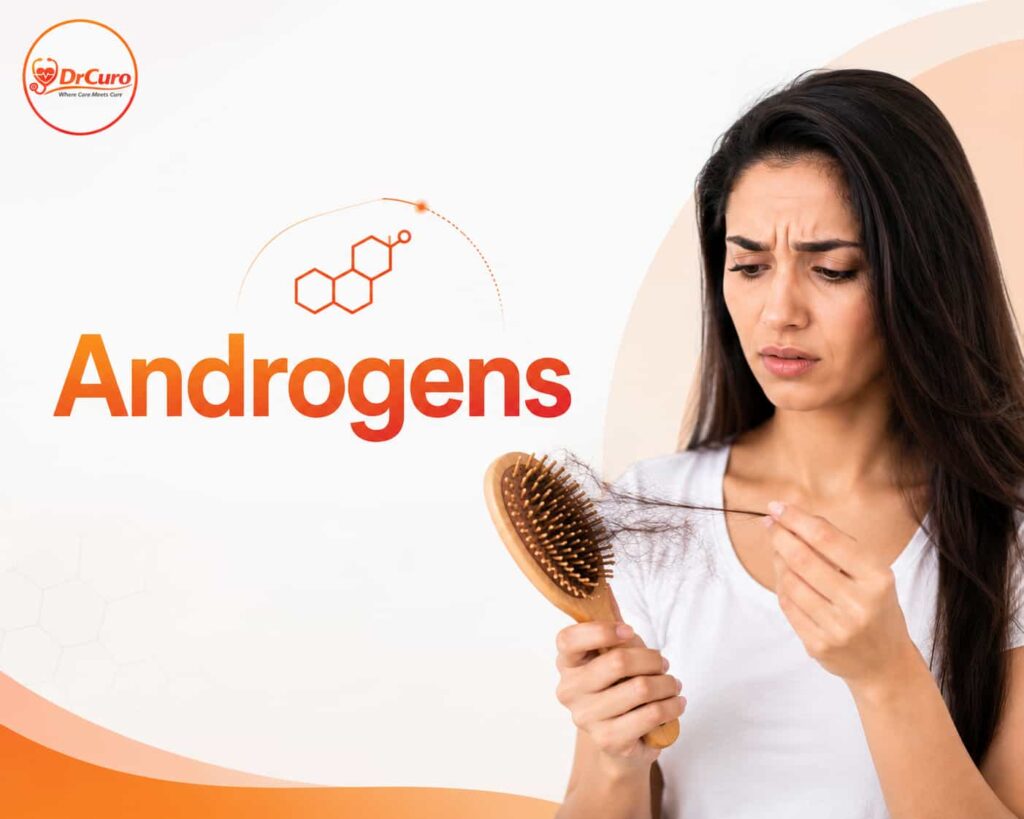
PCOS, or Polycystic Ovary Syndrome, is fundamentally a condition of hormonal dysregulation. The ovaries produce more androgens male hormones like testosterone and DHEA-S than they should. Normally, women produce small amounts of androgens, and they serve useful functions including supporting libido and bone density. But when androgen levels are elevated, they create a cascade of downstream problems across multiple organ systems.
Here is what elevated androgens actually do inside the body:
- They interfere with the pituitary gland’s ability to release the hormones (LH and FSH) that regulate the menstrual cycle, which is why ovulation becomes irregular or stops entirely.
- They stimulate oil glands in the skin, producing acne particularly the stubborn, cystic kind that appears on the jawline, chin, and back.
- They trigger insulin resistance, which means the body’s cells stop responding efficiently to insulin. This raises blood glucose, promotes fat storage, and makes weight management extremely difficult.
- They directly act on hair follicles, binding to androgen receptors in the scalp and disrupting the normal growth cycle of each strand.
That last point is where PCOS symptoms the hair fall connection becomes most personal and most visible.
Why Androgens Destroy Hair on Your Scalp
Hair growth is not a continuous process. Every strand on your head cycles through three distinct phases: the anagen (growth) phase, the catagen (transition) phase, and the telogen (resting and shedding) phase. In a healthy scalp, the vast majority of your hair roughly 85 to 90 percent is in the anagen phase at any given time. Only a small fraction is in telogen, which is why losing 50 to 100 hairs a day is considered normal.
When androgens specifically dihydrotestosterone, or DHT are elevated, they bind to receptors in hair follicles on the scalp and begin a process called miniaturisation. The follicle gradually shrinks with each hair cycle. The anagen phase shortens. New strands grow in thinner than the ones that fell out. Over multiple cycles, the follicle produces hair so thin it is barely visible, and eventually it may stop producing hair altogether.
This pattern of hair loss in PCOS follows what dermatologists call female pattern hair loss or androgenic alopecia. Unlike male pattern baldness, it does not typically create a receding hairline. Instead, women notice:
- Thinning across the top and crown of the scalp
- A widening of the hair parting that was not there before
- Noticeably reduced volume even though the hairline appears intact
- Excessive strands on pillowcases, in shower drains, and on combs
- Scalp becoming visible in certain lighting conditions
The cruelty of this symptom is the irony it carries: while your scalp sheds, you may simultaneously be growing thicker hair on your chin, upper lip, jawline, or chest. This is called hirsutism, and it happens for the same reason elevated DHT acts differently on different follicles depending on their location and receptor sensitivity. Scalp follicles are shrunk by DHT. Facial and body follicles are stimulated by it.
Other PCOS Symptoms You Are Probably Connecting Wrong
PCOS symptoms rarely arrive alone. They come in clusters, and the challenge is that each symptom, on its own, looks like it could belong to a different condition entirely. Acne looks like a skincare problem. Weight gain looks like a dietary issue. Fatigue looks like poor sleep. Hair fall looks like stress. This is why PCOS goes undiagnosed in an estimated 70 percent of affected women globally.
The table below shows how PCOS symptoms are commonly misread and what they are actually signalling:
| Symptom You Notice | What You Assume | What PCOS Is Actually Doing |
| Hair thinning at crown | Stress or nutritional deficiency | DHT miniaturising hair follicles |
| Jawline and chin acne | Poor skincare or diet | Excess androgens stimulating sebaceous glands |
| Weight gain around abdomen | Overeating or inactivity | Insulin resistance promoting fat storage |
| Facial hair on upper lip or chin | Genetics | Elevated androgens acting on facial follicles |
| Irregular or missed periods | Stress or travel | Disrupted LH/FSH signalling preventing ovulation |
| Fatigue after meals | Poor sleep quality | Insulin spikes from insulin resistance |
| Mood swings and low mood | PMS or work stress | Hormonal fluctuations affecting neurotransmitters |
| Difficulty conceiving | Bad timing | Irregular or absent ovulation |
When three or more of these symptoms appear together particularly if hair fall, acne, irregular periods, and weight gain overlap PCOS should be investigated, not treated symptom by symptom in isolation.
Diagnosing PCOS-Related Hair Loss: What Tests Actually Matter
Not all hair fall is PCOS-related, and this distinction matters enormously before you pursue any treatment. Thyroid disorders, iron deficiency anaemia, vitamin D deficiency, and telogen effluvium (stress-induced temporary shedding) can all cause hair loss with patterns that superficially resemble androgenic alopecia. Going straight to PCOS treatments without ruling these out wastes time and may make things worse.
A thorough diagnostic workup for PCOS-related hair fall typically includes the following:
- Serum androgen panel — including total testosterone, free testosterone, DHEA-S, and androstenedione. Elevated androgens confirm hyperandrogenism, which is one of the three Rotterdam criteria for PCOS diagnosis.
- LH and FSH ratio — in PCOS, LH is often elevated relative to FSH, creating a ratio greater than 2:1 or even 3:1.
- Fasting insulin and fasting blood glucose — to assess insulin resistance, often using the HOMA-IR calculation.
- Thyroid function tests (TSH, free T3, free T4) — to rule out hypothyroidism, which independently causes hair loss and menstrual irregularity.
- Complete blood count and serum ferritin — low ferritin (even within the normal range) can cause significant shedding and is frequently missed.
- Vitamin D and B12 levels — both affect hair growth cycles and are commonly deficient in Indian women.
- Pelvic ultrasound — to visualise the ovaries. The presence of 20 or more follicles per ovary, or an ovarian volume greater than 10ml, supports a PCOS diagnosis.
- Scalp trichoscopy — performed by a dermatologist to assess miniaturisation of follicles and confirm androgenic alopecia pattern.
The point of this comprehensive approach is not to run every possible test. It is to build an accurate picture before treatment begins because the treatment for iron-deficiency hair fall is iron supplementation, while the treatment for androgen-driven hair fall in PCOS is hormonal management. Confusing the two leads to months of ineffective intervention.
What Actually Helps: Treatment Options That Work
Treatment for PCOS-related hair fall has to work on two levels simultaneously: addressing the hormonal root cause, and supporting the hair itself through the recovery period. Neither approach alone is sufficient.
Hormonal and Medical Interventions
The most effective treatments target androgens directly. Doctors commonly recommend:
- Combined oral contraceptive pills (COCPs) with anti-androgenic progestin components, which suppress ovarian androgen production and can slow or stop further miniaturisation over time.
- Spironolactone — an aldosterone antagonist that also blocks androgen receptors. Studies show meaningful improvement in hair loss and hirsutism with doses between 50mg and 200mg daily.
- Metformin — primarily an insulin-sensitising medication, but by reducing insulin resistance, it lowers the ovarian stimulation that drives androgen overproduction. Particularly effective in women with PCOS who have concurrent insulin resistance.
- Topical minoxidil (2% for women) — applied directly to the scalp to stimulate blood flow to follicles and extend the anagen phase. Does not address the hormonal cause, but significantly supports hair regrowth during treatment.
- 5-alpha reductase inhibitors such as finasteride or dutasteride these block the conversion of testosterone to DHT at the follicle level, directly preventing miniaturisation. Prescribed in specific cases and always with contraception in women of reproductive age.
Lifestyle Changes That Move the Needle
Lifestyle modifications in PCOS are not filler advice. They directly affect androgen production through their impact on insulin. The following changes have measurable hormonal effects:
- Reducing refined carbohydrate and sugar intake lowers fasting insulin, which reduces ovarian androgen production. Even a 5 to 7 percent reduction in body weight in overweight women with PCOS has been shown to lower testosterone levels meaningfully.
- Resistance training improves insulin sensitivity more effectively than cardio alone in PCOS, making it particularly valuable for managing the metabolic component.
- Consuming adequate protein at least 1.2g per kg body weight supports keratin synthesis, which is the structural protein hair is built from.
- Addressing micronutrient deficiencies, particularly iron, zinc, vitamin D, and biotin, removes the nutritional obstacles to hair regrowth.
- Sleep quality directly affects cortisol regulation. Elevated cortisol worsens insulin resistance, creating a loop that further elevates androgens. Seven to nine hours of uninterrupted sleep is not a luxury — it is a hormonal intervention.
What Not to Do
- Do not buy anti-DHT shampoos as a primary intervention. They may reduce scalp DHT marginally, but they cannot override systemic androgen excess.
- Do not take biotin supplements as a solution. Biotin deficiency is rare, and supplementing when you are not deficient has no meaningful effect on PCOS-related hair loss and can interfere with thyroid test accuracy.
- Do not stop treatment the moment hair appears to stabilise. PCOS-related hair fall management is a long-term commitment typically 6 to 12 months before visible regrowth, and ongoing hormonal management to prevent recurrence.
The Fertility Question: When Hair Fall Is a Sign of Something Bigger
One dimension of PCOS that does not get discussed enough in the context of hair loss is its relationship with fertility. Women who are experiencing PCOS symptoms the hair fall connection included are often in the same hormonal state that makes natural conception difficult. Elevated androgens, irregular ovulation, and insulin resistance are not just cosmetic problems. They are reproductive ones.
Many women who seek fertility treatment are discovering their PCOS for the first time precisely because they have been trying to conceive without success. The hair fall they noticed a year earlier, the acne they managed with topical creams, the weight that would not shift despite controlled eating these were PCOS signals that went unread. By the time they seek fertility treatment, months or years have passed without addressing the underlying hormonal environment.
This is the value of reading PCOS symptoms early and comprehensively. Addressing androgen excess and insulin resistance not only improves hair and skin it restores ovulatory function, improves egg quality, and creates a hormonal environment in which fertility treatment, when needed, is far more likely to succeed. The hair fall and the fertility challenge are not separate problems. They are expressions of the same underlying hormonal dysfunction, and treating one improves the other.
How Long Before Hair Grows Back?
This is the question every woman with PCOS-related hair loss asks, and the honest answer is: it depends, and it takes longer than you want it to. Here is a realistic timeline:
| Phase | Timeframe | What to Expect |
| Early treatment | Months 1–3 | Shedding may temporarily increase as the hair cycle resets. This is expected. |
| Stabilisation | Months 3–6 | Shedding decreases. Fine new strands may appear at the hairline and parting. |
| Visible regrowth | Months 6–12 | Noticeable improvement in density and thickness with consistent treatment. |
| Long-term | Beyond 12 months | Continued strengthening. Severely miniaturised follicles may partially recover. |
Consistency is non-negotiable. Stopping treatment prematurely which many women do once shedding reduces allows androgens to rise again and the cycle restarts from scratch.
Conclusion
PCOS symptoms the hair fall connection is not a cosmetic footnote. It is a clinical signal worth taking seriously, investigating properly, and treating at the root. Hair loss in PCOS is hormonal, progressive, and when caught early very manageable. The women who do best are those who stop treating the symptom and start treating the syndrome.
If you are watching your hairline thin, finding more strands in the shower than seems normal, or noticing a parting that looks wider every month and if this is happening alongside irregular cycles, weight changes, skin concerns, or difficulty conceiving these symptoms belong in a conversation with a specialist, not in a shampoo aisle.
At Dr Curo, we take an integrated approach to PCOS that connects every dot hormonal, metabolic, reproductive, and emotional. Whether you are in the early stages of investigation, managing existing PCOS, or exploring fertility treatment options tailored to your hormonal profile, the right clinical guidance can change the trajectory of your health entirely. Your hair is telling you something. It is worth listening to.
FAQs
Q1. Can PCOS-related hair fall reverse completely?
Partial to significant reversal is possible when hormonal management is started early and maintained consistently. Severely miniaturised follicles may not fully recover, but progression halts and new growth improves with treatment.
Q2. Is hair fall always present in PCOS?
No. Not every woman with PCOS experiences hair loss. It depends on individual androgen sensitivity and the degree of elevation. Some women have high androgen levels but low follicular sensitivity, and vice versa.
Q3. Does PCOS hair fall get worse with age?
Without treatment, yes. As androgen exposure accumulates over time, miniaturisation worsens progressively. This is why early intervention matters more than most women realise.
Q4. Can I get pregnant if I have PCOS and hair fall?
Yes. Many women with PCOS conceive naturally or with minimal fertility support. The degree of ovulatory disruption varies, and effective fertility treatment options exist across all presentations of PCOS.
Q5. Should I see a gynaecologist or a dermatologist for PCOS hair fall?
Ideally both, or a specialist experienced in managing PCOS comprehensively. The hormonal root cause requires gynaecological or endocrinological management, while the scalp and follicle health benefits from a dermatologist’s assessment.






No Comment! Be the first one.