







Type 1 vs Type 2 Diabetes: Key Differences, Causes, Symptoms & Treatment
Diabetes is one of the most misunderstood medical conditions today. Many people assume that all forms of diabetes are the same, but Type 1 and Type 2 diabetes are fundamentally different diseases....
Diabetes is one of the most misunderstood medical conditions today. Many people assume that all forms of diabetes are the same, but Type 1 and Type 2 diabetes are fundamentally different diseases. They differ in their causes, how they develop in the body, their risk factors, treatment approaches, and long-term health impact. Understanding these differences is essential for making informed decisions about diabetes treatment India and managing the condition effectively.
Table Of Content
- First, What Is Diabetes?
- The Core Biological Difference
- Type 1 Diabetes: An Autoimmune Disease
- What Actually Happens
- Who Gets Type 1 Diabetes?
- Symptoms of Type 1 Diabetes
- Type 2 Diabetes: A Metabolic Disease
- What Actually Happens
- The Role of Visceral Fat
- Who Gets Type 2 Diabetes?
- Symptoms of Type 2 Diabetes
- Diagnosing Type 1 vs Type 2 Diabetes
- Shared Diagnostic Criteria (WHO/ADA)
- Tests to Differentiate Type 1 from Type 2
- Treatment: Where the Differences Matter Most
- Type 1 Diabetes Treatment
- Type 2 Diabetes Treatment
- Long-Term Complications: Similar Targets, Different Trajectories
- Microvascular Complications (small blood vessels)
- Macrovascular Complications (large blood vessels)
- Diabetic Foot
- The Psychological Dimension: Diabetes Distress & Burnout
- Special Situations: Pregnancy & Diabetes
- Quick Reference: Type 1 vs Type 2 Diabetes Difference
- Frequently Asked Questions
- The Right Diagnosis Changes Everything
At Dr Curo, we see this confusion every day in our clinics. Patients come in having been told they “have diabetes” without understanding which type they have or why it matters enormously for their treatment plan.
This guide gives you a genuinely advanced, clinically grounded breakdown of the type 1 vs type 2 diabetes difference not a surface-level comparison, but the kind of deep understanding that helps you ask the right questions and make the right decisions about your health.
First, What Is Diabetes?
Diabetes mellitus is a group of metabolic diseases characterised by chronic hyperglycaemia (persistently elevated blood glucose levels) resulting from defects in insulin secretion, insulin action, or both.
Insulin is a hormone produced by beta cells in the pancreas. Its primary role is to act like a “key” opening the doors of body cells so glucose from the bloodstream can enter and be used as fuel. When this system breaks down, glucose accumulates in the blood, causing damage to virtually every organ system over time.
But how this system breaks down is radically different in Type 1 versus Type 2 diabetes.
The Core Biological Difference
| Type 1 Diabetes | Type 2 Diabetes | |
| Core problem | Absolute insulin deficiency | Insulin resistance + relative insulin deficiency |
| Pancreas function | Beta cells destroyed — little/no insulin produced | Beta cells functional but exhausted over time |
| Mechanism | Autoimmune destruction | Metabolic dysfunction |
| Onset | Rapid (days to weeks) | Gradual (years to decades) |
| Insulin dependency | Always, immediately | Not always initially manageable without insulin |
| Reversibility | Currently irreversible | Potentially reversible with lifestyle change |
| Age of onset | Typically childhood/young adulthood | Typically adults (but increasing in younger people) |
| Body weight | Often normal or underweight | Often overweight or obese |
| Genetic risk | HLA gene variants (immune system genes) | Polygenic complex metabolic genes |
Type 1 Diabetes: An Autoimmune Disease
What Actually Happens
Type 1 diabetes is fundamentally an autoimmune condition, not a lifestyle disease. The immune system which should protect the body from viruses and bacteria mistakenly identifies the insulin-producing beta cells in the pancreas as foreign and destroys them.
This destruction is mediated by T-lymphocytes (T-cells) and is associated with specific autoantibodies, including:
- GAD65 antibodies (anti-glutamic acid decarboxylase)
- IA-2 antibodies (islet antigen-2 antibodies)
- Insulin autoantibodies (IAA)
- ZnT8 antibodies (zinc transporter 8)
These autoantibodies can be detected in the blood months to years before clinical symptoms appear meaning there is a pre-symptomatic phase of Type 1 diabetes that is increasingly being recognised and researched for early intervention.
Once 80–90% of beta cells are destroyed, the body can no longer produce enough insulin to regulate blood glucose. At this point, symptoms emerge rapidly and the person requires exogenous insulin to survive.
Who Gets Type 1 Diabetes?
Type 1 diabetes accounts for approximately 5–10% of all diabetes cases. It can occur at any age but has two peak incidence periods:
- Childhood/adolescence (the classic “juvenile diabetes” presentation)
- Late 30s to 40s — LADA (Latent Autoimmune Diabetes in Adults), often misdiagnosed as Type 2
Genetic susceptibility plays a role particularly variants in the HLA-DR and HLA-DQ genes on chromosome 6, which regulate immune responses. However, genetics alone do not determine risk. Identical twins have only a 30–50% concordance rate, meaning environmental triggers also play a critical role.
Potential environmental triggers under investigation include:
- Enterovirus infections (especially Coxsackievirus B)
- Early introduction of cow’s milk proteins in infancy
- Gut microbiome disruption
- Vitamin D deficiency
- Geographical/seasonal patterns of incidence
Symptoms of Type 1 Diabetes
Because beta cell destruction progresses over months but symptoms appear suddenly once the threshold is crossed, Type 1 often presents as a medical emergency diabetic ketoacidosis (DKA).
Classic presenting symptoms (the “4 Ts”):
- Toilet — frequent urination (polyuria)
- Thirsty — excessive thirst (polydipsia)
- Tired — profound fatigue
- Thinner — unexplained rapid weight loss
Signs of DKA (medical emergency):
- Fruity/acetone-smelling breath
- Nausea and vomiting
- Abdominal pain
- Deep, laboured breathing (Kussmaul breathing)
- Confusion and altered consciousness
At Dr Curo, we emphasise that undiagnosed Type 1 in children can deteriorate within days. If a child presents with unexplained weight loss, excessive thirst, and frequent urination get tested immediately.
Type 2 Diabetes: A Metabolic Disease
What Actually Happens
Type 2 diabetes is a far more complex and heterogeneous condition than Type 1. At its core, it involves two simultaneous defects:
1. Insulin Resistance Body cells primarily in the liver, muscle, and fat tissue become progressively less responsive to insulin’s signal. The “key” (insulin) still exists, but the “locks” (insulin receptors) are damaged or reduced. The pancreas compensates by producing more insulin (hyperinsulinaemia).
2. Progressive Beta Cell Dysfunction Over years, the pancreas cannot keep up with the demand for excess insulin. Beta cells become exhausted, their number decreases, and insulin secretion declines eventually leading to frank hyperglycaemia.
This is a decades-long progression that passes through stages:
- Normal glucose tolerance — Insulin resistance present but compensated
- Prediabetes — Impaired fasting glucose (IFG) or impaired glucose tolerance (IGT); HbA1c 5.7–6.4%
- Type 2 Diabetes — HbA1c ≥6.5%, fasting glucose ≥126 mg/dL
The Role of Visceral Fat
One of the most important (and underappreciated) concepts in Type 2 diabetes pathophysiology is the role of ectopic fat deposition particularly visceral fat (fat stored around abdominal organs) and fat deposited inside the liver and pancreas themselves.
Research led by Professor Roy Taylor at Newcastle University has demonstrated convincingly that excess fat within the pancreas directly impairs beta cell function and that significant weight loss can restore normal insulin secretion and reverse Type 2 diabetes in many patients a concept known as remission.
This is why Type 2 diabetes is potentially reversible in a way that Type 1 is not.
Who Gets Type 2 Diabetes?
Type 2 diabetes accounts for 90–95% of all diabetes cases globally and is rising at epidemic proportions, particularly in South Asia.
Risk factors include:
- Obesity (especially central/abdominal obesity waist circumference >90 cm in Asian men, >80 cm in Asian women)
- Physical inactivity
- Family history — having a first-degree relative with Type 2 diabetes increases risk 2–3×
- Age — risk increases with age, but Type 2 is increasingly seen in teenagers and young adults
- Ethnicity — South Asians develop Type 2 diabetes at lower BMI thresholds and at younger ages compared to European populations
- Gestational diabetes history
- PCOS (Polycystic Ovary Syndrome)
- Hypertension and dyslipidaemia (part of metabolic syndrome)
- Obstructive sleep apnoea
- Prolonged stress — cortisol promotes insulin resistance
Symptoms of Type 2 Diabetes
Unlike Type 1, Type 2 diabetes is often asymptomatic for years. By the time it is diagnosed, many patients already have early complications which is why screening in high-risk individuals is so important.
When symptoms do appear, they include:
- Increased thirst and urination (less dramatic than Type 1)
- Fatigue and low energy
- Blurred vision
- Slow-healing wounds or frequent infections
- Tingling, numbness, or pain in hands/feet (early neuropathy)
- Darkened skin patches in the neck or armpits (acanthosis nigricans a sign of insulin resistance)
- Recurrent thrush (yeast infections)
Diagnosing Type 1 vs Type 2 Diabetes
Both types are diagnosed using the same blood glucose criteria, but distinguishing between them requires additional testing something that is critically important because the wrong diagnosis leads to the wrong treatment.
Shared Diagnostic Criteria (WHO/ADA)
- Fasting plasma glucose ≥ 126 mg/dL (on two occasions)
- Random plasma glucose ≥ 200 mg/dL with symptoms
- HbA1c ≥ 6.5%
- 2-hour OGTT glucose ≥ 200 mg/dL
Tests to Differentiate Type 1 from Type 2
1. C-Peptide Level C-peptide is a byproduct of insulin production. Low or undetectable C-peptide indicates the pancreas is producing little to no insulin → suggests Type 1. Normal or elevated C-peptide suggests the pancreas is still working → suggests Type 2.
2. Autoantibody Panel Positive GAD65, IA-2, ZnT8, or IAA antibodies confirm an autoimmune process → Type 1 (or LADA).
3. Clinical Presentation Age at onset, BMI, rate of symptom onset, family history, and ethnic background all contribute to clinical suspicion.
The importance of LADA: LADA (Latent Autoimmune Diabetes in Adults) is a form of Type 1 diabetes that develops slowly in adults and is frequently misdiagnosed as Type 2. Patients with LADA are typically:
- Lean or normal weight
- Over 30 years of age
- Initially responsive to oral medications (for months to a few years)
- Positive for autoantibodies (especially GAD65)
At Dr Curo, we routinely screen for LADA in adults with atypical presentations, because misdiagnosis leads to inadequate treatment and faster progression to complications.
Treatment: Where the Differences Matter Most
Type 1 Diabetes Treatment
Because there is no insulin production, insulin therapy is non-negotiable and life-sustaining from day one. No oral medication can substitute.
Insulin regimens:
- Multiple Daily Injections (MDI): Combination of long-acting basal insulin (e.g., insulin glargine, detemir) and rapid-acting bolus insulin (e.g., aspart, lispro) with meals
- Continuous Subcutaneous Insulin Infusion (CSII) / Insulin Pump: Delivers continuous basal insulin with user-triggered boluses; offers superior glucose control and flexibility
- Closed-Loop / Hybrid Closed-Loop Systems (“Artificial Pancreas”): Combines a continuous glucose monitor (CGM) with an insulin pump that automatically adjusts delivery in real-time the most advanced option available today
Continuous Glucose Monitoring (CGM): Devices like the Freestyle Libre or Dexterity G7 give real-time glucose readings without fingerstick tests and are now the standard of care for Type 1 management at Dr Curo.
Carbohydrate counting and insulin-to-carb ratios are essential skills every Type 1 patient is trained in at our clinic.
Emerging therapies:
- Teplizumab (anti-CD3 monoclonal antibody) — FDA approved in 2022 for delaying Type 1 onset in high-risk individuals; the first disease-modifying therapy for Type 1
- Islet cell transplantation — restores insulin production; limited by donor availability and need for immunosuppression
- Stem cell-derived beta cell therapies — in advanced clinical trials
Type 2 Diabetes Treatment
Treatment for Type 2 diabetes is stepwise, personalised, and increasingly focused on remission alongside glucose control.
Step 1: Lifestyle Intervention (Foundation of All Treatment)
- Low-calorie diet (800–1,000 kcal/day) or low-carbohydrate diet for weight loss and remission
- Structured exercise: 150+ minutes per week of moderate aerobic activity + resistance training
- Sleep optimisation and stress management
Step 2: Oral and Injectable Medications
| Drug Class | Mechanism | Example | Benefits Beyond Glucose |
| Metformin | Reduces hepatic glucose output | Glucophage | Weight-neutral, cheap, safe, first-line |
| SGLT2 Inhibitors | Block glucose reabsorption in kidneys | Empagliflozin, Dapagliflozin | Proven heart & kidney protection |
| GLP-1 Receptor Agonists | Stimulate insulin, suppress appetite | Semaglutide, Liraglutide | Significant weight loss, heart protection |
| DPP-4 Inhibitors | Enhance incretin effect | Sitagliptin | Weight-neutral, well-tolerated |
| Sulphonylureas | Stimulate insulin secretion | Glimepiride | Low cost; risk of hypoglycaemia |
| Pioglitazone | Reduces insulin resistance | Actos | NAFLD benefit; risk of weight gain |
SGLT2 inhibitors and GLP-1 receptor agonists are no longer just glucose-lowering agents they are now first-line recommendations for Type 2 patients with established cardiovascular disease, heart failure, or chronic kidney disease, regardless of baseline HbA1c.
Step 3: Insulin Therapy (if needed) Unlike Type 1, insulin in Type 2 is not always permanent. Some patients require it during acute illness or if oral medications fail, but significant weight loss can sometimes allow insulin to be withdrawn.
Type 2 Diabetes Remission: According to the current consensus definition, remission is achieved when HbA1c remains below 6.5% for at least 3 months without glucose-lowering medication. The DiRECT trial demonstrated that ~50% of patients achieved remission at 1 year through an intensive dietary program a landmark finding that has changed how Dr Curo approaches newly diagnosed Type 2 diabetes.
Long-Term Complications: Similar Targets, Different Trajectories
Both types of diabetes, if poorly controlled, lead to the same categories of complications. However, the timing and pattern differ.
Microvascular Complications (small blood vessels)
| Complication | Description |
| Diabetic Retinopathy | Damage to retinal blood vessels; leading cause of preventable blindness |
| Diabetic Nephropathy | Progressive kidney damage; leading cause of end-stage renal disease |
| Diabetic Neuropathy | Nerve damage causing pain, numbness, and autonomic dysfunction |
In Type 1 diabetes, microvascular complications are closely tied to the duration of disease and glucose control. In Type 2, complications can be present at the time of diagnosis because the disease has often been developing silently for years.
Macrovascular Complications (large blood vessels)
- Coronary artery disease (heart attack)
- Stroke
- Peripheral arterial disease (leading to diabetic foot and amputation)
Type 2 diabetes carries a significantly higher risk of macrovascular disease, partly because it is closely linked with other cardiovascular risk factors (hypertension, dyslipidaemia, obesity) collectively termed metabolic syndrome.
Diabetic Foot
One of the most feared complications a combination of neuropathy (loss of sensation) and poor circulation creates wounds that do not heal, leading in severe cases to infection and amputation. Dr Curo’s diabetes care team includes dedicated diabetic foot screening as part of every annual review.
The Psychological Dimension: Diabetes Distress & Burnout
An area too often neglected in diabetes care is mental health. Both Type 1 and Type 2 diabetes impose a significant psychological burden.
Diabetes distress — the emotional burden of managing a chronic, demanding condition affects up to 45% of people with diabetes. It is distinct from clinical depression but equally impactful on self-management and outcomes.
People with Type 1 diabetes face the relentless burden of insulin dosing decisions, hypoglycaemia fear, and device management. People with Type 2 frequently battle guilt, stigma, and the narrative that their condition is “their own fault.”
At Dr Curo, we integrate mental health screening and support into our diabetes care model because emotional wellbeing is inseparable from glycaemic control.
Special Situations: Pregnancy & Diabetes
Type 1 and Pregnancy: Pre-conception planning is critical. Poorly controlled Type 1 in the first trimester (when the baby’s organs form) dramatically increases the risk of congenital malformations. Target HbA1c before conception should be below 6.5%. Insulin requirements change significantly across trimesters.
Type 2 and Pregnancy: Women with Type 2 diabetes planning pregnancy should ideally switch from oral agents (most are not safe in pregnancy) to insulin preconceptually. They are at high risk of complications including pre-eclampsia, large babies (macrosomia), and caesarean delivery.
Gestational Diabetes (GDM): A separate category diabetes first diagnosed during pregnancy. Women with GDM have a 7× higher lifetime risk of developing Type 2 diabetes and should be monitored long-term — something Dr Curo makes part of every post-pregnancy care plan.
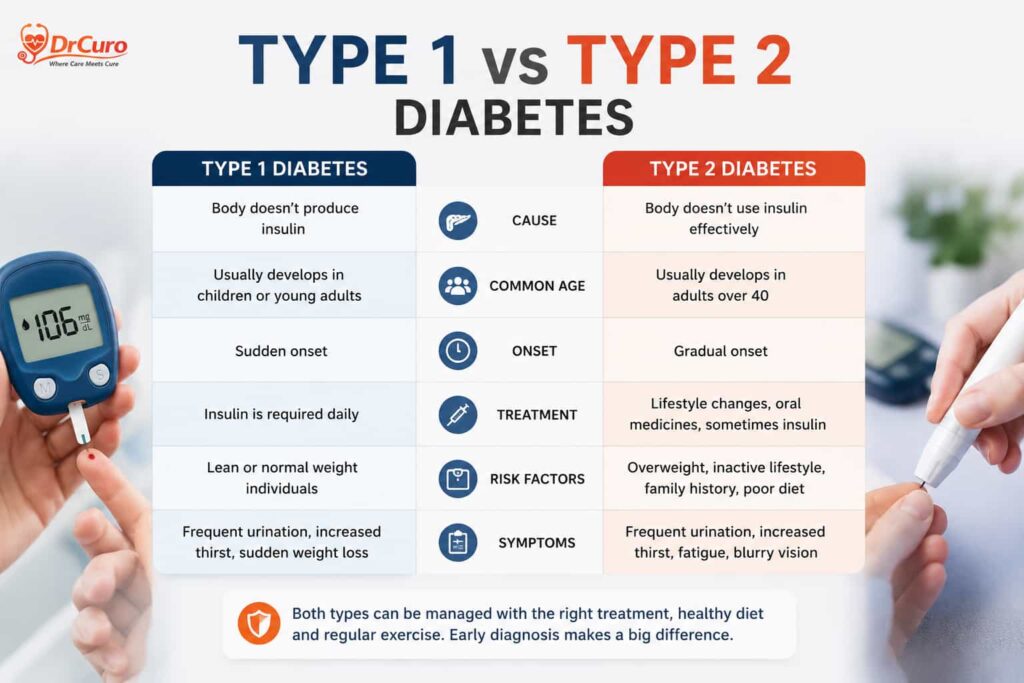
Quick Reference: Type 1 vs Type 2 Diabetes Difference
| Feature | Type 1 | Type 2 |
| Cause | Autoimmune | Metabolic/lifestyle |
| Age of onset | Usually young | Usually adult (rising in youth) |
| Weight | Normal/low | Often overweight |
| Onset speed | Rapid | Gradual |
| Insulin needed | Always | Not always initially |
| Reversible | No | Yes (remission possible) |
| Autoantibodies | Present | Absent |
| C-peptide | Low/absent | Normal/high initially |
| DKA risk | High | Low (HHS more common) |
| Primary treatment | Insulin + CGM | Lifestyle + oral agents ± insulin |
Frequently Asked Questions
Q: Can Type 2 diabetes turn into Type 1? No they are distinct diseases with different mechanisms. However, Type 2 patients whose beta cells progressively fail may eventually require insulin and can be mistaken for having “turned into” Type 1. This is not the case.
Q: Can a Type 1 diabetic ever stop taking insulin? Not with current treatments. Some patients experience a “honeymoon phase” shortly after diagnosis where residual beta cells temporarily produce some insulin, reducing requirements but this does not last. Emerging therapies like teplizumab aim to extend this phase.
Q: Is Type 2 diabetes always caused by being overweight? No. While obesity is a major risk factor, approximately 10–15% of people with Type 2 are normal weight particularly in South Asian populations. Visceral fat distribution, genetics, and other metabolic factors contribute independently of overall body weight.
Q: At what HbA1c level should I worry?
- Below 5.7% — Normal
- 5.7–6.4% — Prediabetes (take action now)
- 6.5% and above — Diabetes diagnosis
Q: Can children get Type 2 diabetes? Yes, and it is increasing. Childhood obesity has driven a significant rise in Type 2 diabetes in adolescents. Type 2 in young people tends to be more aggressive, with faster progression to complications.
The Right Diagnosis Changes Everything
Understanding the type 1 vs type 2 diabetes difference is not academic it directly determines how a person is treated, what medications they receive, what complications they face, and whether remission is a realistic goal.
At Dr Curo, our endocrinology and diabetes specialists go beyond the basic diagnosis. We assess your complete metabolic profile, screen for LADA, test for DNA fragmentation, evaluate cardiovascular risk, and create a personalised management plan whether you are newly diagnosed or have been managing diabetes for years and feel your current care isn’t working.
Diabetes is not a single story. Your type, your body, your life deserves a plan built for you.








No Comment! Be the first one.