







IVF Process Step by Step — Complete Beginner’s Guide
Facing fertility challenges and wondering if IVF is right for you? You’re not alone. Understanding the process is the first step. At Dr Curo, IVF treatment in India is a trusted option for couples...
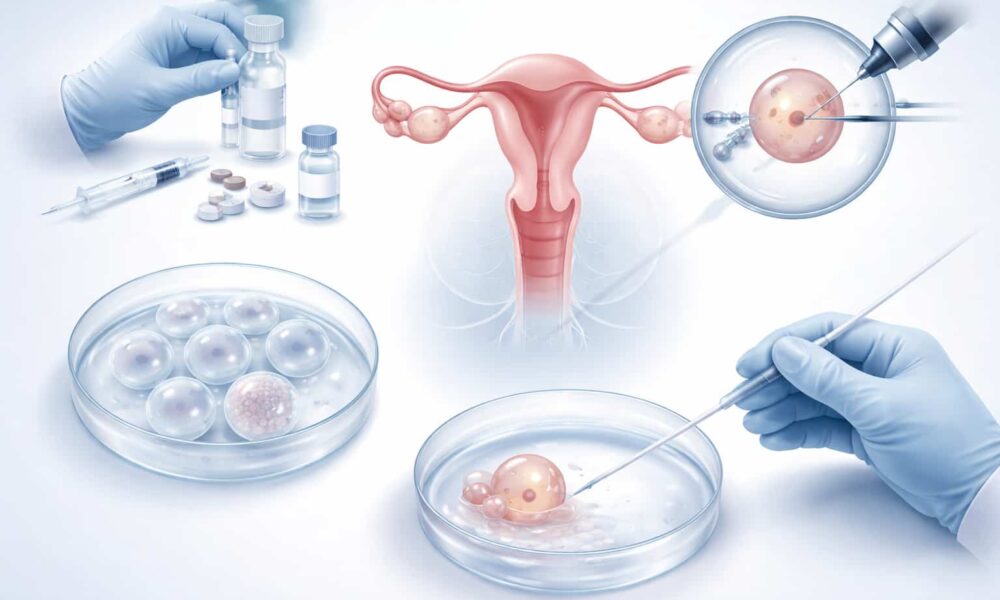
Facing fertility challenges and wondering if IVF is right for you? You’re not alone. Understanding the process is the first step.
Table Of Content
- What is IVF Treatment?
- Why Do People Choose IVF?
- IVF vs IUI — Simple Comparison
- IVF Process Step by Step
- Step 1 — Consultation and Fertility Tests
- Step 2 — Ovarian Stimulation
- Step 3 — Follicle Monitoring
- Step 4 — Egg Retrieval (OPU)
- Step 5 — Sperm Collection and Fertilisation
- Step 6 — Embryo Development in the Lab
- Step 7 — Embryo Transfer
- Step 8 — The Two-Week Wait
- Step 9 — Pregnancy Test
- IVF Success Rates — What Are the Chances?
- Types of IVF Treatment
- Cost of IVF Treatment at Dr Curo
- Side Effects and Risks of IVF
- IVF and Emotional Wellbeing
- How Many IVF Cycles Should You Try?
- Tips to Improve Your IVF Success
- Frequently Asked Questions
- Dr Curo is With You Every Step
At Dr Curo, IVF treatment in India is a trusted option for couples with moderate to severe infertility, offering higher success rates than treatments like IUI.
This simple guide explains the IVF process step by step, so you can move forward with clarity and confidence.
What is IVF Treatment?
IVF stands for In Vitro Fertilisation.
In simple words IVF is a fertility treatment where eggs are collected from a woman’s ovaries, fertilised with sperm in a laboratory, and the resulting embryo is carefully placed back into the uterus to develop into a pregnancy.
The phrase “in vitro” is Latin for “in glass” referring to the fact that fertilisation happens outside the body, in a controlled lab setting rather than inside the fallopian tube as it would naturally.
Unlike IUI, where sperm is placed into the uterus and fertilisation is left to happen on its own, IVF takes full control of the fertilisation process. This gives doctors the ability to monitor embryo development closely and select the strongest embryo for transfer.
At Dr Curo, IVF is performed by experienced reproductive specialists using the latest laboratory technology to give you the best possible chance of success.
Why Do People Choose IVF?
People choose IVF for many different reasons. Here are the most common:
- Blocked or damaged fallopian tubes — eggs cannot travel naturally to meet sperm
- Severe male infertility — very low sperm count, poor motility, or abnormal shape
- Failed IUI cycles — when 3 to 6 IUI attempts have not resulted in pregnancy
- Advanced maternal age — women over 35 where time is an important factor
- Endometriosis — when the condition is affecting egg quality or tube function
- Diminished ovarian reserve — low egg count requiring careful controlled stimulation
- Genetic conditions — IVF with PGT (Preimplantation Genetic Testing) allows embryo screening before transfer
- Single women and same-sex couples — using donor sperm or donor eggs to build a family
- Unexplained infertility — when all tests are normal but pregnancy has not occurred
IVF is generally considered the next step when simpler treatments like IUI have not been successful or when the diagnosis makes IVF the most appropriate first choice.
IVF vs IUI — Simple Comparison
| Feature | IUI Treatment | IVF Treatment |
| Where fertilisation happens | Inside the body natural | Outside the body in lab |
| Invasiveness | Very minimal, no surgery | More involved, egg retrieval needed |
| Cost per cycle | ₹10,000 – ₹30,000 | ₹1,00,000 – ₹2,00,000+ |
| Recovery time | None — go home same day | 1–2 days rest advised |
| Success rate per cycle | 10–20% | 40–50% (under 35) |
| Best suited for | Mild fertility issues | Moderate to severe or complex cases |
Most doctors at Dr Curo recommend starting with IUI when appropriate, because it is simpler and more affordable. When IUI is not suitable or has not worked, IVF becomes the clear and recommended next step.
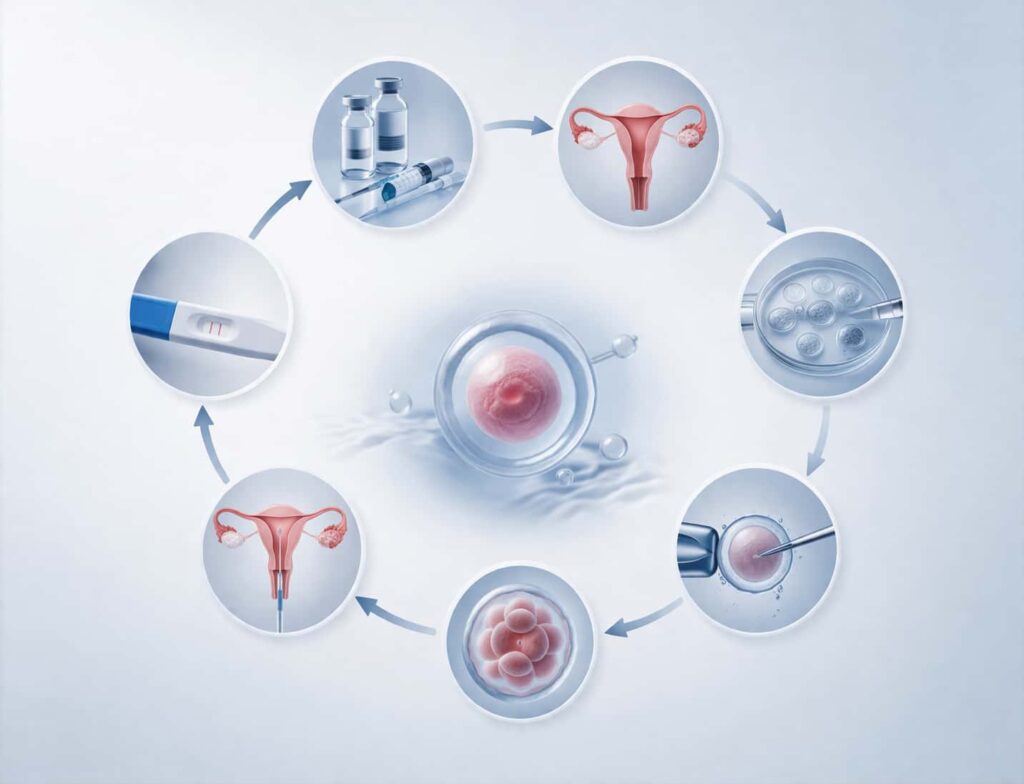
IVF Process Step by Step
Step 1 — Consultation and Fertility Tests
Before the IVF process begins, your Dr Curo doctor conducts a thorough fertility evaluation of both partners.
For the woman this includes blood hormone tests to assess ovarian reserve (AMH, FSH, LH, Estradiol), a detailed pelvic ultrasound to count antral follicles and examine the uterus, and a check of the uterine cavity. For the man, a semen analysis evaluates sperm count, motility, and morphology. A complete medical history and lifestyle review is also taken for both.
This step is essential because IVF treatment is tailored specifically to your results your stimulation protocol, medication doses, and overall plan are all personalised based on what these tests show.
Step 2 — Ovarian Stimulation
In a natural cycle, your body produces just one egg per month. IVF requires multiple eggs to increase the chances of creating viable embryos. This is achieved through ovarian stimulation.
From Day 2 or 3 of your menstrual cycle, injectable hormone medications (called gonadotropins) are started. These are given as small daily injections under the skin most women learn to self-administer these at home very easily.
Medications used include:
- FSH injections (Follicle Stimulating Hormone) — the main stimulation medication to grow multiple follicles
- LH injections — often combined with FSH for better egg quality
- GnRH agonists or antagonists — to prevent premature ovulation before egg retrieval
Stimulation continues for approximately 10 to 14 days depending on your response. Your Dr Curo team will guide you through every injection with clear instructions.
Step 3 — Follicle Monitoring
While on stimulation medications, your progress is carefully tracked through regular ultrasound scans and blood hormone tests every 2 to 3 days at Dr Curo.
The team monitors how many follicles are growing and how large they are getting. When the lead follicles reach approximately 18–20mm in size and hormone levels look right, a trigger injection (hCG or GnRH agonist) is given to finalise egg maturation. The egg retrieval procedure is then scheduled precisely 34–36 hours after the trigger timing here is critical.
Step 4 — Egg Retrieval (OPU)
Egg retrieval, also called Ovum Pick-Up (OPU), is a minor surgical procedure done under light sedation or general anaesthesia so you feel no discomfort at all.
Using an ultrasound-guided needle inserted through the vaginal wall, your Dr Curo doctor carefully draws the fluid from each mature follicle and collects the eggs. The entire procedure takes approximately 20 to 30 minutes. You wake up in the recovery area, rest for a couple of hours, and go home the same day. Mild cramping and light spotting for 1 to 2 days is completely normal.
The number of eggs retrieved depends on your ovarian reserve and your response to stimulation typically anywhere from 5 to 15 eggs in a standard cycle.
Step 5 — Sperm Collection and Fertilisation
On the same day as egg retrieval, the male partner provides a fresh sperm sample. If using donor sperm, a frozen sample is carefully thawed and prepared. If the male partner has no sperm in the ejaculate, a minor surgical sperm retrieval procedure (TESA or PESA) can be performed.
The collected sperm is then used to fertilise the eggs in one of two ways:
- Conventional IVF — eggs and sperm are placed together in a dish and fertilisation happens naturally overnight
- ICSI (Intracytoplasmic Sperm Injection) — a single healthy sperm is injected directly into each egg under a microscope. This is recommended when sperm quality is poor or when previous fertilisation has failed.
The following morning, the embryologist checks which eggs have fertilised successfully. These are now called embryos.
Step 6 — Embryo Development in the Lab
The fertilised embryos are placed in a specially controlled incubator that mimics the conditions inside the body. Over the next 3 to 6 days, the embryologist monitors their development closely.
- Day 1 — Fertilisation confirmed
- Day 3 — Embryos reach the 6–8 cell stage (cleavage stage)
- Day 5 or 6 — The best embryos develop into blastocysts the ideal stage for transfer
At Dr Curo, embryos are graded based on their development, symmetry, and quality. Only the strongest embryo or embryos are selected for transfer. Remaining good-quality blastocysts can be frozen (vitrified) for future use.
Step 7 — Embryo Transfer
Embryo transfer is the final and most important step in the IVF process. It is a simple, painless procedure no anaesthesia is needed.
You lie on the examination table just like a routine pelvic exam. Using ultrasound guidance, a thin, soft catheter is gently passed through the cervix into the uterus. The selected embryo suspended in a tiny drop of fluid is carefully and precisely released into the uterine cavity. The whole procedure takes just 10 to 15 minutes.
Most women describe it as feeling like mild pressure nothing more. You rest at the clinic for 30 minutes and go home.
Your Dr Curo doctor will recommend transferring one or two embryos depending on your age, embryo quality, and medical history. Single embryo transfer is often preferred to reduce the risk of twins.
Step 8 — The Two-Week Wait
After the embryo transfer, you wait approximately 14 days before testing for pregnancy. This is known as the Two-Week Wait (2WW) and for most patients it is the most emotionally intense part of the entire journey.
During this time you should:
- Continue prescribed progesterone support (pessaries, injections, or gel)
- Eat well, stay hydrated, and get adequate sleep
- Do gentle exercise like slow walking nothing strenuous
- Avoid alcohol, smoking, and heavy physical activity
- Not test early with a home pregnancy kit results before 14 days can be misleading and cause unnecessary anxiety
Step 9 — Pregnancy Test
At the end of the two-week wait, a blood test called the beta-hCG test is done at Dr Curo. This is far more accurate than a home urine test and can detect pregnancy much earlier.
A positive result means the embryo has implanted successfully and pregnancy has begun. Your Dr Curo team will guide you on the next steps including an early scan to confirm heartbeat and a smooth handover to your obstetrician.
If the result is negative, your doctor will sit with you to review the cycle, understand what happened, and plan your best next step whether that is a frozen embryo transfer, another fresh IVF cycle, or a different approach altogether.
IVF Success Rates — What Are the Chances?
Success rates depend significantly on age and the underlying cause of infertility. Here is a clear breakdown:
| Age Group | Success Rate Per Cycle | Cumulative Success Over 3 Cycles |
| Under 30 | 45–50% | 80–85% |
| 30–34 | 40–45% | 75–80% |
| 35–37 | 30–35% | 60–68% |
| 38–40 | 20–25% | 45–55% |
| Over 40 | 10–15% | 28–38% |
Key things to understand about these numbers:
- Each cycle gives you a completely fresh opportunity the odds reset every time
- Frozen embryo transfer cycles using previously vitrified blastocysts often have equal or better success rates than fresh cycles
- Embryo quality, uterine health, and lifestyle factors all significantly influence outcomes
- PGT (genetic testing of embryos) can improve success rates by ensuring only chromosomally normal embryos are transferred
- A healthy BMI, no smoking, and good sperm quality all meaningfully increase your chances
Types of IVF Treatment
There is not just one type of IVF. At Dr Curo, your doctor will recommend the right approach based on your specific situation:
Conventional IVF — Standard IVF where eggs and sperm are placed together for natural fertilisation in the lab. Best for couples with good sperm quality.
IVF with ICSI — A single sperm is injected directly into each egg. Recommended for male factor infertility, low fertilisation rates, or previous failed cycles.
IVF with Donor Eggs — Uses eggs from a young, screened, anonymous donor. Recommended for women with very low or no egg reserve, premature ovarian failure, or advanced age.
IVF with Donor Sperm — Uses sperm from a screened, anonymous donor. Used when the male partner has no usable sperm, or for single women and same-sex female couples.
Frozen Embryo Transfer (FET) — Embryos from a previous IVF cycle are thawed and transferred in a later, less medicated cycle. Often has excellent success rates with less physical demand on the body.
IVF with PGT (Preimplantation Genetic Testing) — Embryos are biopsied and genetically tested before transfer to screen for chromosomal abnormalities or inherited conditions.
Cost of IVF Treatment at Dr Curo
| Type of IVF | Approximate Cost (India) |
| Conventional IVF | ₹1,00,000 – ₹1,40,000 |
| IVF with ICSI | ₹1,20,000 – ₹1,60,000 |
| IVF with Donor Eggs | ₹1,60,000 – ₹2,20,000 |
| Frozen Embryo Transfer (FET) | ₹30,000 – ₹60,000 |
| IVF with PGT | ₹1,80,000 – ₹2,50,000 |
IVF is a significant investment — but so is the family you are building. At Dr Curo, pricing is fully transparent with no hidden charges and no surprises. Every rupee is accounted for upfront.
Contact Dr Curo directly for a personalised cost estimate based on your specific treatment plan and diagnosis.
Side Effects and Risks of IVF
IVF is a well-established and safe fertility treatment. Most women go through it with manageable side effects and no serious complications.
Common and mild:
- Bloating and mild abdominal discomfort during stimulation
- Mood changes from hormonal medications
- Tenderness at injection sites
- Light spotting or cramping after egg retrieval or embryo transfer
- Breast tenderness during the two-week wait
Less common risks:
- Ovarian Hyperstimulation Syndrome (OHSS) — in rare cases, the ovaries over-respond to stimulation, causing significant bloating, abdominal pain, and fluid retention. At Dr Curo, stimulation protocols are carefully monitored to minimise this risk. Trigger injection type and dosing adjustments are used proactively. If you experience severe symptoms, contact Dr Curo immediately.
- Multiple pregnancy — transferring more than one embryo increases the chance of twins, which carries its own risks. Single embryo transfer is recommended wherever possible to avoid this.
- Egg retrieval complications — very rarely, bleeding or infection can occur after OPU. Sterile technique and ultrasound guidance make this exceptionally uncommon.
The vast majority of IVF cycles proceed smoothly. Your safety at every step is the highest priority at Dr Curo.
IVF and Emotional Wellbeing
The emotional weight of IVF is real and at Dr Curo we take it just as seriously as the medical side of your treatment.
Many couples going through the IVF process experience anxiety before and after egg retrieval, the intense pressure of waiting for fertilisation reports, emotional highs and lows during the two-week wait, strain in the relationship from the demands of the treatment schedule, and deep disappointment if a cycle does not result in pregnancy.
Dr Curo supports every patient through this with dedicated one-on-one counselling, honest and realistic conversations about what to expect at every stage, stress management guidance, and a warm, non-judgmental environment at every appointment.
You are never just a patient number here you are a person on one of the most meaningful journeys of your life, and you deserve care that reflects that.
How Many IVF Cycles Should You Try?
This is one of the most common questions asked at Dr Curo and the honest answer depends on your age, diagnosis, embryo quality, and response to treatment.
General guidance is that most fertility specialists recommend up to 3 IVF cycles before reassessing the overall approach. If you are under 35 with good ovarian reserve, the cumulative success rate over 3 cycles is very encouraging. If you are over 38 or have significant challenges, your doctor will help you evaluate when to continue, modify the protocol, or consider donor eggs.
It is also important to remember that frozen embryo transfers from a single egg collection cycle give you multiple attempts without going through full stimulation again making a single good collection cycle extremely valuable.
Tips to Improve Your IVF Success
Small but consistent lifestyle changes genuinely improve IVF outcomes at Dr Curo:
- Maintain a healthy weight — both underweight and overweight conditions affect hormone levels, egg quality, and implantation
- Take folic acid daily — at least 400mcg, ideally 3 months before starting treatment
- Quit smoking — smoking reduces egg quality, sperm quality, and embryo viability significantly
- Limit alcohol — alcohol disrupts hormonal balance and lowers implantation rates
- Eat a fertility-supportive diet — vegetables, whole grains, lean protein, healthy fats, and antioxidant-rich foods
- Reduce stress — yoga, meditation, gentle walking, and proper sleep all support better outcomes
- Male partner: avoid heat — no hot baths, saunas, or tight underwear in the weeks before sperm collection
- Never miss monitoring appointments — in IVF, every scan matters. Timing decisions are made on real-time data
Frequently Asked Questions
Q1. Is the IVF process painful? The injections during stimulation are very small and most women manage them comfortably at home. Egg retrieval is done under sedation so you feel nothing during the procedure. Embryo transfer is painless similar to a mild pelvic exam. Overall, IVF is far more manageable than most people expect before they begin.
Q2. How long does one complete IVF cycle take from start to finish? One full IVF cycle typically takes 4 to 6 weeks from the start of stimulation to the pregnancy test. The stimulation phase is 10–14 days, egg retrieval takes one day, embryo development takes 5–6 days, and the two-week wait follows embryo transfer.
Q3. Can I go to work during IVF treatment? Yes. Most women continue working normally through the stimulation and monitoring phase. You will need a day off around egg retrieval and embryo transfer. Light duties during the two-week wait are perfectly fine.
Q4. What is the difference between IVF and ICSI? In standard IVF, eggs and sperm are placed together in a dish and fertilisation happens on its own. In ICSI, a single sperm is injected directly into each egg under a microscope. ICSI is recommended when sperm quality is poor or when fertilisation has failed in a previous cycle.
Q5. What happens to unused embryos after IVF? Good quality embryos that are not transferred in the fresh cycle can be vitrified (frozen) and stored. These frozen embryos can be used in future Frozen Embryo Transfer (FET) cycles often at a fraction of the cost of a full IVF cycle. Your Dr Curo doctor will guide you on storage options and your embryos’ long-term plan.
Q6. Does IVF increase the risk of birth defects? Research shows that IVF babies have similar rates of birth defects to naturally conceived babies. The small statistical differences seen in some studies are largely attributed to the underlying infertility conditions rather than the IVF process itself.
Dr Curo is With You Every Step
Understanding the IVF process step by step is the foundation of walking into treatment with confidence rather than fear. IVF is a structured, science-driven, and deeply personal journey and when done in the right hands, it gives thousands of couples and individuals a genuine chance at the family they have been dreaming of.
It is not a guarantee but it is the most powerful fertility tool available today. And at Dr Curo, you will never navigate it alone.
Whether you are just beginning to explore your fertility options or have already been through difficult cycles elsewhere, our team of reproductive specialists, embryologists, counsellors, and support staff are here for you with world-class expertise and genuine human care at every single step.






No Comment! Be the first one.