








Hot Weather, Hidden Danger: Why Food Poisoning Peaks in Summer
Most Indians welcome summer with open arms mangoes, holidays, late evenings, and cold drinks. What nobody welcomes but almost everybody encounters is what comes quietly alongside the heat. The...

Most Indians welcome summer with open arms mangoes, holidays, late evenings, and cold drinks.
Table Of Content
- What Is Food Poisoning And Why Does It Feel So Bad?
- Why Food Poisoning Peaks in Summer – The Real Reasons
- Reason 1 – Heat Does Exactly What Bacteria Need to Thrive
- Reason 2 – Food Spoils Faster Than Anyone Expects
- Reason 3 – Street Food and Outside Eating Carry Hidden Risks in Summer
- Reason 4 – Water Contamination Rises Sharply in Summer
- Reason 5 – Refrigerator Habits That Work in Winter Fail in Summer
- Reason 6 – Leftover Habits That Are Risky All Year Become Dangerous in Summer
- Reason 7 – Dehydration Makes Everything Worse
- Common Types of Food Poisoning That Peak in Summer
- Bacterial Infections
- Viral Infections
- Toxin-Based Poisoning
- Symptoms That Should Never Be Ignored
- Prevention Tips That Actually Work in Real Indian Households
- 1 Follow the Cook, Store, Consume Rule
- 2 Maintain Refrigerator Temperature and Organisation
- 3 Water Safety Is Non-Negotiable in Summer
- 4 Be Deliberate About Street Food Choices
- 5 Handle Leftovers With Summer Rules
- 6 Practice Rigorous Personal Hygiene Around Food
- 7 Protect Food From Flies and Environmental Contamination
- Myths vs Facts About Food Poisoning
- When Should You See a Doctor?
- How DrCuro Helps You Stay Safe This Summer
- Conclusion
- Frequently Asked Questions
What nobody welcomes but almost everybody encounters is what comes quietly alongside the heat. The stomach cramps that start at midnight. The vomiting that won’t stop. The fever that appears from nowhere after a meal that seemed perfectly fine.
Food poisoning.
Every summer across India, hospitals see a sharp and predictable rise in food poisoning cases. Emergency rooms fill up. Paediatric wards get busier. Families that were planning holidays end up managing dehydrated children and exhausted adults instead.
And the most frustrating part almost none of it is random. Almost all of it is predictable. And most of it is completely preventable.
Food poisoning peaks in summer not because of bad luck. It peaks because of biology because heat creates the perfect environment for the bacteria, viruses, and toxins that contaminate food to grow faster, survive longer, and cause more serious illness than they do in any other season.
Understanding exactly why this happens and what specific habits make it worse is what gives you the ability to protect yourself and your family before the problem arrives at your dinner table.
This is a detailed guide by DrCuro covering the real causes behind summer food poisoning, the foods and situations that carry the highest risk, the warning signs that should never be ignored, and the practical prevention strategies that actually make a difference in real Indian households.
Read this before summer gets serious.
What Is Food Poisoning And Why Does It Feel So Bad?
Food poisoning is what happens when you consume food or drink that has been contaminated with harmful microorganisms bacteria, viruses, parasites or with the toxins that these organisms produce as they grow and multiply.
It sounds simple. The experience is anything but.
When contaminated food enters your digestive system, your body recognises the threat and responds aggressively. The result is the cluster of symptoms that anyone who has experienced food poisoning remembers clearly and hopes never to repeat.
Common symptoms include:
- Nausea – that builds rapidly after eating
- Vomiting – sometimes severe and repeated
- Diarrhoea – watery, frequent, and often accompanied by cramping
- Stomach cramps that come in waves
- Fever – indicating the body is fighting an active infection
- Weakness, dizziness, and profound fatigue
- Dehydration – which develops quickly when vomiting and diarrhoea occur together
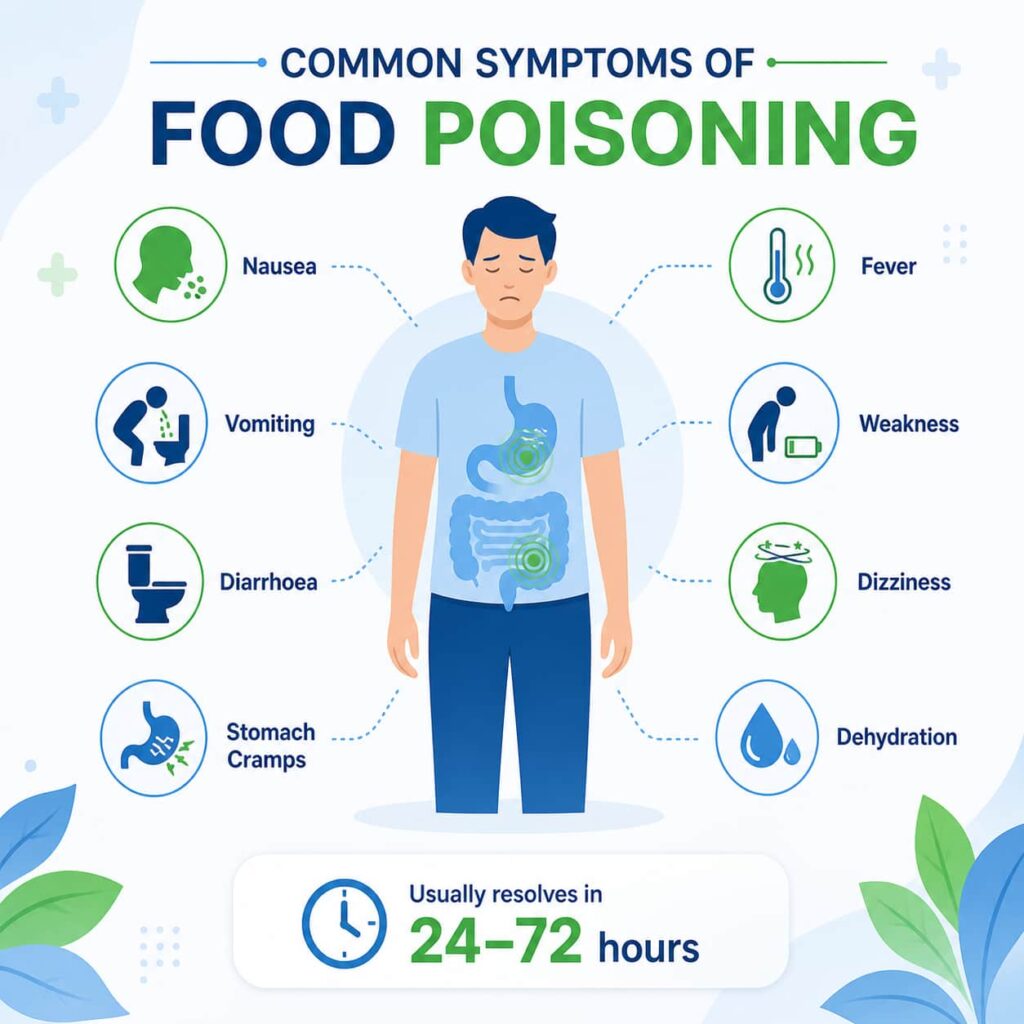
In most healthy adults, mild food poisoning resolves within 24 to 72 hours. The body fights the infection, expels the contaminated material, and recovers.
But in vulnerable groups young children, elderly individuals, pregnant women, people with compromised immunity or chronic illness food poisoning can escalate rapidly into a serious medical emergency. Severe dehydration in children can become dangerous within hours. Certain bacterial infections can cause kidney damage if not treated promptly. And some toxins particularly those produced by Staphylococcus aureus and Clostridium botulinum are not destroyed by cooking and can cause lasting harm.
This is why food poisoning peaks in summer matter not as a minor seasonal inconvenience, but as a genuine public health concern that affects Indian families every year with entirely predictable regularity.
Why Food Poisoning Peaks in Summer – The Real Reasons
Reason 1 – Heat Does Exactly What Bacteria Need to Thrive
This is the foundation of everything else on this list. And understanding it changes how you think about food in summer permanently.
Bacteria are living organisms. Like all living organisms, they require specific conditions to survive and multiply. Temperature is the most critical of those conditions.
The range between 5°C and 60°C is known in food safety science as the danger zone the temperature range in which bacteria multiply most rapidly. Within the danger zone, many common foodborne bacteria can double their population every 20 minutes under ideal conditions. A piece of cooked chicken left on a counter at 35°C a typical Indian summer afternoon temperature can go from safe to dangerously contaminated in under two hours.
In winter, food left outside cools down toward the lower end of the danger zone slowing bacterial growth significantly. In summer, food left outside sits at the upper, most dangerous end of the danger zone accelerating bacterial growth to its maximum rate.
The bacteria responsible for most summer food poisoning cases in India include:
Salmonella – found in poultry, eggs, and dairy products. Causes severe diarrhoea, fever, and vomiting. Can be particularly dangerous in children.
Escherichia coli (E. coli) – found in contaminated water, raw vegetables, and undercooked meat. Certain strains cause bloody diarrhoea and, in severe cases, kidney failure.
Staphylococcus aureus – produces toxins in food that survive even after cooking. Causes rapid-onset vomiting within 1 to 6 hours of consuming contaminated food.
Bacillus cereus – commonly found in cooked rice and starchy foods left at room temperature. Produces toxins that are not destroyed by reheating.
Vibrio cholerae – found in contaminated water and raw seafood. The cause of cholera still a real risk in parts of India during summer, particularly in areas with compromised water supply.
Each of these organisms has one thing in common Indian summer heat is the optimal environment for their growth. Every degree the temperature rises above 30°C makes the problem worse.
Reason 2 – Food Spoils Faster Than Anyone Expects
This is the gap between what people believe about food safety and what is actually happening in their kitchens every summer afternoon.
Most Indians have an intuitive sense of when food has gone bad it smells off, it looks wrong, the texture has changed. This intuition works reasonably well in winter. In summer, it fails consistently because the bacteria that cause food poisoning frequently multiply to dangerous levels before any visible or detectable change occurs in the food.
Food can smell completely normal, look perfectly fresh, and taste entirely acceptable and still carry enough bacterial load to cause serious illness within hours of consumption.
The timeline changes dramatically in summer:
- Cooked food left at room temperature in winter relatively safe for 3 to 4 hours
- Cooked food left at room temperature in summer potentially unsafe within 1 to 2 hours
- Cut fruits left exposed in summer can become contaminated within 30 to 45 minutes in direct heat
- Cooked rice left outside overnight in summer almost certainly unsafe by morning regardless of whether it looks or smells fine
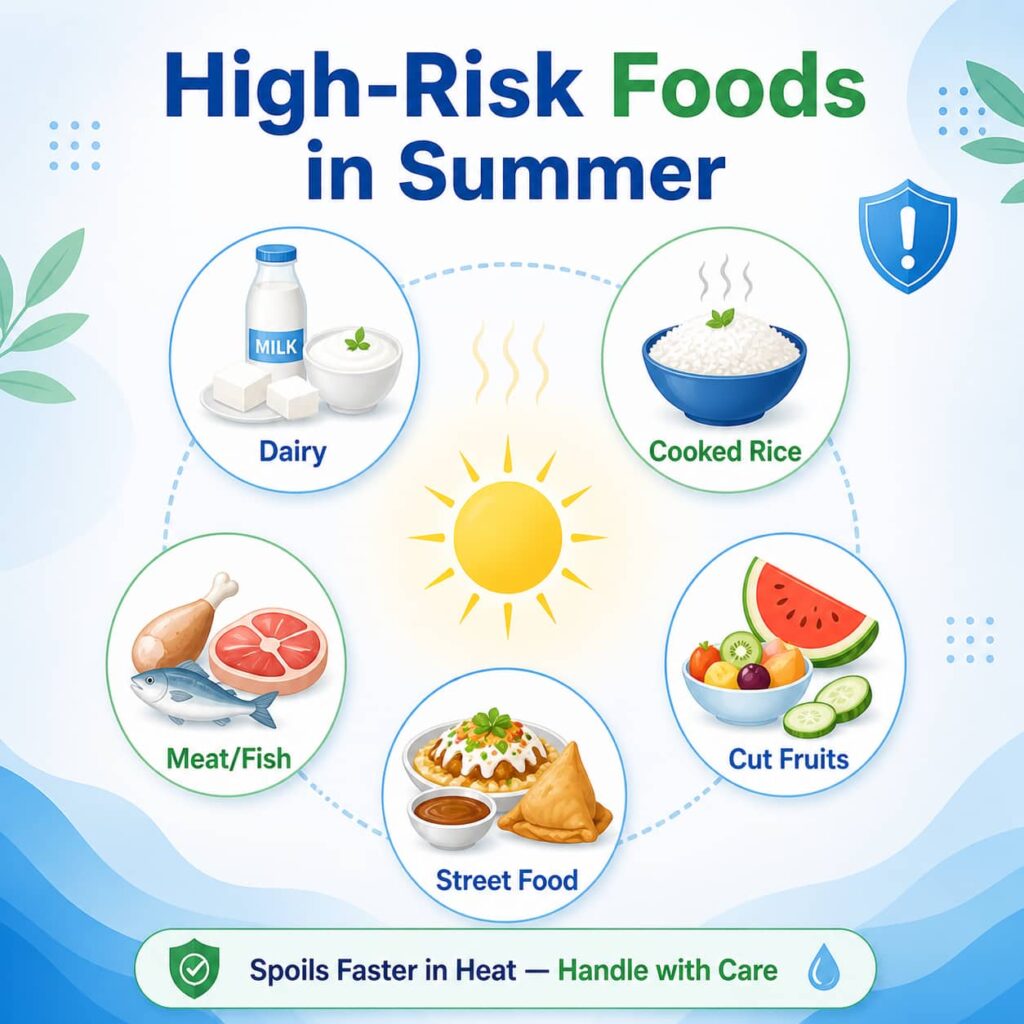
The foods that spoil fastest and cause the most summer food poisoning cases in India:
Milk and milk products – paneer, curd, khoa, cream spoil extremely rapidly in summer heat and are among the most common sources of bacterial contamination
Cooked rice provides the perfect warm, moist environment for Bacillus cereus to produce toxins overnight
Meat, poultry, and fish bacterial growth in protein-rich foods in summer heat is among the fastest of any food category
Cut fruits and vegetables the cutting process introduces bacteria from surfaces, hands, and knives, and the exposed flesh provides an ideal growth environment
Street food items particularly those involving sauces, chutneys, and fillings that are prepared in advance and held at ambient temperature for hours
The solution is not complicated but it requires adjusting habits that have become automatic. Food that was safe to leave out for 3 hours in January cannot be treated the same way in May.
Reason 3 – Street Food and Outside Eating Carry Hidden Risks in Summer
Summer in India means more outdoor activity more travel, more street food, more eating outside the controlled environment of the home kitchen. And while this is one of the genuine pleasures of Indian life, it carries risks in summer that are significantly higher than in cooler months.
Street food vendors particularly the small, mobile ones that operate in high-traffic areas frequently face conditions in summer that make safe food handling genuinely difficult. There is no refrigeration. Ingredients are prepared hours in advance and held at ambient temperature. Water sources may not be filtered. Hand hygiene is inconsistent. Flies which carry bacteria directly from waste to food are at their most active in summer heat.
The highest-risk street food items in Indian summer:
Chaat and chaats with tamarind water – the water used in preparation is frequently unfiltered or stored in conditions that allow contamination
Cut fruits sold by roadside vendors – exposed to flies, heat, and cross-contamination from handling
Gola and ice gola – made with ice from unknown sources that may be produced from unfiltered water
Fresh juices at juice stalls – the blenders, containers, and surfaces are cleaned with variable thoroughness, and fresh fruit left at room temperature deteriorates rapidly
Curd-based dishes and raita – dairy in summer heat is high-risk under even controlled conditions. Under street food conditions, the risk is substantially higher
Fried items reused in old oil – oil that has been used repeatedly and held at high temperature for hours develops compounds that cause digestive distress
None of this means that street food must be avoided entirely. It means that the choices made when eating outside in summer need to be more deliberate than they are in cooler months.
Reason 4 – Water Contamination Rises Sharply in Summer
Water is the hidden vector in a significant proportion of summer food poisoning cases and it is the one that people are least likely to suspect, because contaminated water looks, smells, and tastes identical to clean water.
Summer creates multiple conditions that increase water contamination risk simultaneously:
Increased water scarcity – as demand rises and supply in many Indian cities becomes intermittent, households store water in containers for longer periods. Storage increases contamination risk, particularly if containers are not properly covered and cleaned.
Infrastructure pressure – water supply systems under pressure from high summer demand are more prone to the cross-contamination events that introduce bacteria into the supply.
Higher bacterial activity in water sources – rivers, lakes, and groundwater sources warm up in summer, providing better conditions for waterborne pathogens to survive and multiply.
Ice from unknown sources – ice added to drinks, golas, and fruit juices is frequently made from unfiltered water. The freezing process does not kill bacteria it merely suspends their activity. When the ice melts, the bacteria resume multiplying.
Washing produce with contaminated water – fruits and vegetables washed with contaminated water carry that contamination directly onto the surface of the food.
The practical implication – in summer, water safety requires active attention, not assumption. Filtered or boiled water is not optional during peak summer months. It is the foundation of food safety.
Reason 5 – Refrigerator Habits That Work in Winter Fail in Summer
The refrigerator is the most important food safety tool in the home. Most Indian households use it – but most use it in ways that become inadequate in summer without anyone realising it.
The specific refrigerator failures that cause summer food poisoning:
Overcrowding – when a refrigerator is packed too full, air cannot circulate freely. Temperatures rise in pockets throughout the fridge, creating zones where food is not actually being kept cold enough to prevent bacterial growth. Summer is when refrigerators tend to be most overcrowded more cold drinks, more cut fruit, more leftovers.
Incorrect temperature settings – many households set refrigerator temperatures intuitively rather than precisely. The safe temperature for a refrigerator is below 5°C. Many home refrigerators in India run at 7°C to 10°C which slows bacterial growth but does not stop it, particularly for high-risk foods.
Frequent door opening in summer, the refrigerator door is opened more frequently, for longer periods. Every opening allows warm air in and cold air out, raising the internal temperature temporarily. Multiple openings through a hot day can raise the internal temperature enough to accelerate bacterial growth.
Storing warm food – placing freshly cooked, still-warm food directly into the refrigerator is better than leaving it out but it temporarily raises the internal temperature and can affect nearby items. Allow food to cool slightly before refrigerating but do not leave it out for more than 30 to 45 minutes in summer heat.
Not storing food covered – uncovered food in the refrigerator is contaminated by the bacteria already present in the fridge environment, and cross-contaminates other foods.
The refrigerator does not eliminate risk in summer. It manages it but only when used correctly.
Reason 6 – Leftover Habits That Are Risky All Year Become Dangerous in Summer
India is a culture of leftovers and for good practical reasons. Cooking fresh three times a day is not realistic for most households. Leftovers are economical, convenient, and reduce waste.
In summer, however, leftover habits that are borderline acceptable in cooler months cross into genuinely dangerous territory.
The specific leftover risks in summer:
Overnight rice – cooked rice is one of the highest-risk leftover foods in any season. In summer, Bacillus cereus spores that survive cooking germinate rapidly at room temperature and produce toxins within 2 to 3 hours. Reheating kills the bacteria but does not destroy the toxins already produced. Rice left outside overnight in summer should not be consumed.
Dal and curries with dairy – dishes containing curd, cream, or paneer deteriorate particularly fast. What was made fresh at 7 PM can be unsafe by midnight if left outside, and marginal by morning even if refrigerated.
Reheating assumptions – many people believe that reheating food thoroughly kills all harmful organisms and makes it safe again. This is partially true for bacteria most are killed at temperatures above 70°C. It is not true for the toxins that some bacteria produce. Staphylococcal toxin and Bacillus cereus toxin are heat-stable they survive cooking temperatures and continue to cause illness even when the bacteria themselves have been destroyed.
Repeated reheating – reheating food multiple times creates additional risk with each cycle. Nutrients degrade, textures change, and any toxins present accumulate. Food should ideally be reheated only once.
The leftover rule for summer is simple refrigerate within one hour of cooking, consume within 24 hours, reheat only once, and discard anything that has been left at room temperature for more than one hour.
Reason 7 – Dehydration Makes Everything Worse
This reason operates differently from the others it does not cause food poisoning, but it makes the outcome of food poisoning significantly more serious.
Summer dehydration is almost universal across India. Most people are mildly to moderately dehydrated through much of the hot season losing more fluid through sweat than they are replacing through drinking. This chronic mild dehydration has several effects that directly worsen food poisoning outcomes:
Reduced digestive acid concentration – the stomach’s hydrochloric acid is the first line of defence against swallowed bacteria. When the body is dehydrated, digestive secretions are reduced in volume and potentially in concentration. Fewer bacteria are neutralised by stomach acid before they reach the intestines.
Impaired immune function – chronic mild dehydration reduces the efficiency of multiple immune system components, making the body less capable of fighting an active infection.
Faster progression to dangerous dehydration – someone who is already mildly dehydrated when food poisoning begins will reach dangerous levels of dehydration much faster than someone who was well-hydrated. In children and elderly individuals, this can become a medical emergency within hours.
Longer recovery – a dehydrated body takes longer to recover from any infection. The immune response is less efficient, tissue repair is slower, and the energy deficit is harder to overcome.
The most important thing you can do to reduce the severity of food poisoning if it occurs stay consistently well-hydrated throughout the summer season. It does not prevent infection, but it gives the body significantly better tools to fight it.
Common Types of Food Poisoning That Peak in Summer
Bacterial Infections
Salmonellosis – caused by Salmonella bacteria found in poultry, eggs, and unpasteurised dairy. Symptoms appear 6 to 72 hours after consumption. Causes severe diarrhoea, fever, and abdominal cramps. Common in summer due to rapid bacterial multiplication in warm food.
E. coli infection – particularly dangerous strains like E. coli O157:H7 can cause bloody diarrhoea and, in severe cases, haemolytic uremic syndrome a form of kidney failure that is particularly dangerous in children. Found in contaminated water, raw vegetables, and undercooked meat.
Staphylococcal food poisoning – rapid onset symptoms within 1 to 6 hours because the illness is caused by pre-formed toxins in food rather than active infection. Causes sudden, violent vomiting. Common in summer in foods that have been handled and then held at warm temperatures sandwiches, salads, cream-filled pastries.
Cholera – caused by Vibrio cholerae in contaminated water and raw seafood. Still an active risk in parts of India during summer, particularly in areas with compromised water infrastructure. Can cause severe, rapid dehydration that becomes life-threatening within hours without treatment.
Viral Infections
Norovirus – highly contagious, spreads through contaminated food, water, and surfaces. Causes sudden-onset vomiting and diarrhoea. Can spread through an entire family or workplace rapidly.
Rotavirus – the leading cause of severe diarrhoeal illness in young children in India. While vaccination has reduced its impact, it remains a significant summer health risk for unvaccinated children.
Toxin-Based Poisoning
Toxin-based food poisoning is produced when bacteria grow in food and release toxins before consumption. The toxins — not the bacteria cause the illness. Reheating food kills bacteria but does not destroy these toxins. This is why food that has been thoroughly reheated can still cause food poisoning the toxins produced hours earlier remain active and harmful.
Non-vegetarian food chicken, fish, eggs, mutton Protein-rich foods support the fastest bacterial growth of any food category. Chicken in particular carries Salmonella risk even before cooking cross-contamination from raw chicken to surfaces and other foods is a significant source of infection. Fish deteriorates particularly rapidly in summer heat and should be consumed only when very fresh.
Street food chaat, gola, cut fruits, fresh juices As discussed above the combination of ambient temperature storage, inconsistent hygiene, and high-risk ingredients makes street food the single highest-risk eating context in Indian summer.
Cooked rice and starchy leftovers Bacillus cereus in rice is a genuine and underappreciated risk. Reheating does not make leftover rice safe if it has been left at room temperature for more than one to two hours in summer.
Cut fruits and salads The cutting process introduces bacteria from multiple surfaces. Exposed cut fruit in summer heat deteriorates within 30 to 45 minutes. Pre-cut fruit sold at markets or street stalls has typically been sitting for hours.
Cream-filled and custard-based desserts Pastries, cakes, and sweets with cream or custard fillings are among the highest-risk dessert items in summer. The filling provides an ideal bacterial growth medium and is frequently stored at inadequate temperatures in bakeries and sweet shops.
Symptoms That Should Never Be Ignored
Most food poisoning resolves without medical intervention in healthy adults. The following symptoms require prompt medical attention delaying care when these are present can lead to serious complications.
Seek medical help immediately if you notice:
- Fever above 38.5°C that does not reduce with standard fever medication
- Blood in stool or vomit indicating potential bacterial infection causing intestinal damage
- Vomiting so persistent that no fluid can be kept down for more than 2 to 3 hours
- Signs of severe dehydration no urination for 6 or more hours, extremely dry mouth, sunken eyes, dizziness when standing
- Symptoms lasting more than 48 to 72 hours without improvement
- Neurological symptoms confusion, blurred vision, difficulty swallowing which may indicate botulism or severe electrolyte disturbance
- Any food poisoning symptoms in a child under 2 years, an elderly individual, or a pregnant woman these groups should receive medical evaluation earlier rather than later
At DrCuro, we see the consequences of delayed care in food poisoning cases every summer. The difference between a case that resolves at home and one that requires hospitalisation is frequently the decision about when to seek help made too late.
Prevention Tips That Actually Work in Real Indian Households
1 Follow the Cook, Store, Consume Rule
This is the single most effective food safety principle for Indian summer and the one most consistently violated.
Cook – prepare food as close to consumption time as possible. The shorter the gap between cooking and eating, the less opportunity bacteria have to multiply.
Store – any food not consumed immediately must be refrigerated within 45 minutes to 1 hour in summer. Not two hours. Not when it is convenient. Within one hour.
Consume – refrigerated food in summer should be consumed within 24 hours. Not the standard advice of 3 to 4 days that applies in cooler seasons. The faster turnover of food in summer is not wasteful it is protective.
2 Maintain Refrigerator Temperature and Organisation
Set the refrigerator to between 1°C and 4°C verify with a thermometer if possible. Do not overcrowd. Store raw meat and fish on the bottom shelf in sealed containers where any drips cannot contaminate food below. Store cooked food covered. Check that the door seal is intact and that the door is not left open longer than necessary.
3 Water Safety Is Non-Negotiable in Summer
Drink only filtered or boiled water. Insist on it in your household consistently not occasionally. Avoid ice from unknown sources. Wash all fruits and vegetables including those you intend to peel under filtered or boiled water. The bacteria on the surface of an unwashed orange can transfer to the flesh during peeling.
4 Be Deliberate About Street Food Choices
Avoid street food during the peak heat hours of 12 PM to 4 PM this is when ambient temperature is highest and bacterial growth in street food is fastest. Choose vendors where food is cooked fresh in front of you rather than prepared in advance. Avoid raw or cut items. Prefer freshly cooked hot food over anything that has been sitting. Carry hand sanitiser and use it before eating anything outdoors.
5 Handle Leftovers With Summer Rules
Refrigerate within one hour. Consume within 24 hours. Reheat to a temperature that produces visible steam throughout not just warm on the outside. Reheat only once. Discard anything that has been at room temperature for more than one hour in summer. When in doubt, throw it out the cost of a discarded meal is always less than the cost of a food poisoning episode.
6 Practice Rigorous Personal Hygiene Around Food
Wash hands with soap for at least 20 seconds before preparing food, before eating, and after using the toilet. Keep nails trimmed and clean. Avoid preparing food for others when experiencing diarrhoea or vomiting even if you feel the worst has passed. Clean kitchen surfaces regularly with a diluted disinfectant cutting boards in particular harbour bacteria in small scratches and crevices that are not visible to the eye.
7 Protect Food From Flies and Environmental Contamination
A single housefly can carry millions of bacteria on its body collected from waste, decomposing matter, and contaminated surfaces. In summer, fly populations are at their highest. Keep all food covered at all times. Use mesh covers for food left on the table during meals. Never leave food uncovered in a kitchen. Empty and clean waste bins daily flies breed in organic waste and a bin left uncleaned is a direct breeding ground adjacent to your food preparation area.
Myths vs Facts About Food Poisoning
Myth 1: Reheating food thoroughly makes it completely safe
Fact: Reheating kills active bacteria but it does not destroy the heat-stable toxins that some bacteria produce before the food is reheated. Food that has been contaminated and left at room temperature long enough for toxin production to occur will still cause illness even after thorough reheating.
Myth 2: If food smells and looks fine, it is safe to eat
Fact: The bacteria responsible for most food poisoning cases – Salmonella, E. coli, Staphylococcus aureus produce no detectable change in the smell, appearance, or taste of contaminated food. You cannot use your senses to determine food safety in summer. Time and temperature are the only reliable indicators.
Myth 3: Only non-vegetarian food causes food poisoning
Fact: Vegetarian foods particularly dairy products, cooked rice, cut fruits, raw vegetables, and water — are responsible for a very large proportion of food poisoning cases in India. Paneer, curd, and milk are among the highest-risk foods in summer. Vegetarian does not mean safe.
Myth 4: Food poisoning is always mild and self-limiting
Fact: While many food poisoning cases resolve without medical intervention, certain bacterial infections – E. coli O157:H7, Vibrio cholerae, Salmonella typhi can cause serious and potentially fatal illness, particularly in vulnerable individuals. Food poisoning that involves bloody stool, persistent high fever, or signs of severe dehydration requires urgent medical assessment.
Myth 5: Keeping food in the fridge means it is completely safe
Fact: The refrigerator slows bacterial growth it does not stop it. Listeria monocytogenes a bacterium found in dairy products and ready-to-eat meats grows at refrigerator temperatures. Food stored incorrectly in a fridge that is not cold enough, or for too long, can still cause food poisoning.
Myth 6: Drinking alcohol with a meal kills food poisoning bacteria
Fact: The concentration of alcohol in any beverage consumed with a meal is far too low to have any meaningful antibacterial effect on food or in the digestive system. This belief has no scientific basis and provides no protection.
When Should You See a Doctor?

Most mild food poisoning can be managed at home with oral rehydration, rest, and bland food once vomiting settles. The following situations require prompt medical attention do not delay.
Go to a doctor or hospital immediately if:
- You cannot keep any fluid down for more than 2 to 3 hours due to persistent vomiting
- There is blood in your stool or vomit
- Fever is above 38.5°C and not responding to medication
- You feel extremely weak, dizzy when standing, or confused
- Urination has stopped for more than 6 hours
- Symptoms are in a child under 5, a pregnant woman, an elderly individual, or someone with a chronic illness
- Symptoms have not improved after 48 hours or are getting worse rather than better
At home management for mild cases:
Sip ORS or nimbu pani with rock salt frequently in small amounts do not drink large quantities at once as this can trigger vomiting. Rest completely. Eat nothing until vomiting settles, then introduce bland, easily digestible food — khichdi, plain rice, banana, plain toast. Avoid dairy, spicy food, and fatty food until fully recovered. Avoid anti-diarrhoeal medications without medical advice diarrhoea is the body’s mechanism for expelling the contamination.
How DrCuro Helps You Stay Safe This Summer
At DrCuro, we do not wait for the crisis to start the conversation about prevention.
Food poisoning peaks in summer every year. The reasons are consistent. The risk factors are known. The prevention strategies are straightforward. And yet the cases keep coming because awareness does not automatically translate into changed behaviour.
Our approach at DrCuro is built on three commitments:
Education before the season – giving families the information they need to understand why summer food safety is different from food safety in other seasons, and what specific changes make the difference.
Recognition of warning signs – helping individuals and families identify when food poisoning symptoms require medical attention and when home management is appropriate so that neither delay nor unnecessary panic drives the decision.
Practical, real-world guidance – not generic advice that sounds sensible but changes nothing. Specific, actionable habits that work in the actual conditions of Indian households, Indian kitchens, and Indian summer.
Because staying healthy in summer is not only about avoiding the heat. It is about recognising and avoiding the hidden dangers that the heat creates in your kitchen, in the food you buy, in the water you drink, and in the habits that feel safe but aren’t.
Conclusion
Food poisoning peaks in summer every year in India. Not randomly. Not unpredictably. For specific, biological, and behavioural reasons that are entirely understood and entirely addressable.
The heat accelerates bacterial growth to its maximum rate. Food spoils faster than intuition suggests. Street food carries risks that cooler months conceal. Water becomes a hidden vector. Refrigerator habits that barely pass in winter fail in summer. Leftover practices that work nine months of the year become dangerous in the three hottest ones.
And dehydration the backdrop condition of Indian summer makes every outcome worse.
The solution is not complicated. But it requires deliberate adjustment of habits, of assumptions, and of the timeline on which decisions about food safety are made.
The summer food safety rules that actually matter:
- Cook fresh and eat immediately whenever possible
- Refrigerate within one hour not two, not when convenient
- Consume refrigerated food within 24 hours in summer
- Drink only filtered or boiled water no exceptions
- Be deliberate and selective about street food choices
- Reheat only once and discard what you cannot finish
- Wash hands consistently before cooking, before eating, after the bathroom
- Cover all food always, without exception
- Seek medical help early for vulnerable individuals children, elderly, pregnant women
Small adjustments in daily habit. Significant reduction in summer risk.
At DrCuro, we believe that the best time to think about food poisoning is before it happens not after. This summer, let information be your protection. Stay aware, stay careful, and stay healthy.
DrCuro
Frequently Asked Questions
Q1. Why does food poisoning peak in summer specifically?
Because summer heat creates the optimal temperature range for foodborne bacteria to multiply. Between 30°C and 40°C typical Indian summer temperatures bacteria like Salmonella and E. coli can double their population every 20 minutes in food left at room temperature. The same food that is safe for 3 hours in winter can become dangerous within 1 hour in summer.
Q2. How quickly can food become unsafe in Indian summer heat?
Faster than most people expect. Cooked food left at room temperature in peak summer heat can become unsafe within 1 to 2 hours. Cut fruits can deteriorate within 30 to 45 minutes in direct heat. Dairy products particularly milk, curd, and paneer can become unsafe within a similar timeframe. The rule in summer is simple if in doubt, throw it out.
Q3. Can drinking water cause food poisoning?
Yes, and it does so regularly in Indian summers. Contaminated water is one of the primary vectors for cholera, E. coli infection, and several other waterborne illnesses. Ice made from unfiltered water carries the same risk as unfiltered water itself freezing does not kill bacteria. Drink only filtered or boiled water in summer, and be cautious about ice in drinks outside the home.
Q4. Is reheating food enough to make it safe in summer?
Partially. Reheating to a temperature that produces visible steam throughout the food kills most active bacteria. However, it does not destroy the heat-stable toxins produced by bacteria like Staphylococcus aureus and Bacillus cereus which remain active and harmful even after thorough reheating. Food that has been left at room temperature long enough for toxin production to occur is not made safe by reheating.
Q5. Who is most at risk from summer food poisoning?
Children under 5 are at highest risk because they dehydrate faster and their immune systems are still developing. Elderly individuals face higher risk because immune function declines with age and dehydration progresses faster. Pregnant women face risk both to their own health and to the developing baby certain foodborne bacteria like Listeria can cross the placenta. People with chronic illness or compromised immunity face higher risk of severe outcomes from infections that healthy adults would manage without medical intervention.







No Comment! Be the first one.