








IVF for PCOS: Success Rates and Precautions
IVF for PCOS: What Every Patient Needs to Know Before Starting Treatment Polycystic Ovary Syndrome (PCOS) is one of the most common hormonal disorders in women of reproductive age. In India alone, 1...
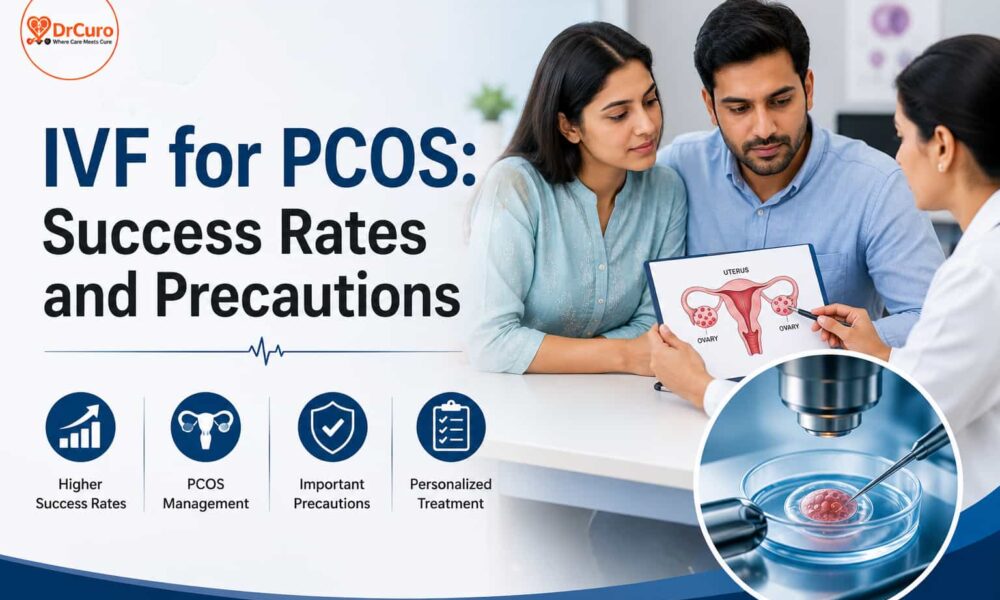
IVF for PCOS: What Every Patient Needs to Know Before Starting Treatment
Table Of Content
- What Makes PCOS Different When It Comes to Fertility?
- When Should a PCOS Patient Consider IVF?
- IVF Success Rates for PCOS Patients: The Real Numbers
- The Biggest Risk in IVF for PCOS: Ovarian Hyperstimulation Syndrome (OHSS)
- Smart Precautions That Make IVF Safer for PCOS Patients
- What Happens During IVF for PCOS — Step by Step
- Common Questions PCOS Patients Ask About IVF
- Why Choosing the Right Clinic Matters More Than You Think
Polycystic Ovary Syndrome (PCOS) is one of the most common hormonal disorders in women of reproductive age. In India alone, 1 in 5 women lives with PCOS. And for many of them, the hardest question is not “Do I have PCOS?” it is “Can I still have a baby?”
The good news is yes, you absolutely can.
IVF for PCOS patients has helped thousands of women achieve motherhood, even after years of unsuccessful fertility treatments. However, IVF with PCOS requires a very different approach compared to standard IVF. From managing hormone response to reducing the risk of complications, every step needs careful planning and personalised care during IVF treatment in India to improve the chances of a healthy and successful pregnancy.
At Dr Curo, we believe you deserve the full picture not just hope, but real, honest, actionable information.
What Makes PCOS Different When It Comes to Fertility?
Before jumping to IVF, it helps to understand why PCOS causes fertility problems in the first place.
PCOS disrupts the hormonal signals that control ovulation. Women with PCOS often have higher levels of androgens (male hormones), irregular or absent periods, and multiple small cysts on the ovaries. These cysts are not dangerous on their own but they are a sign that eggs are not maturing and releasing properly.
No ovulation = no natural pregnancy.
That is the core problem. And while medications like Clomid or letrozole help many PCOS women ovulate, not everyone responds. Some women also have blocked tubes, a partner with low sperm count, or have simply tried other treatments for too long without success. That is when IVF becomes the right step forward.
When Should a PCOS Patient Consider IVF?
Not every woman with PCOS needs IVF. Doctors usually recommend it when:
- Ovulation induction medications have failed after 3 to 6 cycles
- There are additional fertility factors like tubal blockage or male infertility
- The woman is above 35 and time is a concern
- Previous IUI (intrauterine insemination) cycles have not worked
- Comprehensive testing shows IVF gives the highest chance of success
At Dr Curo, we never rush patients into IVF. We always look at the complete picture first — hormone levels, ultrasound findings, partner’s semen analysis, and lifestyle factors — before recommending the most suitable path.
IVF Success Rates for PCOS Patients: The Real Numbers
Here is the part most clinics do not talk about clearly enough.
IVF success rates for PCOS patients are actually quite good often better than for women without PCOS in some ways. Why? Because women with PCOS typically have a high ovarian reserve, meaning their ovaries contain a large number of eggs. During IVF stimulation, this means more eggs can be retrieved in a single cycle.
More eggs = more embryos = more chances.
Studies show that IVF success rates for PCOS patients range between 40% to 60% per cycle for women under 35, depending on the clinic, protocol used, and individual health factors. Some research even suggests cumulative success rates (after multiple frozen embryo transfers) can go as high as 70% to 80%.
However and this is important a high egg count in PCOS also comes with a risk that must be managed carefully.
The Biggest Risk in IVF for PCOS: Ovarian Hyperstimulation Syndrome (OHSS)
If there is one thing every PCOS patient must know before starting IVF, it is OHSS — Ovarian Hyperstimulation Syndrome.
Because PCOS ovaries are already highly sensitive and have more follicles than usual, they can over-respond to the hormonal stimulation drugs used in IVF. When this happens, the ovaries swell up, fluid leaks into the abdomen, and in severe cases it can become a medical emergency.
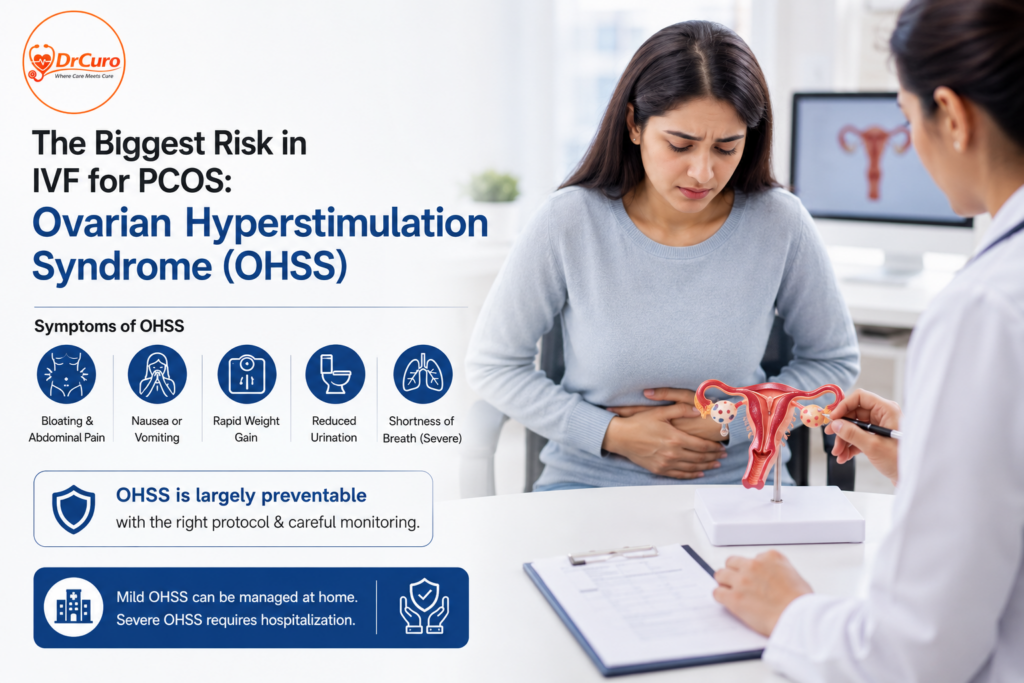
Symptoms of OHSS include:
- Bloating and abdominal pain
- Nausea or vomiting
- Rapid weight gain (more than 1 kg in 24 hours)
- Reduced urination
- Shortness of breath in severe cases
Mild OHSS is manageable at home with rest and hydration. Severe OHSS requires hospitalization.
The critical point here is that OHSS is largely preventable with the right protocol. At Dr Curo, our specialists use personalised stimulation protocols with careful monitoring to keep your response in the safe zone never too little, never too much.
Smart Precautions That Make IVF Safer for PCOS Patients
A good fertility clinic does not just aim for pregnancy it aims for a safe pregnancy. Here are the key precautions that should be in place for every PCOS patient undergoing IVF:
1. Freeze-All Strategy
Instead of doing a fresh embryo transfer in the same cycle as egg retrieval, many specialists now recommend freezing all embryos and doing a frozen embryo transfer (FET) in a later cycle. This allows the body to fully recover, significantly reduces OHSS risk, and often improves implantation rates. For PCOS patients, this approach has shown better pregnancy outcomes in multiple studies.
2. Low-Dose Stimulation Protocol
Using lower starting doses of hormonal injections and adjusting them based on daily monitoring helps prevent the ovaries from over-responding. This is not a one-size-fits-all process — it requires daily ultrasounds and blood tests to track follicle growth and hormone levels.
3. GnRH Antagonist Protocol
This is currently considered the safest stimulation protocol for PCOS patients. It allows the doctor to trigger egg release in a way that dramatically lowers OHSS risk compared to older protocols.
4. Metformin Support
Metformin, a medication often used for insulin resistance (which is common in PCOS), has been shown to reduce OHSS risk when used alongside IVF stimulation. If you are already on Metformin for PCOS, do not stop it without consulting your fertility specialist.
5. Lifestyle Preparation Before IVF
This one is underrated but incredibly important. Women with PCOS who lose even 5% to 10% of their body weight (if overweight) before IVF show significantly better hormone profiles, better egg quality, and better embryo development. Managing blood sugar, eating a low glycaemic index diet, sleeping well, and reducing stress all directly affect your IVF outcome.
What Happens During IVF for PCOS — Step by Step
Understanding the process removes a lot of anxiety. Here is what a typical IVF cycle looks like for a PCOS patient at Dr Curo:
Step 1 — Comprehensive Pre-IVF Testing Full hormone panel (AMH, FSH, LH, testosterone, thyroid, insulin), pelvic ultrasound for antral follicle count, semen analysis for the partner, and uterine cavity evaluation.
Step 2 — Ovarian Stimulation (8 to 14 days) Daily hormone injections to stimulate the ovaries. Monitored closely with regular ultrasounds and blood tests. Dose adjustments made in real time.
Step 3 — Trigger Shot When follicles reach the right size, a trigger injection causes final egg maturation. For PCOS patients, a GnRH agonist trigger (instead of the standard hCG trigger) is often preferred to reduce OHSS risk.
Step 4 — Egg Retrieval A minor procedure done under sedation. Eggs are collected from the follicles using a fine needle guided by ultrasound. It takes about 20 to 30 minutes.
Step 5 — Fertilisation in the Lab Eggs are fertilised with sperm using conventional IVF or ICSI (where a single sperm is injected directly into the egg). ICSI is often preferred for better fertilisation rates.
Step 6 — Embryo Development Fertilised eggs are monitored as they develop into embryos over 3 to 5 days. The healthiest embryos are selected.
Step 7 — Freeze-All or Fresh Transfer For most PCOS patients, embryos are frozen. The transfer is planned for the next cycle when the uterus is in the best condition to receive them.
Step 8 — Pregnancy Test A blood pregnancy test (beta hCG) is done about 10 to 14 days after embryo transfer.
Common Questions PCOS Patients Ask About IVF
Does IVF cure PCOS? No. IVF helps you achieve pregnancy despite PCOS, but it does not treat the underlying hormonal condition. After delivery, PCOS management continues.
Will my baby have PCOS? PCOS does have a genetic component. There is a higher chance your daughter may develop PCOS. However, with good lifestyle habits, its impact can be minimised.
Can I do IVF if I have PCOS and diabetes? Yes, but blood sugar control must be excellent before and during IVF. Uncontrolled diabetes significantly affects egg quality and increases miscarriage risk.
How many IVF cycles will I need? Most women with PCOS achieve pregnancy within 1 to 3 cycles, especially when a freeze-all strategy is used. Your doctor will give a more personalised estimate based on your individual situation.
Why Choosing the Right Clinic Matters More Than You Think
With PCOS, the margin between a well-managed cycle and a dangerous one can be narrow. A clinic that does not monitor carefully, uses aggressive stimulation to retrieve as many eggs as possible, or pushes for a fresh transfer when your body is not ready can put you at serious risk.
At Dr Curo, our fertility specialists are trained to treat PCOS-related infertility with the precision and care it deserves. We use individualised protocols, advanced lab technology, and a patient-first approach that ensures your safety is never traded for speed.
We are not just here to get you pregnant. We are here to get you safely pregnant.
Note :
PCOS can make the journey to motherhood longer and more complicated — but it absolutely does not make it impossible. IVF for PCOS patients, when done right, offers some of the best success rates in reproductive medicine. The key is understanding the risks, following the right precautions, and working with a team that treats you as an individual, not just a case number.
If you are living with PCOS and wondering whether IVF is the right path for you, the first step is a detailed consultation not assumptions.
Ready to Take the Next Step?
Book a personalised fertility consultation with Dr Curo today. Our specialists will review your complete health profile, explain your options clearly, and design a plan that gives you the safest, most effective path to pregnancy.
Contact Dr Curo — Because Every Fertility Journey Deserves Expert Guidance.




No Comment! Be the first one.