








8 Warning Signs of Infertility in Women
Your body speaks to you every day, but these signals are often overlooked. When it comes to fertility, ignoring them can mean losing valuable time. Many women spend months even years trying to...
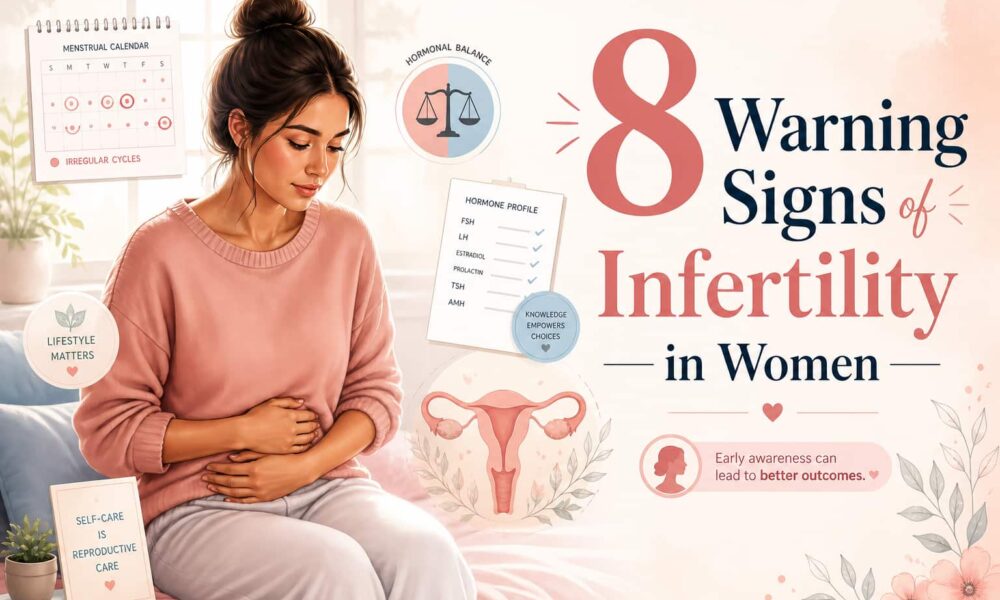
Your body speaks to you every day, but these signals are often overlooked. When it comes to fertility, ignoring them can mean losing valuable time. Many women spend months even years trying to conceive, not realising their body has been showing warning signs all along. Recognising these early can lead to quicker diagnosis and the right infertility treatment India.
Table Of Content
- What Are Signs of Infertility in Women?
- Why Do These Signs Get Ignored?
- Sign 1 – Irregular or Missing Periods
- Sign 2 – Very Painful Periods
- Sign 3 – Heavy or Very Light Bleeding
- Sign 4 – Hormonal Imbalance Symptoms
- Sign 5 – Pain During Sex
- Sign 6 – Milky Discharge From the Nipples
- Sign 7 – Repeated Miscarriages
- Sign 8 – No Pregnancy After 12 Months of Trying
- Other Subtle Signs You Should Not Ignore
- Signs of Infertility in Women – Quick Overview Table
- When Should You See a Fertility Doctor?
- How Are These Signs Diagnosed at Dr Curo?
- Treatment Options at Dr Curo
- Frequently Asked Questions
- Dr Curo Is With You Every Step
This blog highlights the 8 most important signs of infertility in women, explained in simple, honest language so you can understand what to look for, what these signs may indicate, and when it’s time to consult a specialist.
What Are Signs of Infertility in Women?
Signs of infertility in women are physical signals that something in the reproductive system may not be working as it should. These signs do not always mean you cannot have children. But they do mean your body is telling you something worth paying attention to.
Infertility does not always look dramatic. It rarely announces itself with a clear, obvious problem. More often, it shows up quietly as a period that comes too late, pain that feels a little too strong, or a cycle that never quite feels normal.
The earlier these signs are recognised, the earlier a diagnosis can be made and the more treatment options are available to you.
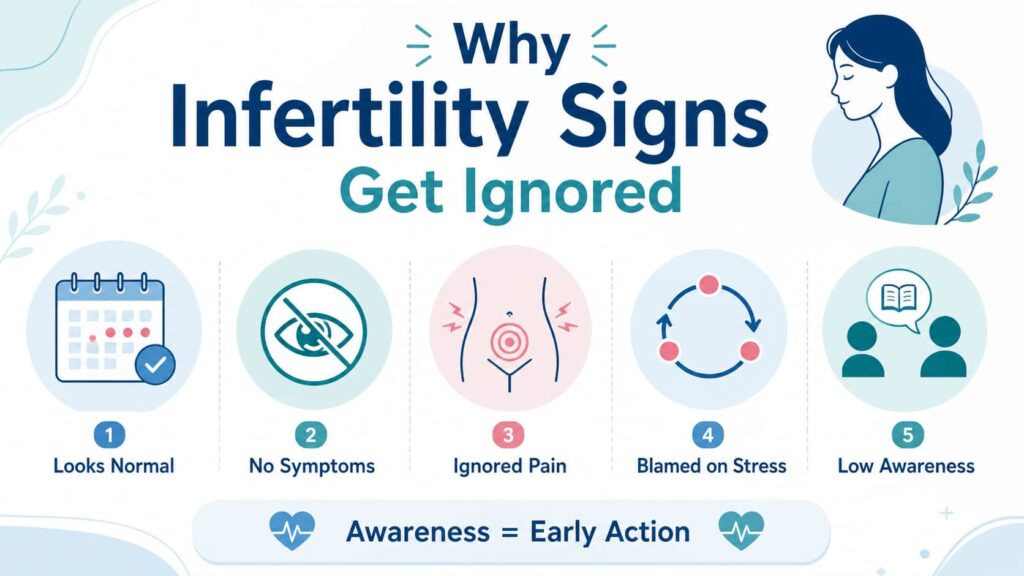
Why Do These Signs Get Ignored?
Most women who have signs of infertility do not realise they have a fertility problem at all. Here is why:
- Many signs look like normal period problems things women are told to just “put up with”
- Some signs have no physical symptoms at all blocked tubes, for example, are completely silent
- Painful periods are often dismissed as normal when they may actually indicate endometriosis
- Irregular cycles are often blamed on stress when PCOS may be the real reason
- Society rarely talks openly about fertility health until a woman is already trying to conceive
At Dr Curo, we believe awareness is the first step. Knowing the signs of infertility in women gives you the power to act early before time becomes a factor.
Sign 1 – Irregular or Missing Periods
This is one of the most common and most overlooked signs of infertility in women.
A normal menstrual cycle is between 21 and 35 days. It should arrive at roughly the same time each month. If your period comes very early, very late, or not at all that is your body telling you that ovulation is not happening regularly.
And without regular ovulation, natural pregnancy becomes very difficult.
What irregular periods can mean:
| Pattern | What It May Indicate |
| Periods more than 35 days apart | PCOS or hormonal imbalance |
| Periods fewer than 21 days apart | Low ovarian reserve or hormonal issue |
| No period for 3 or more months | PCOS, thyroid disorder, or premature ovarian insufficiency |
| Periods that come at completely random times | Ovulation is unpredictable or absent |
What you should do:
If your periods are consistently irregular not just occasionally it is worth speaking to a fertility specialist. At Dr Curo, a simple hormone blood test and ultrasound can usually identify the cause within one consultation.
Sign 2 – Very Painful Periods
Some discomfort during periods is normal. But pain that stops you from going to work, pain that does not respond to normal painkillers, or pain that gets worse every month that is not normal. And it is one of the most important signs of infertility in women to recognise.
The condition most commonly linked to very painful periods is endometriosis a condition where tissue similar to the uterine lining grows outside the uterus. This tissue bleeds every month with no way to exit the body, causing inflammation, scarring, and severe pain.
Endometriosis affects fertility by:
- Damaging or blocking the fallopian tubes
- Reducing egg quality
- Creating an environment in the uterus that makes implantation harder
- Causing scar tissue around the reproductive organs
Signs that your period pain may indicate endometriosis:
- Cramping that starts days before your period and continues throughout
- Pain that radiates to your lower back or legs
- Pain during or after sex
- Bloating, nausea, or bowel problems during your period
- Pain that gets worse every year not better
Endometriosis is one of the most underdiagnosed conditions in women. Many women suffer for 7 to 10 years before receiving a correct diagnosis. At Dr Curo, endometriosis is diagnosed through laparoscopy and treated with targeted hormonal therapy or surgery.
Sign 3 – Heavy or Very Light Bleeding
The amount you bleed during your period is a direct reflection of what is happening inside your uterus and with your hormones.
Heavy bleeding – soaking through a pad or tampon every hour for several hours can be a sign of uterine fibroids, polyps, or adenomyosis. These conditions can make it harder for a fertilised egg to implant and grow.
Very light bleeding – just spotting or barely a period can indicate a thin uterine lining, low oestrogen levels, or the early stages of premature ovarian insufficiency.
Both extremes are signs of infertility in women that deserve medical attention.
| Bleeding Pattern | Possible Cause | How It Affects Fertility |
| Extremely heavy bleeding | Fibroids, polyps, adenomyosis | Can block implantation or cause miscarriage |
| Very light or absent flow | Thin uterine lining, low oestrogen | Makes implantation difficult |
| Bleeding between periods | Polyps, hormonal imbalance | Disrupts the uterine environment |
| Very short periods (1–2 days) | Low ovarian reserve or hormonal issue | May indicate declining egg supply |
If your bleeding pattern has changed, become much heavier, or is consistently very light — do not ignore it. These are genuine signs of infertility in women that can be diagnosed and treated at Dr Curo.
Sign 4 – Hormonal Imbalance Symptoms
Your hormones control every single part of your reproductive system. When they are out of balance, your body will usually show it even if you do not immediately connect the symptoms to fertility.
Common hormonal imbalance symptoms that are signs of infertility in women:
- Sudden or unexplained weight gain especially around the belly
- Acne in adulthood, particularly on the jaw and chin
- Excess facial or body hair on the chin, upper lip, chest, or stomach
- Thinning hair on the scalp
- Skin darkening in the neck, armpits, or groin
- Fatigue that does not improve with rest
- Mood swings that feel out of proportion
- Feeling cold all the time or unexplained weight gain signs of an underactive thyroid
Many of these symptoms point to PCOS Polycystic Ovary Syndrome which is the single most common cause of infertility in women. PCOS causes the ovaries to produce excess male hormones and disrupts the entire ovulation process.
Other hormonal conditions that show similar symptoms include thyroid disorders and high prolactin levels both of which suppress ovulation and make natural conception very difficult.
The encouraging news is that hormonal causes of infertility are among the most straightforward to treat. At Dr Curo, a simple blood panel can identify exactly which hormones are out of balance and targeted medication can correct most of them effectively.
Sign 5 – Pain During Sex
Pain during or after sex medically called dyspareunia is not something you should simply accept. It is one of the signs of infertility in women that is most commonly dismissed or felt too embarrassed to mention.
Pain during sex can be caused by several conditions that also affect fertility:
| Cause | How It Affects Fertility |
| Endometriosis | Scar tissue and inflammation affect egg quality and tube health |
| Uterine fibroids | Can block implantation depending on their location |
| Ovarian cysts | Large cysts can affect ovulation |
| Pelvic inflammatory disease (PID) | Causes tube damage and scarring |
| Vaginismus | Can prevent natural conception from occurring |
If sex is consistently painful especially with deep penetration please do not stay silent about it. It is a medical symptom, not something to push through. At Dr Curo, our team handles these conversations with complete sensitivity and respect. What you describe helps us get to the right diagnosis faster.
Sign 6 – Milky Discharge From the Nipples
Noticing a milky white discharge from your nipples when you are not pregnant or breastfeeding is called galactorrhoea and it is one of the less obvious but important signs of infertility in women.
This happens when the body produces too much prolactin the hormone responsible for breast milk production. Outside of pregnancy and breastfeeding, elevated prolactin suppresses ovulation. Without ovulation, natural conception is not possible.
High prolactin can be caused by:
- A small benign tumour on the pituitary gland called a prolactinoma
- Thyroid disorders
- Certain medications including antidepressants and antipsychotics
- Prolonged stress
The good news is that high prolactin is one of the most treatable hormonal causes of infertility. At Dr Curo, a simple blood test measures prolactin levels and medication can bring them back to normal often restoring ovulation within a few months.
If you notice nipple discharge that is not related to breastfeeding, mention it to your doctor immediately. It is easy to investigate and easy to treat.
Sign 7 – Repeated Miscarriages
Losing a pregnancy is one of the most painful experiences a woman can go through. One miscarriage, while devastating, is relatively common affecting roughly 1 in 5 confirmed pregnancies.
But two or more miscarriages is called recurrent pregnancy loss and it is a serious sign of infertility in women that needs proper investigation.
Repeated miscarriages tell us that while fertilisation is happening, something is preventing the pregnancy from continuing. This could be related to:
- Chromosomal abnormalities in the embryo often linked to egg quality or age
- Uterine problems a septum, fibroids, or scar tissue preventing normal implantation
- Hormonal imbalances particularly low progesterone or thyroid problems
- Antiphospholipid syndrome an immune condition that causes blood clotting in placental vessels
- Genetic factors in either partner
What you should know:
| Number of Miscarriages | What It Suggests | What to Do |
| 1 miscarriage | Common may be chromosomal chance | Monitor and try again naturally |
| 2 miscarriages | Warrants investigation | See a fertility specialist |
| 3 or more miscarriages | Recurrent pregnancy loss needs full workup | Comprehensive testing at Dr Curo |
At Dr Curo, recurrent miscarriage is investigated thoroughly with blood tests, uterine imaging, genetic testing, and immune screening. In most cases, a treatable cause is found. With the right support, many women who have experienced repeated miscarriages go on to have successful pregnancies.
Sign 8 – No Pregnancy After 12 Months of Trying
This is the most direct of all the signs of infertility in women and the one that finally brings most women to a fertility clinic.
If you have been trying to conceive naturally with regular unprotected sex for 12 months or more without success, that is the clinical definition of infertility. It means something is likely preventing conception from happening and it is time to find out what.
For women over 35, this window shortens to 6 months.
For women over 40, do not wait at all see a specialist right away.
The important thing to understand is that 12 months of trying without success does not mean you cannot have children. It means your body needs some help and help is available. At Dr Curo, most couples who come to us after 12 months of trying go on to achieve pregnancy with the right diagnosis and treatment.
Other Subtle Signs You Should Not Ignore
Beyond the 8 main signs, there are a few other subtle signals worth paying attention to:
- No change in cervical mucus around ovulation – healthy ovulation is usually accompanied by clear, stretchy discharge mid-cycle. If you never notice this, ovulation may not be occurring regularly
- Consistently low basal body temperature – a temperature rise mid-cycle confirms ovulation has happened. If your temperature chart shows no rise, ovulation may be absent
- Pelvic or lower abdominal pain outside of periods – this can indicate ovarian cysts, endometriosis, or pelvic adhesions
- A history of STIs or pelvic infections – even infections treated years ago can leave scar tissue on the fallopian tubes
- A previous ectopic pregnancy – this increases the risk of tube damage and future ectopic pregnancies
Signs of Infertility in Women – Quick Overview Table
| Sign | What It May Indicate | Action Needed |
| Irregular or missing periods | PCOS, thyroid disorder, hormonal imbalance | See a specialist |
| Very painful periods | Endometriosis, fibroids | See a specialist |
| Heavy or very light bleeding | Fibroids, polyps, low oestrogen | See a specialist |
| Hormonal imbalance symptoms | PCOS, thyroid disorder, high prolactin | Blood test and ultrasound |
| Pain during sex | Endometriosis, PID, ovarian cysts | See a specialist |
| Milky nipple discharge | High prolactin levels | Blood test immediately |
| Repeated miscarriages | Uterine, immune, or chromosomal issues | Full fertility workup |
| No pregnancy after 12 months | Multiple possible causes | See a fertility specialist now |
When Should You See a Fertility Doctor?
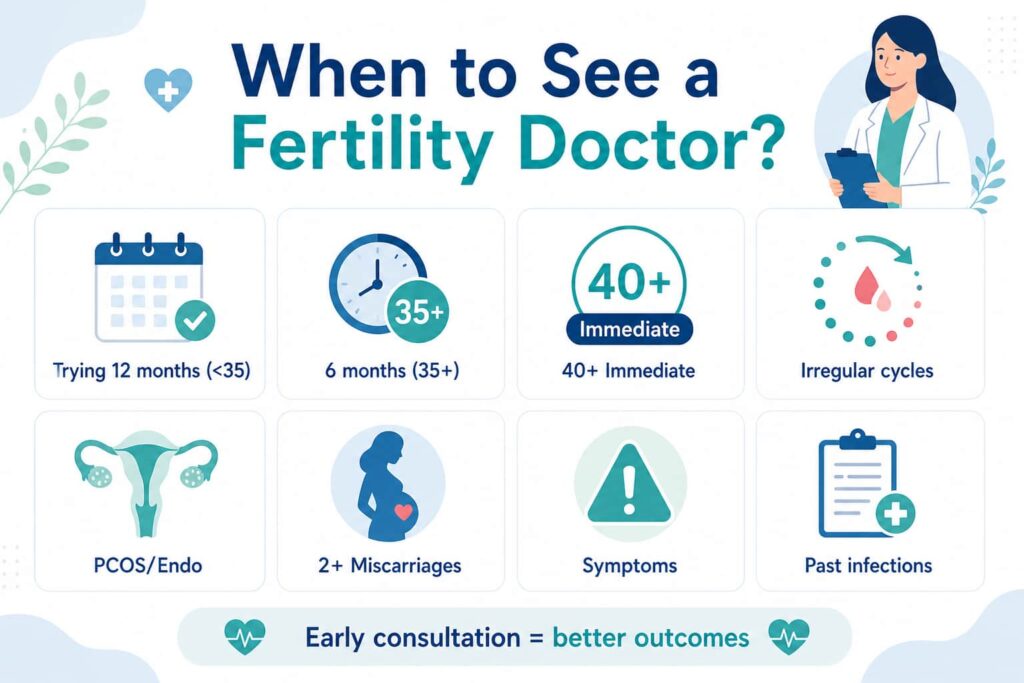
At Dr Curo, we recommend booking a fertility consultation if:
- You are under 35 and have been trying to conceive for 12 months without success
- You are 35 or older and have been trying for 6 months without success
- You are over 40 see a specialist immediately, do not wait
- You have irregular, very painful, or absent periods
- You have been diagnosed with PCOS, endometriosis, or fibroids
- You have had two or more miscarriages
- You have noticed any of the signs listed in this blog
- You have a history of pelvic infections or an ectopic pregnancy
There is never a wrong time to ask questions. Coming in early does not mean something is definitely wrong it means you are taking your fertility health seriously. And that is always the right decision.
How Are These Signs Diagnosed at Dr Curo?
When you come to Dr Curo with signs of infertility, your specialist will build a complete picture using a structured set of investigations:
Hormone blood tests check FSH, LH, AMH, oestrogen, progesterone, prolactin, thyroid hormones, and androgen levels. These are done on specific days of your cycle for accuracy.
Pelvic ultrasound gives a clear view of your uterus and ovaries. It can detect PCOS, fibroids, polyps, cysts, and provides an antral follicle count a direct measure of your egg reserve.
HSG test is a simple X-ray procedure where dye is passed through the uterus and tubes to check for blockages. It takes around 20 to 30 minutes as an outpatient procedure.
Hysteroscopy uses a small camera passed through the cervix to look directly inside the uterus. It detects polyps, fibroids, scar tissue, and uterine abnormalities.
Laparoscopy is a minor surgical procedure that allows direct visual assessment of the fallopian tubes and pelvic organs. It is the only reliable way to diagnose endometriosis.
Your Dr Curo specialist will only recommend the tests that are relevant to your specific signs and history nothing unnecessary, nothing missed.
Treatment Options at Dr Curo
Once the cause behind your signs of infertility is identified, treatment begins. At Dr Curo, every treatment plan is personalised built specifically around your diagnosis, your age, and your goals.
| Cause Identified | Treatment Options at Dr Curo |
| PCOS | Lifestyle changes, ovulation induction, IUI, IVF |
| Endometriosis | Hormonal therapy, laparoscopic surgery, IVF |
| Blocked tubes | Laparoscopic surgery (mild cases), IVF |
| Uterine fibroids or polyps | Hysteroscopic surgery, then IUI or IVF |
| Hormonal imbalance | Targeted hormone medication |
| High prolactin | Medication to normalise prolactin levels |
| Low ovarian reserve | IVF with own eggs or donor egg IVF |
| Recurrent miscarriage | Blood thinners, progesterone support, IVF with genetic testing |
The goal is always to use the simplest, most effective treatment first. Many women with treatable causes go on to conceive naturally or with IUI. More complex cases move forward to IVF with strong success rates at Dr Curo.
Frequently Asked Questions
Q1. What are the most common signs of infertility in women? The most common signs are irregular or absent periods, very painful periods, hormonal imbalance symptoms like acne and excess hair, and no pregnancy after 12 months of trying. PCOS is the single most common underlying cause and is linked to many of these signs.
Q2. Can I have signs of infertility and still get pregnant naturally? Yes. Having one or more signs does not mean you cannot conceive naturally. It means there may be an underlying condition worth investigating. Many women with PCOS, mild endometriosis, or hormonal imbalances do go on to conceive especially with the right medical support.
Q3. Are painful periods always a sign of infertility? Not always. Some period pain is normal. But pain that is severe, gets worse every year, or does not respond to normal painkillers may indicate endometriosis — which can affect fertility if left untreated. It is always worth getting it checked.
Dr Curo Is With You Every Step
Recognising the signs of infertility in women is not about worry it is about awareness. It is about giving yourself the knowledge to act at the right time, with the right support.
Every sign your body shows you is information. And information, in fertility care, is power.
At Dr Curo, we understand that this journey is not just medical it is deeply personal. The uncertainty, the waiting, the hope, and the fear we see all of it, and we take all of it seriously. Our team of fertility specialists, diagnostic experts, and counsellors are here not just to treat a condition but to support you as a whole person, every step of the way.
Book your consultation with Dr Curo today and take the first step toward clarity, confidence, and the family you are hoping for.






No Comment! Be the first one.