








Physiotherapy for Knee Pain: Best Exercises, Benefits & Joint Pain Treatment Guide
Introduction: Why Knee Pain Demands More Than Just Rest Knee pain is not just a minor inconvenience it is one of the most debilitating musculoskeletal conditions affecting millions of people...

Introduction: Why Knee Pain Demands More Than Just Rest
Knee pain is not just a minor inconvenience it is one of the most debilitating musculoskeletal conditions affecting millions of people around the world, from young athletes to senior citizens. Whether you are struggling to climb stairs in the morning, wincing during a simple walk in the park, or lying awake at night because of persistent discomfort, knee pain can rob you of the life you deserve. The frustrating reality is that many people treat knee pain as something they simply have to endure, reaching for painkillers that offer temporary relief without ever addressing the actual problem. This is where physiotherapy for knee pain becomes not just an option, but a transformational solution.
Table Of Content
- Introduction: Why Knee Pain Demands More Than Just Rest
- Understanding Knee Pain: What’s Really Happening in Your Joint
- What Is Physiotherapy for Knee Pain?
- The Real Benefits of Physiotherapy for Knee Pain
- 1. Reduces Pain Naturally Without Medication
- 2. Restores Joint Mobility and Flexibility
- 3. Builds Protective Muscle Strength
- 4. Corrects Faulty Movement Patterns
- 5. Delays or Prevents the Need for Surgery
- 6. Accelerates Post-Surgical Recovery
- 7. Improves Balance, Coordination, and Fall Prevention
- 8. Enhances Mental Health and Quality of Life
- Key Physiotherapy Techniques Used in Joint Pain Treatment
- The Best Physiotherapy Exercises for Knee Pain
- 1. Straight Leg Raises
- 2. Quad Sets (Isometric Quadriceps Activation)
- 3. Standing Hamstring Curls
- 4. Seated Hamstring Stretch
- 5. Wall Squats (Supported Squats)
- 6. Step-Ups
- 7. Calf Raises
- 8. Clamshells (Hip Abductor Strengthening)
- Exercise Summary Table
- Conditions That Respond Best to Physiotherapy
- Home Management Tips to Support Your Physiotherapy Programme
- Physiotherapy vs Medication: A Comparison for Knee Pain
- When Should You Seek Physiotherapy for Knee Pain?
- Conclusion: Reclaim Your Movement with Physiotherapy for Knee Pain
Physiotherapy is a clinically proven, non-invasive approach to joint pain treatment that targets the root cause of discomfort rather than masking the symptoms. It combines targeted exercise, manual therapy, movement re-education, and lifestyle guidance to restore your knee’s function from the inside out. This comprehensive guide will walk you through everything you need to know what causes knee pain, how physiotherapy works, which exercises deliver the best results, and how to build a recovery routine that actually lasts.
Understanding Knee Pain: What’s Really Happening in Your Joint
Before diving into treatment, it helps to understand why the knee is so prone to pain in the first place. The knee is the largest joint in the human body and one of the most mechanically complex. It must bear the full weight of your body during every step, squat, jump, and turn. It is held together by a combination of bones (femur, tibia, fibula, and patella), cartilage (meniscus), four major ligaments, and a network of muscles and tendons all of which must work in perfect coordination.
When any one of these structures is weakened, overloaded, or injured, the knee begins to compensate in unhealthy ways. Weak quadriceps force the kneecap to track incorrectly. Tight hamstrings pull the joint out of alignment. Inflamed bursae press against nerves. The result is a cascade of pain, swelling, stiffness, and dysfunction that worsens over time if left untreated.
Common causes of knee pain include:
- Osteoarthritis — gradual breakdown of cartilage causing bone-on-bone friction
- Rheumatoid arthritis — autoimmune inflammation targeting the joint lining
- Meniscus tears — damage to the shock-absorbing cartilage pads
- ACL or PCL ligament injuries — common in sports and high-impact activities
- Patellar tendonitis — inflammation of the tendon connecting the kneecap to the shinbone
- Bursitis — swelling of the fluid-filled sacs that cushion the knee
- Runner’s knee (chondromalacia patellae) — softening of the cartilage under the kneecap
- IT band syndrome — tightness in the iliotibial band causing outer knee pain
- Obesity and postural imbalances — excess weight or poor alignment increasing joint stress
- Post-surgical stiffness — reduced mobility after knee replacement or repair
Each of these conditions responds well to physiotherapy, though the specific exercises and techniques used will vary depending on the diagnosis.
What Is Physiotherapy for Knee Pain?
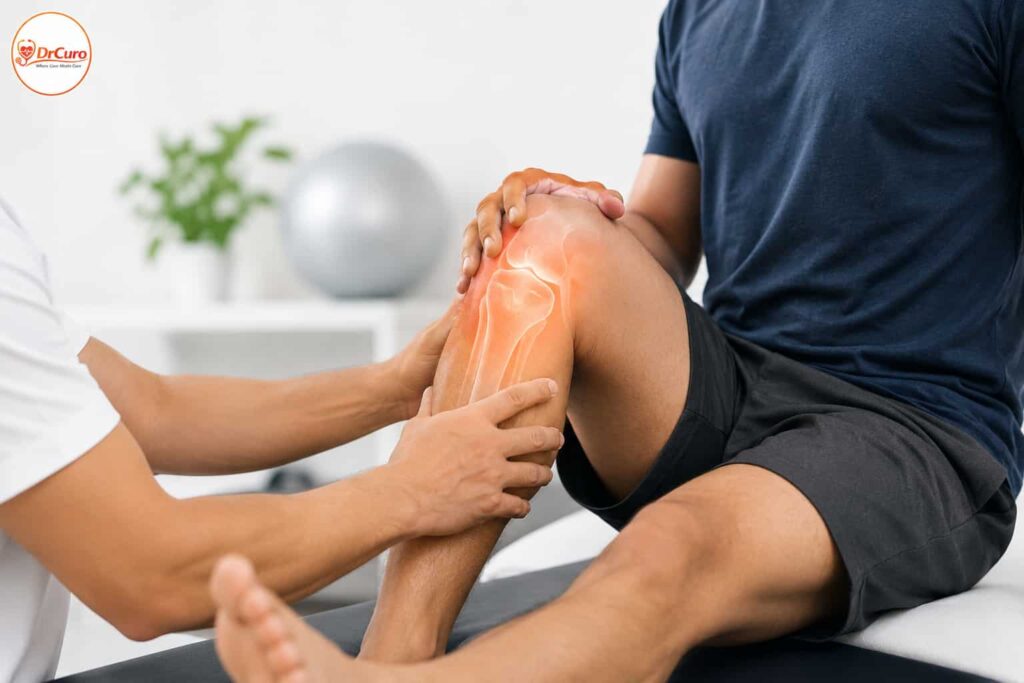
Physiotherapy for knee pain is a structured, evidence-based treatment programme delivered by a trained physiotherapist to improve strength, flexibility, mobility, balance, and overall joint function. Unlike surgery or medication, physiotherapy works by retraining the muscles and movement patterns that surround and support the knee making the joint more stable, less painful, and more resilient over time.
A qualified physiotherapist begins with a thorough assessment that examines your posture, gait, range of motion, muscle strength, and pain levels. From this evaluation, they design a personalised joint pain treatment plan that evolves as your condition improves. If you are looking for a trusted platform to connect with experienced physiotherapists from the comfort of your home, DrCuro offers online consultations and personalised rehabilitation guidance making professional knee care accessible wherever you are. Sessions may be conducted in a clinic, a rehabilitation gym, or virtually through platforms like DrCuro, making physiotherapy more flexible and convenient than ever before.
What a physiotherapy plan typically includes:
- A detailed assessment of pain triggers and movement limitations
- A progressive exercise programme targeting strength and flexibility
- Manual therapy techniques such as joint mobilisation and soft tissue release
- Gait and posture correction training
- Advice on activity modification and injury prevention
- Education about self-management strategies for long-term joint health
- Monitoring and progression of exercises to match your recovery
The Real Benefits of Physiotherapy for Knee Pain
Many people underestimate what physiotherapy can achieve. They assume it means a few basic stretches and some heat packs. In reality, a well-designed physiotherapy programme delivers profound and lasting improvements across multiple dimensions of health. Here is what consistent physiotherapy can do for your knees:
1. Reduces Pain Naturally Without Medication
Targeted exercises reduce mechanical stress on the knee, calm inflammatory pathways, and release natural pain-relieving endorphins. Many patients report significant pain reduction within two to four weeks of starting a structured programme.
2. Restores Joint Mobility and Flexibility
Stiffness is one of the most frustrating aspects of knee pain. Physiotherapy uses stretching, mobilisation techniques, and range-of-motion exercises to gradually loosen tight structures and restore normal movement.
3. Builds Protective Muscle Strength
The muscles around the knee — particularly the quadriceps, hamstrings, glutes, and calves — act as natural shock absorbers. Strengthening them reduces the burden placed on cartilage, ligaments, and the joint capsule itself.
4. Corrects Faulty Movement Patterns
Poor movement habits such as knee valgus (knees caving inward), flat-footed walking, or excessive trunk lean place uneven stress on the knee. Physiotherapy identifies and corrects these patterns to prevent recurring injuries.
5. Delays or Prevents the Need for Surgery
Research consistently shows that many patients who commit to physiotherapy are able to avoid or significantly delay surgical intervention, even for serious conditions like advanced osteoarthritis or meniscus tears.
6. Accelerates Post-Surgical Recovery
For those who do require surgery, physiotherapy is essential both before and after the procedure. Pre-operative strengthening and post-operative rehabilitation dramatically improve surgical outcomes and shorten recovery timelines.
7. Improves Balance, Coordination, and Fall Prevention
Balance training restores neuromuscular control your brain’s ability to coordinate stable movement which is especially important for older adults at risk of falls.
8. Enhances Mental Health and Quality of Life
Chronic pain takes a psychological toll. As physiotherapy reduces pain and restores function, patients consistently report improvements in mood, sleep quality, self-confidence, and overall wellbeing.
Key Physiotherapy Techniques Used in Joint Pain Treatment
Modern physiotherapy employs a wide variety of hands-on and exercise-based techniques. A well-rounded joint pain treatment plan may include several of the following approaches, tailored to the individual’s specific condition and goals.
| Technique | Description | Best For |
| Manual Joint Mobilisation | Physiotherapist moves the joint through specific ranges to reduce stiffness | Arthritis, post-surgery stiffness |
| Soft Tissue Massage | Targeted pressure on muscles and connective tissue to release tension | Muscle tightness, tendon pain |
| Dry Needling / Acupuncture | Fine needles inserted into trigger points to relieve muscle pain | Chronic muscle tension, nerve pain |
| Therapeutic Taping (Kinesio) | Elastic tape applied to support alignment and reduce swelling | Patellar tracking issues, swelling |
| Ultrasound Therapy | Sound waves used to promote deep tissue healing | Tendonitis, ligament injuries |
| TENS (Electrical Stimulation) | Low-level electrical currents to reduce pain and activate muscles | Chronic pain, muscle weakness |
| Heat Therapy | Warmth applied to relax muscles and improve blood flow | Muscle stiffness, pre-exercise warm-up |
| Cold Therapy (Cryotherapy) | Ice packs used to reduce acute swelling and inflammation | Post-exercise swelling, acute injuries |
| Hydrotherapy | Therapeutic exercise performed in warm water | Severe arthritis, limited weight-bearing |
| Gait Retraining | Analysis and correction of walking or running patterns | Overuse injuries, biomechanical faults |
The Best Physiotherapy Exercises for Knee Pain
Exercise is the foundation of every successful physiotherapy for knee pain programme. The following exercises are widely used by physiotherapists and rehabilitation specialists. Always consult a physiotherapist before beginning if your pain is severe or if you have recently had surgery or injury.
1. Straight Leg Raises
Straight leg raises are one of the safest and most effective ways to strengthen the quadriceps without bending the knee under load. They are ideal for early-stage rehabilitation and post-surgical recovery.
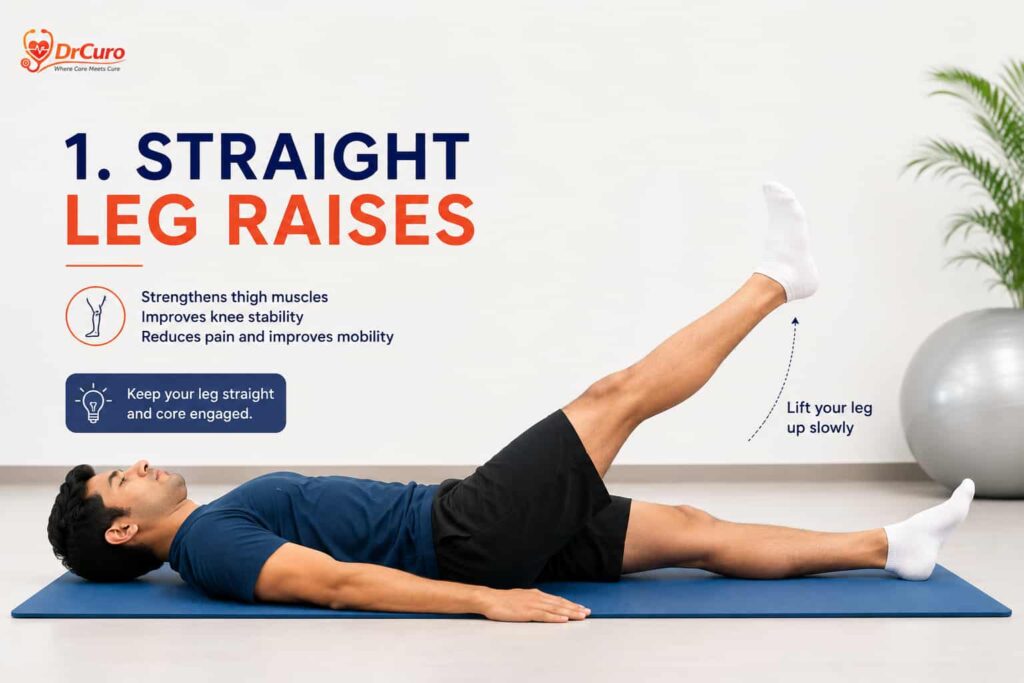
How to perform:
- Lie flat on your back on a firm surface
- Bend one knee with your foot flat on the floor
- Keep the other leg straight and tighten the thigh muscle
- Slowly raise the straight leg to the height of the bent knee
- Hold for 3–5 seconds at the top, then lower slowly
- Repeat 10–15 repetitions per side for 2–3 sets daily
Why it works: This exercise directly targets the vastus medialis (inner quadriceps), which is critical for patella tracking and overall knee stability all without placing any compressive force on the joint.
2. Quad Sets (Isometric Quadriceps Activation)
This simple but powerful exercise reactivates the quadriceps in people who have lost muscle tone due to pain or surgery a phenomenon known as arthrogenic muscle inhibition.
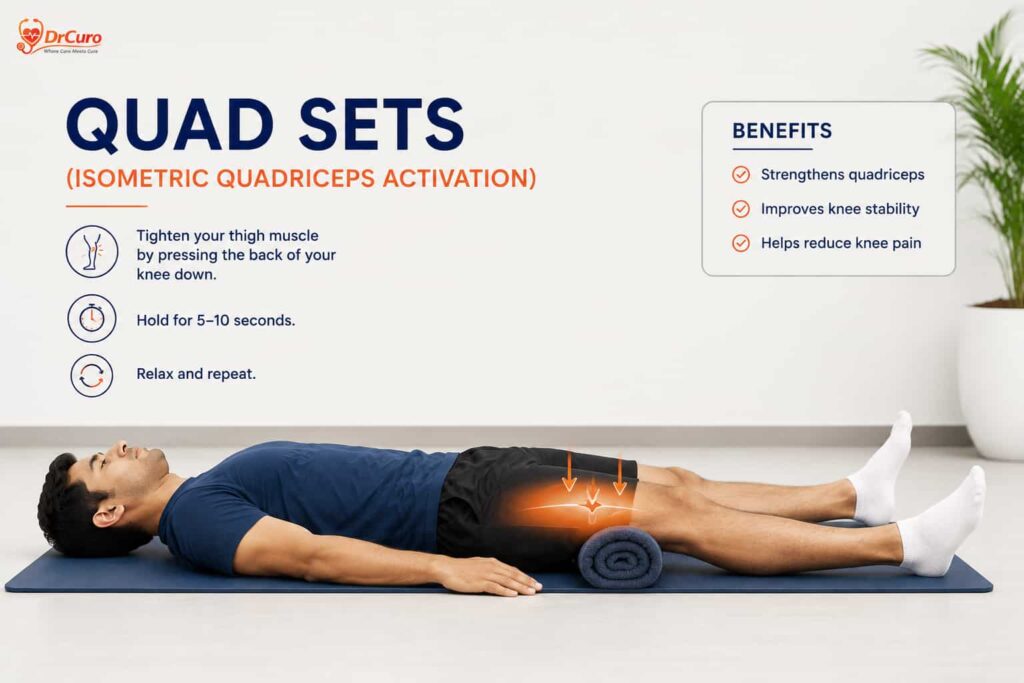
How to perform:
- Sit on the floor or a firm bed with legs fully extended
- Place a small rolled towel under the knee of the leg you are working on
- Tighten the thigh muscle by pressing the back of your knee down into the towel
- Hold the contraction for 5–10 seconds, then relax fully
- Repeat 10–15 times per set, 2–3 sets throughout the day
Why it works: By teaching the quadriceps to “switch on” again, quad sets rebuild the neural connection between the brain and the muscle, which is often disrupted by pain or disuse.
3. Standing Hamstring Curls
Strong and flexible hamstrings take pressure off the front of the knee and help balance the forces acting on the joint.
How to perform:
- Stand upright, holding onto a chair or wall for balance
- Bend one knee, curling your heel up toward your buttock
- Hold for 2–3 seconds at the top
- Lower slowly with control and repeat 10–12 times per side
- Complete 2–3 sets
Why it works: This movement strengthens the posterior chain, reducing anterior knee stress and supporting proper leg alignment during walking and running.
4. Seated Hamstring Stretch
Tight hamstrings are a major contributor to knee pain because they pull on the back of the knee and tilt the pelvis, distorting the mechanics of the entire lower limb.
How to perform:
- Sit on the floor with one leg fully extended and the other bent
- Sit tall and hinge forward from the hips toward the extended foot
- Reach your hands toward your toes until you feel a gentle pull behind the thigh
- Hold the stretch for 25–30 seconds and repeat 3 times on each leg
- Perform once or twice daily
Why it works: Regular hamstring stretching improves posterior chain flexibility, reduces strain behind the knee, and restores proper pelvic alignment all of which contribute to reduced knee pain over time.
5. Wall Squats (Supported Squats)
Wall squats are a highly effective functional exercise that builds quadriceps and glute strength while limiting joint stress through controlled range of motion.
How to perform:
- Stand with your back flat against a smooth wall, feet shoulder-width apart
- Slowly slide your back down the wall until your thighs are at roughly 45–90 degrees
- Keep your knees directly over your toes and your weight through your heels
- Hold the position for 10–30 seconds, breathing steadily
- Slide back up, rest for 10 seconds, and repeat 5–8 times
Why it works: This exercise distributes load across the entire lower limb rather than isolating the knee, making it both safer and more functional than a traditional squat for people with joint pain.
6. Step-Ups
Step-ups replicate the mechanics of stair climbing a daily activity that is often painful for people with knee problems and progressively build the strength needed to perform it comfortably.
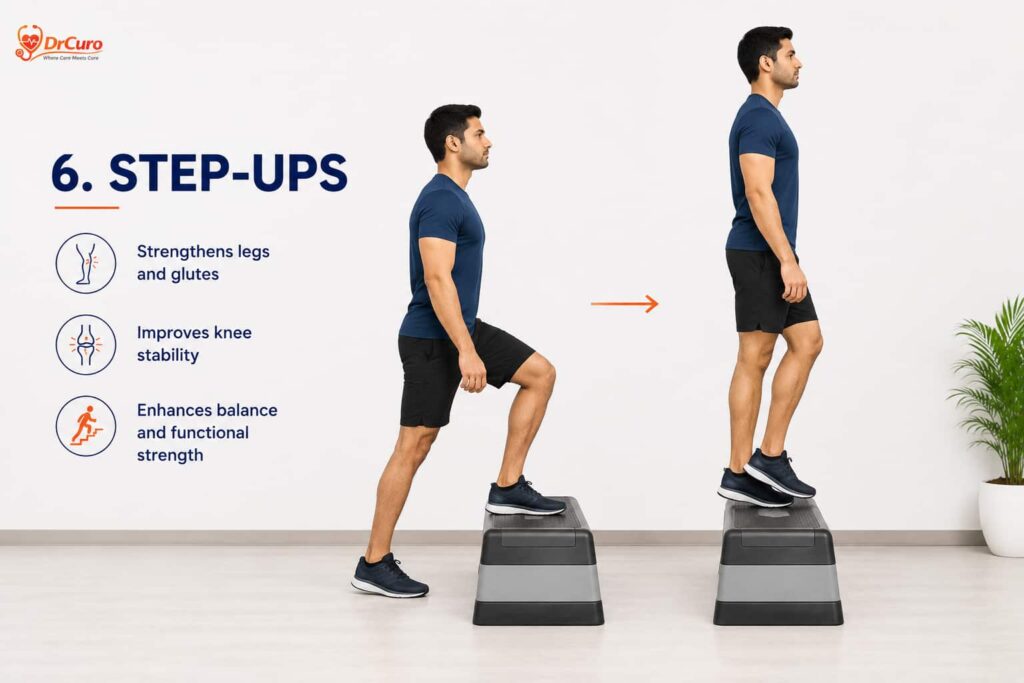
How to perform:
- Stand in front of a low step or sturdy platform (start with 10–15cm)
- Step up with your affected leg, driving through the heel
- Bring your other foot up to meet it
- Step back down in a controlled manner, leading with the unaffected leg
- Perform 8–12 repetitions on each leg for 2–3 sets
Why it works: Step-ups strengthen the quads, hamstrings, and glutes in a movement pattern that directly carries over to real-life functional activities like climbing stairs.
7. Calf Raises
The calf muscles play a crucial role in absorbing impact and propelling the body forward during walking. Weak calves shift excessive load to the knee.
How to perform:
- Stand upright with feet hip-width apart, holding a wall for balance if needed
- Rise slowly onto the balls of your feet, lifting both heels
- Hold at the top for 2–3 seconds
- Lower slowly back to the floor and repeat 12–15 times for 2–3 sets
Why it works: Strong calves improve push-off mechanics during gait, reduce knee torque, and help maintain proper ankle and knee alignment.
8. Clamshells (Hip Abductor Strengthening)
Weak hip abductors are one of the most overlooked causes of knee pain. When the outer hip muscles cannot control the femur, the knee collapses inward with every step, dramatically increasing joint stress.
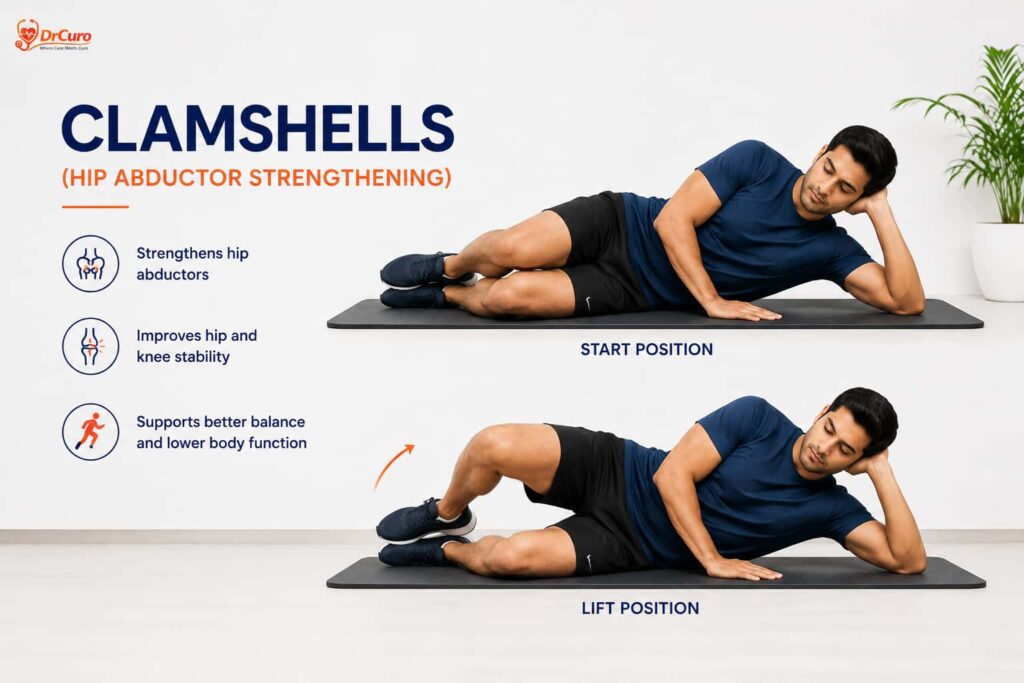
How to perform:
- Lie on your side with hips and knees bent to approximately 45 degrees
- Keep your feet together and your hips stacked vertically
- Slowly raise your top knee as far as you can without rotating your pelvis
- Hold for 2–3 seconds and lower with control
- Perform 12–15 repetitions on each side for 2–3 sets
Why it works: Strengthening the gluteus medius and tensor fasciae latae stabilises the pelvis and femur, correcting the inward knee collapse pattern that drives many overuse injuries.
Exercise Summary Table
| Exercise | Primary Muscles | Sets x Reps | Key Benefit |
| Straight Leg Raise | Quadriceps | 3 x 12–15 | Knee stability without joint compression |
| Quad Sets | Quadriceps (isometric) | 3 x 10–15 | Reactivates inhibited quad muscles |
| Standing Hamstring Curl | Hamstrings | 3 x 10–12 | Reduces anterior knee stress |
| Seated Hamstring Stretch | Hamstrings | 3 x 30 sec | Improves posterior chain flexibility |
| Wall Squat | Quads, Glutes | 3 x 10–30 sec | Functional strength with controlled load |
| Step-Up | Quads, Hamstrings, Glutes | 3 x 8–12 | Mimics stair-climbing mechanics |
| Calf Raise | Gastrocnemius, Soleus | 3 x 12–15 | Reduces knee torque during walking |
| Clamshell | Gluteus Medius, Hip Abductors | 3 x 12–15 | Corrects knee valgus and hip control |
Conditions That Respond Best to Physiotherapy
Physiotherapy for knee pain is not a one-size-fits-all treatment, but its versatility makes it effective across an enormous range of diagnoses.
| Knee Condition | How Physiotherapy Helps | Expected Timeline |
| Osteoarthritis | Reduces pain, preserves cartilage, improves mobility | 6–12 weeks for significant improvement |
| Meniscus Tear (partial) | Strengthens surrounding muscles to offload damaged tissue | 4–8 weeks depending on severity |
| ACL / PCL Injury | Restores full function, prepares for return to sport | 9–12 months for complete rehabilitation |
| Patellar Tendonitis | Reduces inflammation, corrects loading patterns | 6–12 weeks |
| Post Knee Replacement | Regains range of motion and independent mobility | 3–6 months |
| Runner’s Knee | Corrects biomechanical faults, strengthens hips and quads | 4–8 weeks |
| Bursitis | Reduces inflammation, addresses causative movements | 3–6 weeks |
| IT Band Syndrome | Stretches and strengthens lateral hip and thigh structures | 4–6 weeks |
Home Management Tips to Support Your Physiotherapy Programme
Recovery does not stop when you leave the physiotherapy clinic. What you do at home between sessions matters enormously. These evidence-based habits will accelerate your results and protect your knees in the long term.
- Maintain a healthy body weight — every kilogram of body weight adds approximately four kilograms of force to the knee during walking
- Wear supportive, well-fitted footwear — proper shoes reduce impact forces and promote healthy alignment
- Avoid prolonged sitting — get up and move for a few minutes every 30–45 minutes to prevent stiffness
- Apply ice after activity — 10–15 minutes of cold therapy after exercise reduces post-activity swelling
- Use heat before exercise — a warm compress before your session loosens stiff muscles and joints
- Sleep in a supported position — placing a pillow between your knees when side sleeping reduces rotational stress
- Stay consistent with your home exercise programme — skipping days slows progress significantly
- Avoid high-impact activities during acute flare-ups — switch to swimming or cycling if walking aggravates pain
- Track your pain levels — keep a simple diary to identify triggers and monitor progress over time
- Communicate with your physiotherapist — report any unexpected increases in pain or swelling immediately
Physiotherapy vs Medication: A Comparison for Knee Pain
| Factor | Physiotherapy for Knee Pain | Pain Medication |
| Addresses root cause | Yes — targets muscle weakness, poor alignment, joint mechanics | No — masks pain signals only |
| Long-term effectiveness | Lasting improvements with consistent practice | Temporary relief; returns when medication stops |
| Side effects | Minimal — muscle soreness during adaptation phase only | Significant — GI issues, dependency, cardiovascular risks |
| Improves physical function | Significantly improves strength, mobility, and balance | No functional improvement whatsoever |
| Reduces surgery risk | Can delay or eliminate need for surgery | No impact on surgical need |
| Cost over time | One-time investment with lasting benefits | Ongoing cost with no cumulative benefit |
| Independence | Builds patient self-management skills | Creates dependency on external treatment |
When Should You Seek Physiotherapy for Knee Pain?
Many people wait far too long before seeking professional help, hoping that rest and time will solve the problem. While minor muscle soreness after exercise often resolves within a few days, true knee pain especially pain that interferes with daily life needs professional attention sooner rather than later.
You should consult a physiotherapist if:
- Knee pain has persisted for more than two weeks without improvement
- You notice visible swelling, warmth, or redness around the joint
- Pain wakes you up at night or prevents restful sleep
- You find yourself limping, favouring one leg, or avoiding activities you enjoy
- Your knee feels unstable, “gives way”, or locks during movement
- You are recovering from a sports injury, fall, or accident
- You have recently had knee surgery and need structured rehabilitation
- Pain is affecting your work, exercise routine, or mental health
- You have been told you may need surgery and want to explore non-surgical options first
Platforms like DrCuro make it easier than ever to get an expert physiotherapy assessment without waiting weeks for an in-person appointment. A quick online consultation through DrCuro can give you clarity on your condition and a clear path forward so you are not left guessing or relying on generic advice. Early intervention consistently leads to faster recovery and better long-term outcomes.
Conclusion: Reclaim Your Movement with Physiotherapy for Knee Pain
Knee pain does not have to be a permanent sentence. With the right approach one grounded in evidence, personalised to your body, and consistent in its application physiotherapy can genuinely change your life. It is not a quick fix, but it is a real one. Every straight leg raise, every wall squat, every clamshell exercise builds a stronger, more stable, more resilient version of your knee, one session at a time.
Physiotherapy for knee pain gives you something that no painkiller ever can: the ability to move freely, confidently, and without fear. Whether your pain is caused by osteoarthritis, a sports injury, post-surgical stiffness, or simply years of wear and tear, a structured physiotherapy programme combined with smart joint pain treatment strategies at home can restore your mobility and dramatically improve your quality of life.
If knee pain is holding you back today, take the first step and book a consultation with a qualified physiotherapist. Whether you visit a clinic near you or connect online through DrCuro, expert guidance is closer than you think. Your knees have carried you this far it is time to give them the support they deserve.








No Comment! Be the first one.