







Frozen Embryo Transfer: Success Rate & Process — A Complete Guide by Dr Curo
What Is Frozen Embryo Transfer (FET)? Frozen Embryo Transfer, commonly called FET, is a procedure where previously frozen embryos (from an IVF cycle) are thawed and placed into a woman’s...
What Is Frozen Embryo Transfer (FET)?
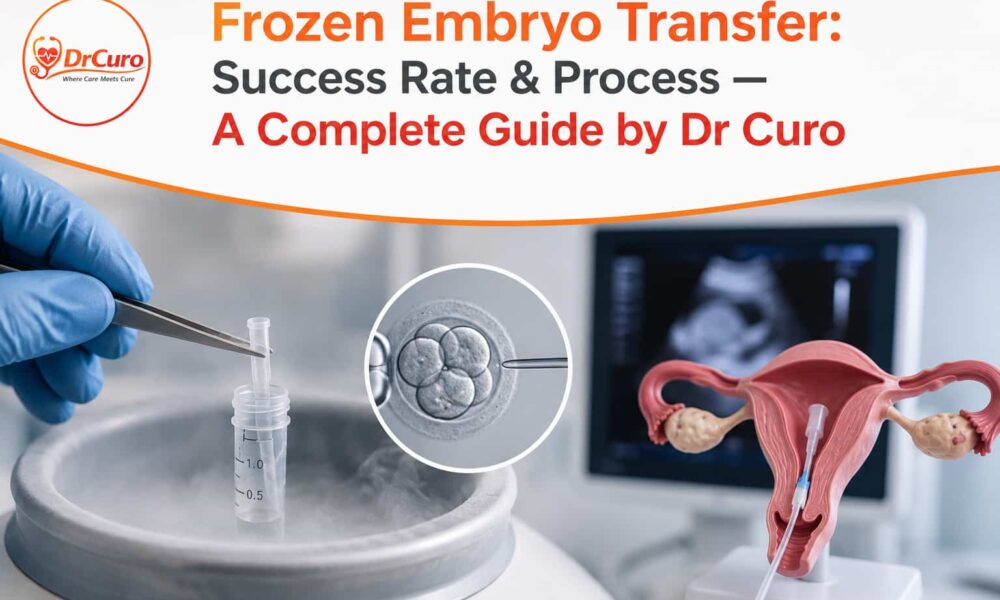
Frozen Embryo Transfer, commonly called FET, is a procedure where previously frozen embryos (from an IVF cycle) are thawed and placed into a woman’s uterus. This is done with the hope that the embryo will implant and lead to a successful pregnancy.
Table Of Content
- What Is Frozen Embryo Transfer (FET)?
- Why Is Frozen Embryo Transfer So Popular Today?
- How Does the Frozen Embryo Transfer Process Work?
- Step 1: Initial Consultation and Assessment
- Step 2: Preparing the Uterus (Endometrial Preparation)
- Step 3: Monitoring with Ultrasound and Blood Tests
- Step 4: Embryo Thawing
- Step 5: The Transfer Procedure
- Step 6: The Two-Week Wait (Luteal Phase Support)
- Frozen Embryo Transfer Success Rate — What Does the Data Say?
- General Success Rate Figures
- Key Factors That Affect Frozen Embryo Transfer Success Rate
- FET vs Fresh Embryo Transfer — Quick Comparison
- Who Is a Good Candidate for Frozen Embryo Transfer?
- Tips to Improve Your Frozen Embryo Transfer Success Rate
- What Happens After the Transfer? Recognizing Early Signs
- Why Choose Dr Curo for Frozen Embryo Transfer?
- Frequently Asked Questions (FAQs)
- Note :
Many couples and individuals undergoing IVF treatment in India often have extra embryos remaining after a successful cycle. Instead of discarding them, these embryos are carefully frozen and safely stored for future use. When the person is ready to try for pregnancy again, these frozen embryos are thawed and transferred back into the uterus a process known as Frozen Embryo Transfer (FET).
Dr Curo specializes in making this journey as smooth, informed, and successful as possible for every patient.
Why Is Frozen Embryo Transfer So Popular Today?
Over the last decade, FET has become one of the most preferred fertility treatments worldwide. Here’s why:
- Better success rates than fresh embryo transfers in many cases
- Less physical stress on the woman’s body no need for ovarian stimulation again
- Flexible timing — you can plan the transfer when your body is most ready
- Cost-effective — frozen embryos from one IVF cycle can be used multiple times
- Improved embryo survival rates thanks to advanced vitrification (flash-freezing) technology
How Does the Frozen Embryo Transfer Process Work?
Understanding the FET process step by step can help reduce anxiety and give you better control over your fertility journey.
Step 1: Initial Consultation and Assessment
Before anything else, your doctor will review your medical history, previous IVF cycle details, and overall health. At Dr Curo, every patient gets a personalized plan based on their unique situation not a one-size-fits-all approach.
Step 2: Preparing the Uterus (Endometrial Preparation)
This is one of the most important steps. The uterine lining (endometrium) needs to be thick and healthy to accept the embryo.
There are two main ways this is done:
- Natural cycle FET — Used for women who ovulate naturally. The transfer is timed with the natural ovulation cycle. No or very few medications are needed.
- Medicated cycle FET — Estrogen is given first to build the uterine lining. Then progesterone is added to prepare the lining for implantation. The doctor monitors the lining via ultrasound.
Step 3: Monitoring with Ultrasound and Blood Tests
Regular ultrasound scans and hormone blood tests are done to check:
- Uterine lining thickness (ideal is 8mm or more)
- Estrogen and progesterone levels
- Overall uterine health
This monitoring helps the doctor decide the perfect day for the transfer.
Step 4: Embryo Thawing
On the day of transfer, the frozen embryo is carefully thawed in the lab. Modern vitrification techniques have made embryo survival rates after thawing very high often above 90%.
The embryo is assessed by the embryologist to confirm it is healthy and suitable for transfer.
Step 5: The Transfer Procedure
The actual transfer is simple and usually painless:
- You will lie on an examination table
- A thin, soft catheter (tube) is passed through the cervix into the uterus
- The embryo is gently placed inside the uterus using the catheter
- The whole process takes about 10–20 minutes
- No anesthesia is usually needed
- You can go home the same day
Step 6: The Two-Week Wait (Luteal Phase Support)
After transfer, you will continue taking progesterone support (as prescribed). This helps maintain the uterine lining and supports early implantation.
This phase lasts about 10–14 days before a pregnancy test is done.
Frozen Embryo Transfer Success Rate — What Does the Data Say?
This is the question every patient asks and rightly so.
The frozen embryo transfer success rate depends on several factors, but overall, FET has shown impressive results globally and in India.
General Success Rate Figures:
| Age Group | FET Success Rate (Approximate) |
| Under 35 years | 50% – 65% |
| 35–37 years | 40% – 55% |
| 38–40 years | 30% – 45% |
| 41–42 years | 20% – 35% |
| Above 42 years | 10% – 20% |
Note: These are general estimates. Individual success rates can vary based on clinic, embryo quality, and patient health.
Key Factors That Affect Frozen Embryo Transfer Success Rate:
1. Age of the Woman Age is the single biggest factor. Younger women generally have better quality eggs and embryos, which leads to higher success rates.
2. Embryo Quality and Stage
- Blastocyst embryos (5-day embryos) have higher success rates than Day 3 embryos
- Embryos that are graded as top quality have better implantation chances
- PGT-A tested embryos (genetically tested) have even higher success rates
3. Uterine Lining Quality A thick, well-developed uterine lining (trilaminar pattern, 8mm+) significantly improves chances of successful implantation.
4. Number of Previous IVF Attempts First-time FET cycles generally have good success. Repeated failures may point to other underlying issues that need investigation.
5. Cause of Infertility
- Tubal factor infertility — good prognosis with FET
- PCOS — generally responds well
- Uterine abnormalities — may lower success rates
- Male factor infertility — success depends on sperm quality used during IVF
6. Frozen vs Fresh — Who Wins?
Studies in recent years show that frozen embryo transfers often perform as well as or better than fresh transfers in many patient groups. This is because:
- The uterus gets time to recover from ovarian stimulation
- Hormonal balance is more natural during a frozen cycle
- Embryo development can be better observed before freezing
FET vs Fresh Embryo Transfer — Quick Comparison
| Factor | Fresh Transfer | Frozen Embryo Transfer |
| Timing | Done right after egg retrieval | Done weeks or months later |
| Hormone stimulation | High stimulation | Low or no stimulation |
| Risk of OHSS | Higher | Very low |
| Success rate | Slightly lower in some cases | Equal or higher in many cases |
| Flexibility | Fixed timing | Flexible |
| Cost per cycle | Higher overall | Lower (embryos already stored) |
Who Is a Good Candidate for Frozen Embryo Transfer?
FET is a great option for:
- Couples who have leftover embryos from a previous IVF cycle
- Women who were at risk of ovarian hyperstimulation syndrome (OHSS)
- Women who need uterine treatment before transfer
- Patients who want to delay pregnancy for medical or personal reasons
- Single mothers or same-sex couples using donor eggs or sperm
- Patients who had a failed fresh transfer cycle
Tips to Improve Your Frozen Embryo Transfer Success Rate
At Dr Curo, we always guide our patients on lifestyle and medical steps to maximize their chances.
Before the Transfer:
- Maintain a healthy weight both underweight and overweight can affect implantation
- Eat a balanced, nutritious diet rich in folic acid, iron, and antioxidants
- Avoid smoking and alcohol completely
- Manage stress yoga, meditation, and light walks help
- Sleep well aim for 7–8 hours per night
- Take prescribed supplements like folic acid, Vitamin D, and CoQ10 if advised

During the Two-Week Wait:
- Avoid heavy exercise or strenuous activity
- Do not take over-the-counter medicines without asking your doctor
- Stay warm and comfortable
- Avoid hot baths, saunas, or steam rooms
- Do not skip progesterone medications
- Try to stay calm stress does not directly cause failure, but it affects overall wellbeing
What to Avoid:
- Caffeine in large amounts
- Raw or undercooked food
- Extreme dieting
- Self-medicating
- Searching obsessively for symptoms online it increases anxiety
What Happens After the Transfer? Recognizing Early Signs
About 10–14 days after transfer, a blood test (beta hCG test) is done to confirm pregnancy.
Some women notice early signs before the test:
- Light spotting (implantation bleeding)
- Mild cramping
- Breast tenderness
- Fatigue
- Nausea (less common this early)
Important: These signs can also be caused by progesterone medications. Do not take a home pregnancy test too early it can give a false positive or false negative. Always wait for the blood test advised by your doctor.
Why Choose Dr Curo for Frozen Embryo Transfer?
At Dr Curo, we understand that fertility treatment is not just medical it is deeply personal and emotional. Our approach is built on:
- Personalized care — Every patient’s protocol is designed individually
- Advanced lab technology — High-grade vitrification equipment for better embryo survival
- Experienced team — Fertility specialists, embryologists, and counselors working together
- Transparent communication — We explain every step clearly so you are never confused
- Emotional support — We are with you at every stage, not just in the clinic
- Affordable pricing — Quality fertility care that doesn’t break your budget
- High success rates — Our frozen embryo transfer success rate is consistently among the best
We believe every patient deserves honest guidance, the best possible technology, and compassionate care — and that is exactly what Dr Curo delivers.
Frequently Asked Questions (FAQs)
Q: Is frozen embryo transfer painful? A: The procedure itself is generally not painful. Some women feel mild cramping, similar to a period. It is usually done without anesthesia.
Q: How many frozen embryos should be transferred? A: In most cases, doctors recommend transferring one embryo at a time (single embryo transfer or SET) to reduce the risk of multiple pregnancies. Your doctor will advise based on your age and embryo quality.
Q: Can frozen embryos be stored for a long time? A: Yes. Embryos can be stored safely for many years using vitrification. Studies have shown healthy pregnancies from embryos stored for over 10 years.
Q: What if the frozen embryo transfer fails? A: A failed cycle is emotionally hard, but it does not mean future cycles will also fail. Your doctor will review what happened, make adjustments, and plan the next steps. Many patients succeed after 2–3 attempts.
Q: Is FET safe for the baby? A: Yes. Research consistently shows that babies born through FET are as healthy as naturally conceived babies, with no significant increase in birth defects.
Note :
Frozen Embryo Transfer is a powerful option that gives hope to thousands of families every year. The frozen embryo transfer success rate has improved dramatically with modern technology, and with the right medical team by your side, your chances of a successful pregnancy are real and encouraging.
At Dr Curo, we are committed to walking this journey with you with expertise, honesty, and heart. If you are considering FET or have questions about your fertility options, reach out to us today. Your dream of parenthood is our mission.
Disclaimer: The information provided in this blog is for educational purposes only. Please consult a qualified fertility specialist for medical advice specific to your condition.






No Comment! Be the first one.