








Gallstones: Symptoms, Treatment and Dietary Tips
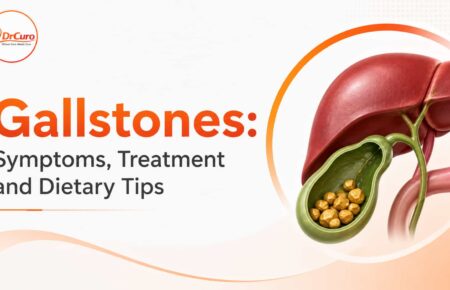
Gallstones are small, hard lumps that form inside the gallbladder, a tiny organ tucked under the liver. Some are as tiny as a grain of sand, while others can grow as big as a golf ball. Many people...
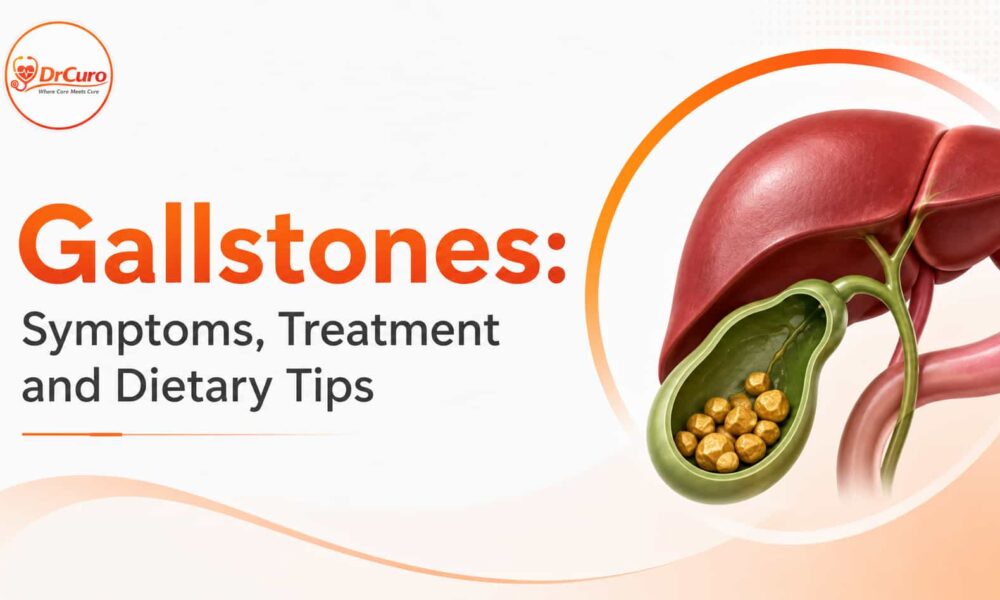
Gallstones are small, hard lumps that form inside the gallbladder, a tiny organ tucked under the liver. Some are as tiny as a grain of sand, while others can grow as big as a golf ball. Many people carry gallstones for years without ever knowing it, because they cause no pain at all. But for others, gallstones can trigger sudden, sharp pain, bloating, nausea, or discomfort after eating. Since digestive health affects so much of our daily comfort and energy, understanding gallstones early can help you avoid unnecessary pain and catch problems before they become serious. In this blog, we’ll walk you through what gallstones are, why they form, how to spot the symptoms, what treatment looks like, and which foods can help or hurt along the way.
Table Of Content
- What Exactly Are Gallstones?
- What Causes Gallstones?
- Common Symptoms of Gallstones
- Gallstone Symptoms at a Glance
- When Should You See a Doctor?
- How Do Doctors Diagnose Gallstones?
- Treatment Options for Gallstones
- Gallstones and Diet: What Should You Eat?
- Gallstone-Friendly Food Guide
- Simple Daily Habits That Help
- Can Gallstones Be Prevented?
- Gallstones vs Other Digestive Problems
- Common Myths About Gallstones
- Frequently Asked Questions
- Final Thoughts
What Exactly Are Gallstones?
Think of your gallbladder as a small storage pouch for bile, a fluid made by the liver that helps your body break down fat. Bile is made up of cholesterol, bile salts, and a substance called bilirubin. Normally, these stay balanced and flow smoothly. But sometimes, if there’s too much cholesterol or bilirubin in the bile, tiny crystals start to form. Over time, these crystals can harden and grow into full gallstones.
Some people develop just one stone, while others may have several at once. On their own, gallstones don’t always cause trouble. Many people have what doctors call “silent gallstones” stones that sit quietly and never cause symptoms. Problems usually start only when a stone blocks the tube that carries bile out of the gallbladder, which is when pain and swelling begin.
What Causes Gallstones?
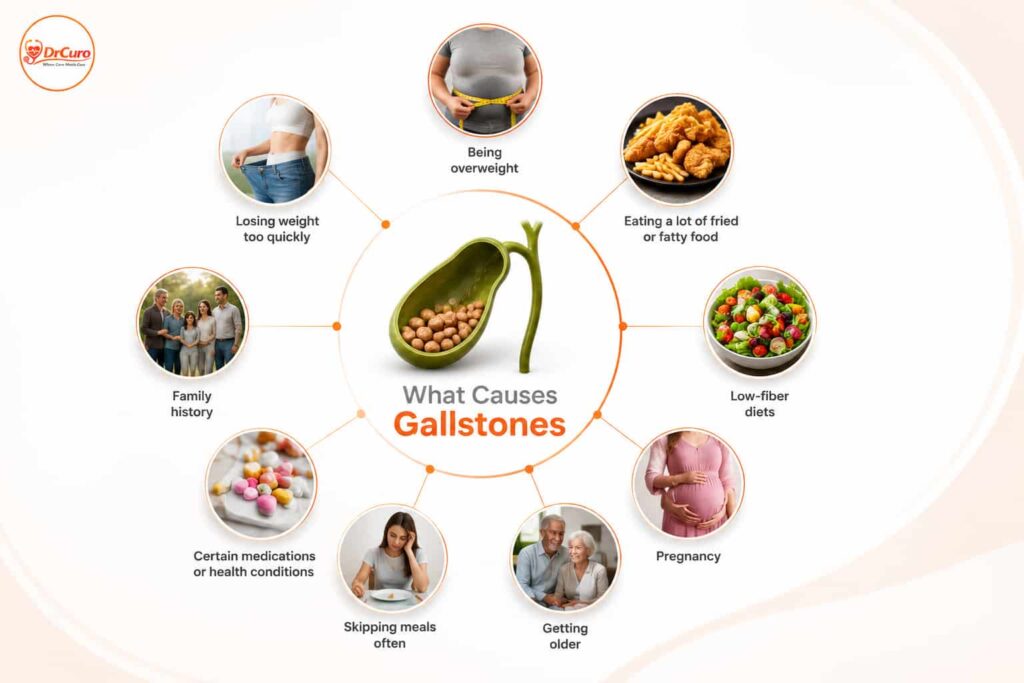
There’s no single reason gallstones form usually, it’s a mix of factors. Here are the most common ones:
- Being overweight – extra weight can raise cholesterol levels in bile
- Losing weight too quickly – crash diets can push the liver to release more cholesterol
- Eating a lot of fried or fatty food – regularly overloading on grease puts strain on the gallbladder
- Low-fiber diets – not eating enough fruits, vegetables, and whole grains
- Pregnancy – hormone changes can affect how the gallbladder works
- Family history – gallstones can run in families
- Getting older – risk naturally goes up with age
- Skipping meals often – this can affect how well the gallbladder empties
- Certain medications or health conditions – some can raise the risk
Having one or more of these risk factors doesn’t guarantee you’ll get gallstones, and some people develop them with no obvious risk factors at all.
Common Symptoms of Gallstones
Most people with gallstones never feel a thing. But when a stone blocks the bile duct, symptoms can hit suddenly this is often called a “gallbladder attack.”
Watch out for:
- Sudden pain in the upper right side or middle of the belly
- Pain that spreads to your back or right shoulder
- Pain that shows up after a heavy or fatty meal
- Nausea or vomiting
- Bloating or a heavy, full feeling
- Indigestion, gas, or burping
- Fever or chills (a sign of possible infection)
- Yellowing of the skin or eyes
The pain can last anywhere from a few minutes to a few hours, and it can range from mild to very severe. One attack doesn’t always mean you need surgery right away, but repeated attacks are a sign you shouldn’t ignore.
Gallstone Symptoms at a Glance
| Symptom | What It Feels Like |
| Upper abdominal pain | Sudden, sharp pain on the right or middle of the belly |
| Back pain | Pain that travels toward the back |
| Shoulder pain | Discomfort that spreads to the right shoulder |
| Nausea | A queasy, sick feeling |
| Vomiting | Often comes along with strong pain |
| Bloating | Feeling swollen or overly full |
| Indigestion | Burning or heaviness after eating |
| Fever | May point to inflammation or infection |
| Jaundice | Yellow tint in the skin or eyes |
When Should You See a Doctor?
Not every stomach ache means gallstones gas, acidity, ulcers, and other digestive issues can feel similar. That’s why it’s important not to self-diagnose based on pain alone.
You should see a doctor right away if you notice:
- Severe belly pain that doesn’t ease up
- Pain along with fever or chills
- Yellow skin or eyes
- Repeated vomiting
- Dark urine or pale stools
- Sudden weakness or faintness
Getting checked quickly can help catch a blocked bile duct or infection early, before it turns into a bigger problem.
How Do Doctors Diagnose Gallstones?
Your doctor will usually start by asking about your symptoms and medical history, followed by a physical check. If gallstones are suspected, they may order:
- Ultrasound – the most common test, using sound waves to picture the gallbladder
- Blood tests – to check for infection, inflammation, or liver issues
- CT scan – to get a more detailed look when needed
- MRI-based bile duct imaging – for a closer look at the bile ducts in specific cases
The right test depends on your symptoms and overall health.
Treatment Options for Gallstones
Treatment isn’t always necessary it depends on whether the stones are causing symptoms.
1. Watchful Waiting
If your gallstones aren’t causing problems, your doctor may simply suggest keeping an eye on things and coming back if symptoms appear.
2. Medication
In some cases, medicines can help dissolve certain cholesterol-based stones. This isn’t right for everyone, can take a long time to work, and stones may return after stopping treatment.
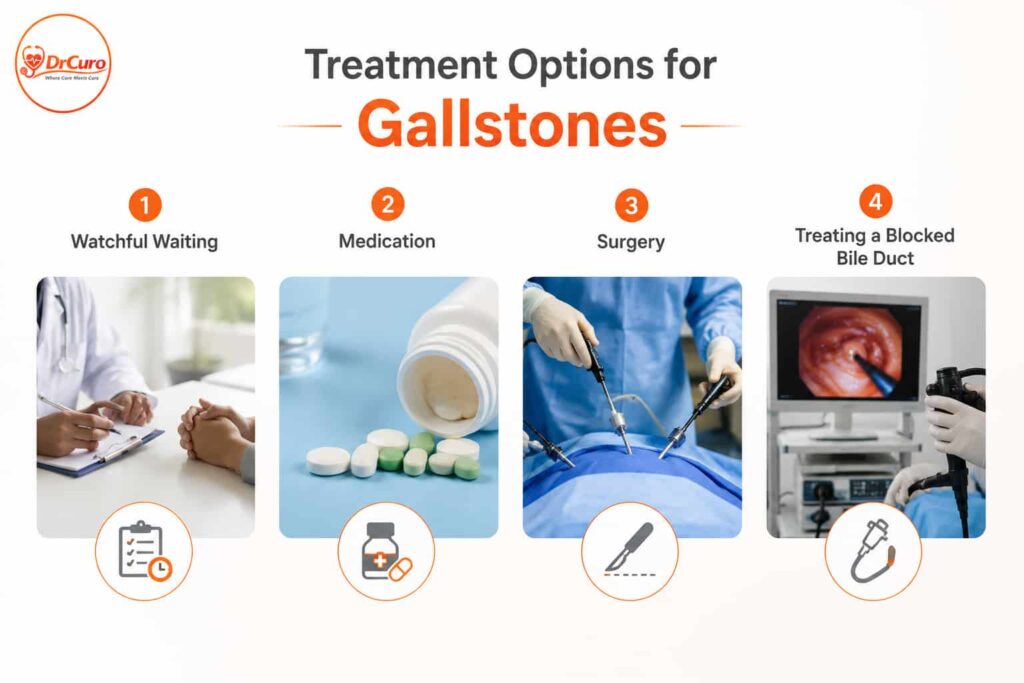
3. Surgery
If gallstones keep causing pain or complications, doctors often recommend removing the gallbladder a procedure called a cholecystectomy. Most of the time, this is done through small incisions (laparoscopic surgery), though open surgery is sometimes needed. The good news is that people live perfectly normal lives without a gallbladder bile simply flows straight from the liver into the intestine instead.
4. Treating a Blocked Bile Duct
If a stone moves and blocks the main bile duct, a procedure called ERCP can be used to remove it.
Gallstones and Diet: What Should You Eat?
While diet won’t dissolve existing stones, eating well can ease discomfort and support better digestive health overall. If fatty meals tend to trigger your symptoms, cutting back on grease can make a real difference. Eating smaller, more frequent meals instead of a few large ones is often easier on the gallbladder too.
Foods That Are Better Choices
- Fresh fruits like apples, bananas, oranges, and berries
- Vegetables like spinach, carrots, and leafy greens
- Whole grains such as oats and brown rice
- Lentils and beans
- Lean protein and skinless chicken
- Fish cooked with minimal oil
- Low-fat dairy, if it suits you
- Plenty of water throughout the day
Foods to Limit
- Deep-fried and fried snack foods
- Fatty or processed meats
- Butter and heavy cream
- Full-fat cheese and dairy
- Fatty cakes and pastries
- Fast food and oily takeout
You don’t need to cut out all fat your body still needs some. The goal is simply balance, and cutting back on the heavy, greasy stuff.
Gallstone-Friendly Food Guide
| Food Group | Better Choices | Limit These |
| Grains | Oats, brown rice, whole wheat | Fried bread, oily grains |
| Vegetables | Leafy greens, carrots, beans | Veggies cooked in excess oil |
| Fruits | Apples, oranges, berries | Cream-heavy fruit desserts |
| Protein | Fish, skinless chicken, lentils | Fatty or processed meat |
| Dairy | Low-fat milk and yogurt | Full-fat cream and cheese |
| Snacks | Fresh fruit, whole-grain snacks | Fried snacks, fast food |
| Cooking Style | Steaming, baking, grilling | Deep frying |
Simple Daily Habits That Help
- Eat smaller meals instead of big, heavy ones
- Cook with steaming, grilling, or baking instead of deep frying
- Add fiber gradually fruits, veggies, beans, whole grains
- Avoid crash diets or very fast weight loss
- Stay well hydrated
- Don’t skip meals regularly
- Notice your personal food triggers and avoid them
- Choose healthier fats in small amounts
- Aim for slow, steady weight loss if needed
Can Gallstones Be Prevented?
You can’t always prevent gallstones age, genetics, and certain health conditions play a role you can’t control. But healthy habits can lower your risk. Regular exercise, a balanced diet full of fruits, vegetables, and fiber, maintaining a steady weight, and avoiding extreme diets all support long-term digestive health.

Gallstones vs Other Digestive Problems
| Condition | Common Symptoms |
| Gallstones | Upper belly pain, nausea, vomiting, pain after fatty meals |
| Acid reflux | Heartburn, sour taste, chest burning |
| Gastritis | Upper stomach discomfort, nausea |
| Peptic ulcer | Burning or aching pain in the upper belly |
| Gas/bloating | Fullness, swelling, burping |
| Pancreatitis | Severe upper belly pain spreading to the back |
Common Myths About Gallstones
Myth: Every gallstone needs surgery.
Fact: Silent gallstones often need no treatment at all.
Myth: Diet can dissolve gallstones.
Fact: A healthy diet supports digestive health but won’t remove existing stones.
Myth: You can’t live without a gallbladder.
Fact: People live completely normal lives after gallbladder removal.
Myth: Gallstones always cause pain.
Fact: Many are silent and found only during unrelated tests.
Myth: Skipping meals prevents gallstones.
Fact: Skipping meals often can actually raise your risk.
Frequently Asked Questions
1. What’s the main symptom of gallstones?
Sudden pain in the upper right or middle belly, often after eating a heavy meal, sometimes spreading to the back or shoulder.
2. Can gallstones go away on their own?
Not usually. Silent gallstones may never need treatment, but symptomatic ones typically need medical care.
3. Can I still eat normally with gallstones?
Yes, most people can just watch out for fatty and fried foods, which tend to trigger symptoms.
4. Is milk bad for gallstones?
Not necessarily. Low-fat dairy is usually easier to tolerate than full-fat options.
5. Does exercise help?
It supports healthy weight and overall wellness, though it won’t remove existing stones.
6. Are gallstones dangerous?
They can be harmless if silent, but a blocked bile duct can lead to infection or inflammation so severe symptoms need prompt attention.
Final Thoughts
Gallstones are extremely common, and many people never even know they have them. But when symptoms like sharp belly pain, nausea, fever, or yellowing skin show up, it’s a sign to get checked without delay. Alongside proper diagnosis and treatment, small changes eating balanced meals, choosing healthier fats, and staying active can go a long way in supporting your digestive health. Don’t rely on home remedies alone if your symptoms are severe or keep coming back; always get guidance from a qualified doctor. At Dr Curo, we’re here to bring you simple, honest, and reliable health information so you can make informed choices for your well-being.





No Comment! Be the first one.