







IVF Pregnancy Symptoms: Early Signs to Watch
Medically Reviewed by Dr Curo Clinical Team | Reproductive Medicine & Fertility Specialists If you have just had an embryo transfer, the next two weeks can feel like the longest and most...

Medically Reviewed by Dr Curo Clinical Team | Reproductive Medicine & Fertility Specialists
Table Of Content
- Early IVF Pregnancy Symptoms – Complete Week by Week Timeline
- Days 1 to 5 After Transfer
- Days 6 to 10 After Transfer
- Days 10 to 14 After Transfer
- IVF Pregnancy Symptoms vs Medication Side Effects How to Tell the Difference?
- hCG Levels After IVF – What Numbers Mean
- Symptoms That Are Encouraging After IVF
- Symptoms That Need Immediate Medical Attention
- Two-Week Wait Emotional Symptoms and Mental Health
- Common Myths About IVF Pregnancy Symptoms Debunked
- FET vs Fresh Transfer – Do Symptoms Differ?
- Quick Reference – IVF Pregnancy Symptoms Timeline
- Frequently Asked Questions About IVF Pregnancy Symptoms
- A Final Word From Dr Curo
If you have just had an embryo transfer, the next two weeks can feel like the longest and most emotional time of your life. Every twinge, every cramp, every little sensation in your body makes you wonder could this be it?
You are not alone. Millions of women undergoing IVF ask the same question every day: what early IVF pregnancy symptoms should I actually look for?
One of the biggest challenges during IVF treatment in India is that early pregnancy symptoms can feel almost identical to the side effects caused by fertility medications especially progesterone and estrogen supplements. That is why it is so important to understand what is considered normal, which signs may indicate a positive outcome, and when symptoms require medical attention. Every IVF patient deserves clear, honest guidance during this stage of the journey.
At Dr Curo, we have helped thousands of patients through their IVF journeys. In this detailed guide, we are going to walk you through everything the early signs, the week by week timeline, the difference between medication side effects and real pregnancy symptoms, the hCG levels to expect, and much more.
Let us begin.
What Actually Happens in Your Body After Embryo Transfer?
Before we talk about symptoms, it helps to understand what your body is going through after the embryo is transferred.
After the embryo is placed inside the uterus, it needs approximately 6 to 10 days to implant into the uterine lining. This process is called implantation. Once implantation happens successfully, the embryo starts producing a hormone called hCG human chorionic gonadotropin. This is the pregnancy hormone.
As hCG levels rise in your blood, your body starts responding and that is when the early IVF pregnancy symptoms begin to appear.
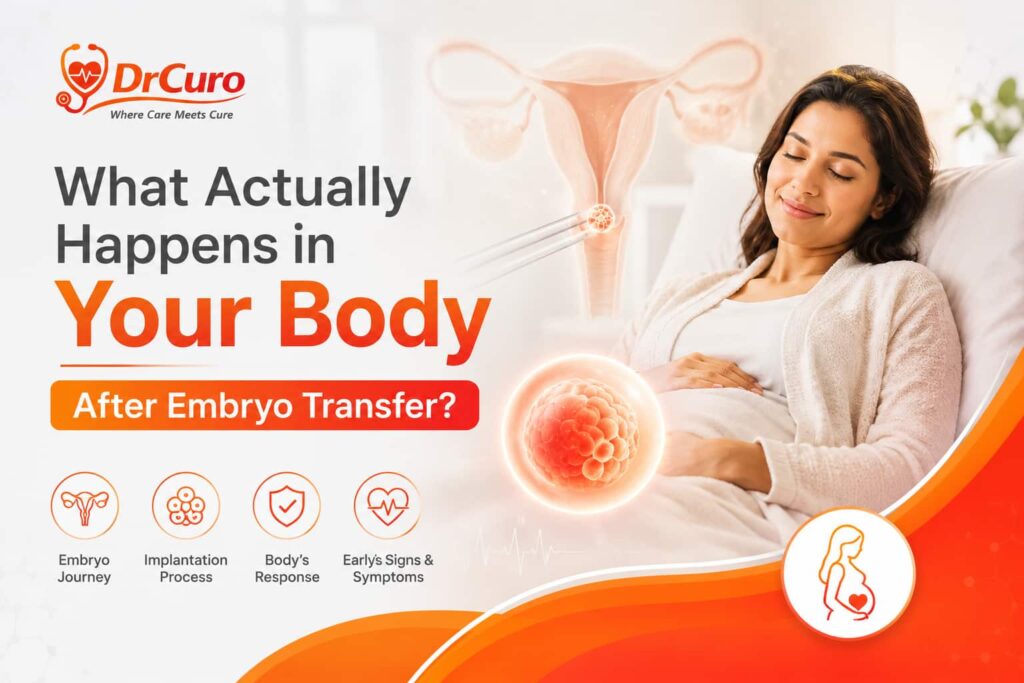
However, the progesterone and estrogen medications you take after the transfer also cause many of the same symptoms. This is why the two-week wait is so confusing. Your body is showing signs either way whether the transfer worked or not.
According to the American Society for Reproductive Medicine, IVF accounts for over 2% of all births in the United States, and success rates for women under 35 using fresh embryos are around 46% per cycle. Understanding your body during this period is a critical part of the process.
Early IVF Pregnancy Symptoms – Complete Week by Week Timeline
Days 1 to 5 After Transfer
In the first five days after embryo transfer, most women do not feel anything significantly different. The embryo is still in the process of hatching from its shell and beginning to attach to the uterine wall.
What you may feel during this time:
Mild bloating – this is mostly from the progesterone medication and the retrieval procedure your body is still recovering from.
General fatigue – feeling tired is completely normal and is largely driven by the hormonal medications.
Pelvic heaviness – some women describe a feeling of fullness or pressure in the lower abdomen. This is normal.
Slight mood changes – hormones are already working, and emotional sensitivity is very common.
At this stage, it is nearly impossible to tell whether these feelings are from pregnancy or medication.
Days 6 to 10 After Transfer
This is the window when implantation typically occurs. If your embryo is going to implant, it usually happens somewhere between day 6 and day 10 after a blastocyst transfer.
This is also when the first genuinely meaningful IVF pregnancy symptoms may appear.
Implantation bleeding or spotting – This is one of the most discussed early IVF pregnancy symptoms. You may notice very light pink or brownish discharge. This happens when the embryo burrows into the uterine lining and causes a tiny amount of bleeding. It is not a period. It is lighter, shorter, and a different color. Not every woman experiences this — in fact, studies suggest only about 25 to 30 percent of pregnant women notice implantation bleeding.
Mild implantation cramping – Along with spotting, some women feel very light cramps that are similar to period cramps but noticeably milder. This is the uterus responding to implantation.
Breast tenderness and swelling – Your breasts may feel sore, heavy, or more sensitive than usual. The areola may appear slightly darker. While progesterone also causes this, it tends to feel more pronounced if implantation has occurred.
Increased fatigue – You may feel more tired than usual, even if you are getting enough sleep. This deep fatigue is one of the most consistent early IVF pregnancy symptoms and is caused by rising hCG levels.
Lower back ache – A dull ache in the lower back is common during implantation and early pregnancy.
Vivid dreams – Many women report unusually vivid or emotional dreams during early pregnancy. This is linked to hormonal changes affecting sleep cycles.
Days 10 to 14 After Transfer
As hCG levels begin to rise more significantly, IVF pregnancy symptoms become more noticeable and more consistent.
Nausea and morning sickness – This is one of the most well-known early pregnancy symptoms. Despite being called morning sickness, it can happen at any time of day. Some women feel a constant low-level queasiness while others experience actual vomiting. It typically starts around day 10 to 14 after transfer.
Frequent urination – If you are making more trips to the bathroom than usual, this is a positive sign. Rising hCG and progesterone affect blood flow to the kidneys and increase urine production.
Food aversions and cravings – You may suddenly find certain smells or foods completely unbearable, or you may develop strong cravings for specific things. This is a hormonal response.
Heightened sense of smell – This is one of the lesser-known but very telling early pregnancy signs. Smells you never noticed before may suddenly feel overwhelming.
Headaches – Hormonal fluctuations particularly rising estrogen can trigger mild to moderate headaches in early pregnancy.
Bloating and constipation – Progesterone slows down the digestive system. This causes bloating, gas, and constipation. If this feels more intense than usual, it may be a sign that hCG is adding to the effect.
Mood swings and emotional sensitivity – Feeling suddenly tearful, anxious, or unusually emotional is completely normal. The hormonal shifts happening in your body are significant.
Metallic taste in the mouth – Some women report a strange metallic taste, which is linked to rising estrogen levels in early pregnancy.
Dizziness or lightheadedness – Changes in blood pressure and blood volume during early pregnancy can cause mild dizziness.
IVF Pregnancy Symptoms vs Medication Side Effects How to Tell the Difference?
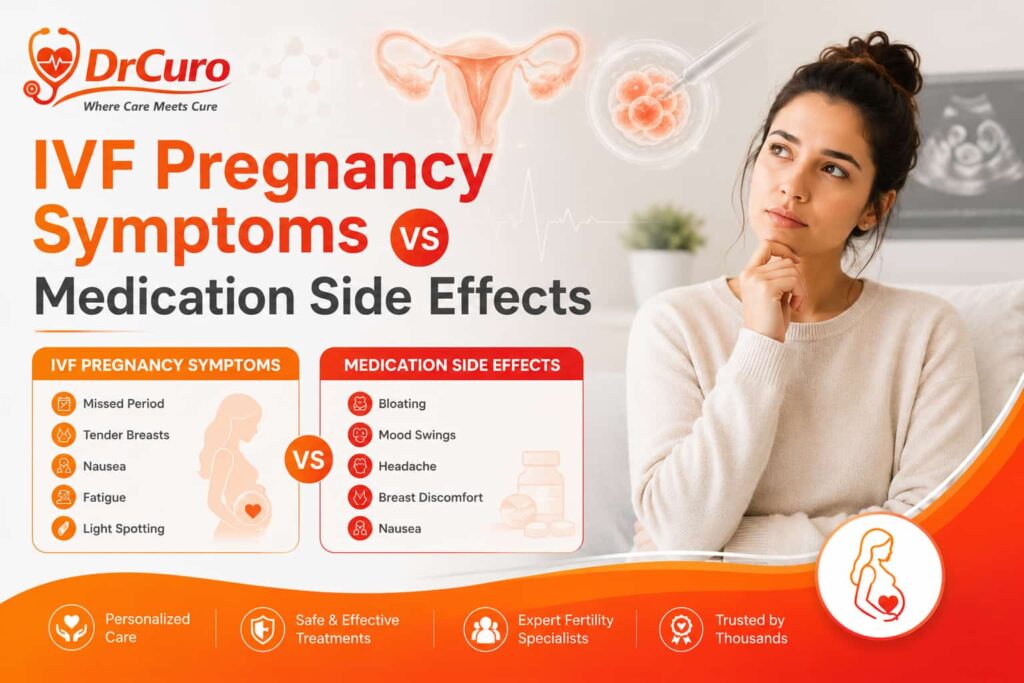
This is genuinely one of the hardest parts of the two-week wait – and at Dr Curo, we hear this question from almost every patient.
The honest answer is: you often cannot tell the difference based on symptoms alone.
Here is why. Progesterone – which you take as injections, suppositories, or gel after the transfer causes breast tenderness, bloating, fatigue, mood swings, and even mild nausea. These are the exact same symptoms that early pregnancy causes.
So how do you separate the two?
The only reliable way is through a blood beta-hCG test. This test measures the actual level of the pregnancy hormone in your bloodstream. No symptom, no matter how strong, can give you a definitive answer.
Here is a helpful way to think about it. If your symptoms feel unusually strong stronger than previous cycles that can sometimes be an encouraging sign. But it is never a guarantee.
Please do not try to use home pregnancy tests before your official blood test date. Here is why:
If you had an hCG trigger shot during your cycle, it stays in your system for up to 10 days and will cause a false positive on a home test even if implantation did not occur.
If you test too early before day 12 or 13 hCG levels may not be high enough to show on a home test yet, giving you a false negative even if you are pregnant.
Wait for the blood test. It is the only answer that truly matters.
hCG Levels After IVF – What Numbers Mean
Understanding hCG levels is an important part of understanding IVF pregnancy symptoms and confirmation.
After a successful implantation, hCG levels should rise as follows:
At 14 days after a 5-day blastocyst transfer, a positive beta-hCG result is generally considered to be above 100 mIU/mL, though some clinics consider anything above 25 mIU/mL as a positive.
Healthy hCG levels should double approximately every 48 to 72 hours in a normal early pregnancy.
If your hCG levels are rising but slowly for example doubling every 96 hours instead of 48 your doctor will monitor this closely, as it may indicate a chemical pregnancy or an ectopic pregnancy.
If your hCG levels are rising well and doubling correctly, this is one of the strongest early indicators of a healthy pregnancy.
Your doctor at Dr Curo will schedule your first ultrasound around 6 to 7 weeks of pregnancy to confirm the heartbeat and the location of the pregnancy.
Symptoms That Are Encouraging After IVF
While no single symptom can confirm pregnancy, the following combination of signs together especially appearing around days 8 to 12 are generally considered encouraging:
Light spotting between days 6 and 10 that is pink or brown, not red and heavy
Mild cramping that is lighter than a normal period
Breast tenderness that feels different or more intense than previous cycles
Growing fatigue that gets stronger rather than lighter over the days
Nausea beginning around day 10 to 12
Frequent urination becoming noticeable
A general sense that your body feels different from non-pregnant cycles
Again symptoms alone are not confirmation. But when several of these appear together in the right timeframe, they are an encouraging sign.
Symptoms That Need Immediate Medical Attention
Some symptoms after an embryo transfer are not normal and need to be addressed right away. Contact Dr Curo or your fertility clinic immediately if you experience:
Heavy vaginal bleeding – Light spotting is normal. Bleeding that is heavy like a full period, or that is bright red and continuous, is not normal and needs to be checked immediately.
Severe pelvic or abdominal pain – Mild cramps are fine. Sharp, severe, or one-sided pain is not normal and could indicate an ectopic pregnancy or another complication.
Signs of Ovarian Hyperstimulation Syndrome (OHSS) – This is a serious condition that is more common after fresh embryo transfers. Watch for sudden and significant abdominal bloating, rapid weight gain of more than 2 kg in 24 hours, severe nausea and vomiting, decreased urination, and difficulty breathing. OHSS requires immediate medical attention.
High fever – A fever above 38 degrees Celsius after transfer is not normal and needs to be evaluated.
No fetal heartbeat on ultrasound after 7 weeks If your hCG levels are positive but no heartbeat is detected by 7 weeks on ultrasound, your doctor will guide you on next steps.
Never ignore symptoms that feel severe or suddenly different. Always reach out to your care team.
Two-Week Wait Emotional Symptoms and Mental Health
At Dr Curo, we firmly believe that the emotional symptoms of IVF are just as real and just as important as the physical ones and they are talked about far too little.
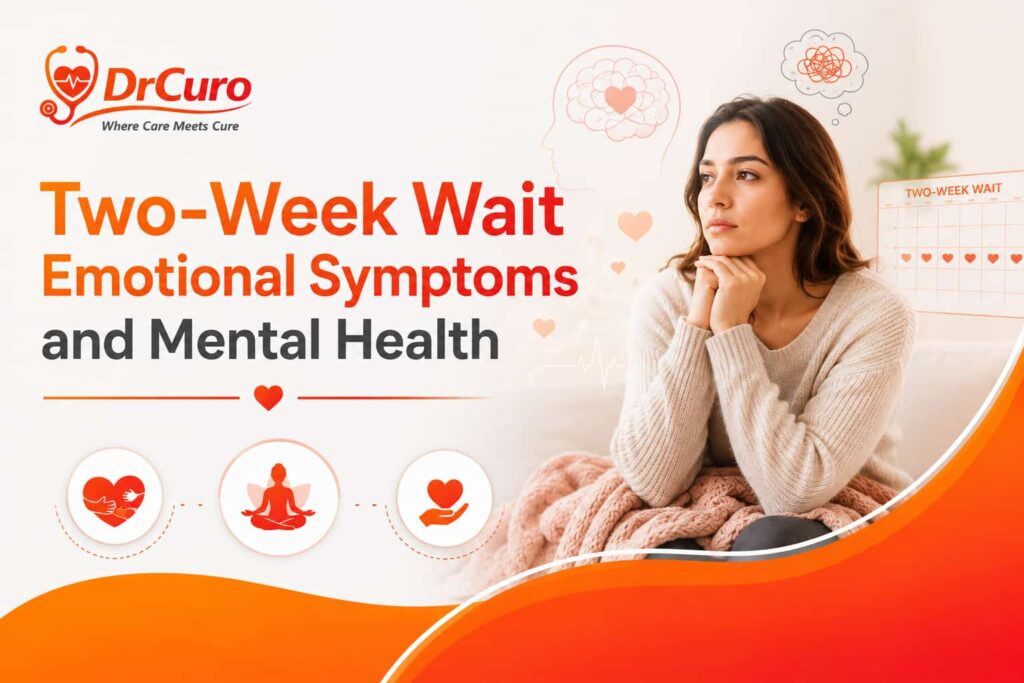
The two-week wait is one of the most psychologically challenging periods that IVF patients experience. Research published in the journal Human Reproduction has shown that anxiety levels in IVF patients during the two-week wait are comparable to those of patients awaiting cancer diagnoses. That is how significant this period is emotionally.
Common emotional IVF pregnancy symptoms during this time include:
Intense anxiety and constant symptom checking refreshing the same list of symptoms online repeatedly, comparing to last cycle, analyzing every twinge.
Emotional exhaustion carrying hope and fear simultaneously is draining in a way that is hard to describe.
Difficulty concentrating at work or in conversations your mind keeps returning to one thing.
Sleep disturbances difficulty falling asleep or waking up early with racing thoughts.
Irritability and withdrawal pulling away from social situations because they feel too heavy.
These are not weaknesses. These are normal, human responses to an incredibly high-stakes waiting period.
What genuinely helps:
Staying gently active short daily walks, light stretching, or prenatal yoga can help regulate your nervous system.
Setting boundaries around symptom searching allow yourself one check per day, not constant searching.
Talking openly with your partner, a close friend, or a therapist who understands fertility.
Journaling writing out your thoughts and feelings rather than keeping them inside.
Staying connected with the Dr Curo care team we are here to answer questions and provide reassurance throughout your wait.
You do not have to white-knuckle through this alone.
Common Myths About IVF Pregnancy Symptoms Debunked
Myth 1: No symptoms means the transfer failed. This is one of the most damaging myths. Many women who have completely successful IVF pregnancies feel almost nothing in the first two weeks. Lack of symptoms does not mean failure. Some of the strongest pregnancies start silently.
Myth 2: Strong symptoms mean it definitely worked. Strong symptoms can simply mean your body is responding strongly to progesterone medication. Symptoms alone cannot confirm pregnancy.
Myth 3: A positive home pregnancy test before the blood test confirms pregnancy. Home tests can give false positives due to the hCG trigger shot still being in your system. Always rely on the blood beta-hCG test at the correct time.
Myth 4: Cramping after transfer always means something is wrong. Mild cramping is completely normal and is often a sign of implantation. It is only severe or sharp cramping that needs attention.
Myth 5: If you had symptoms last cycle and it failed, symptoms this cycle mean nothing. Every cycle is different. Your body responds differently each time. Previous cycle outcomes do not determine the meaning of current symptoms.
Myth 6: Bed rest after transfer improves chances. This is a widely believed myth with no medical evidence to support it. Most fertility specialists, including the team at Dr Curo, recommend normal light activity after transfer. Strict bed rest has not been shown to improve IVF success rates.
FET vs Fresh Transfer – Do Symptoms Differ?
Many patients ask whether IVF pregnancy symptoms differ between a fresh embryo transfer and a frozen embryo transfer (FET).
In a fresh transfer cycle, your body has just been through the egg retrieval process and is still recovering. Hormone levels are naturally higher, and you may be at risk of OHSS. Symptoms can feel more intense overall.
In a frozen embryo transfer, your body is in a more prepared and medicated state. Progesterone supplements are the main driver of symptoms rather than your own hormonal production. Symptoms may feel slightly different or milder – but this does not affect success rates.
Studies show that frozen embryo transfers in recent years have had comparable or even slightly better outcomes than fresh transfers in many cases, largely due to improved embryo vitrification techniques.
Quick Reference – IVF Pregnancy Symptoms Timeline
Days After Transfer What You May Experience
Days 1 to 5 – Mild bloating, fatigue, pelvic heaviness from medications and recovery
Days 6 to 10 – Implantation spotting, light cramps, breast tenderness, increased fatigue, lower back ache
Days 10 to 14 – Nausea, frequent urination, food aversions, heightened smell, headaches, mood swings, metallic taste, dizziness
Day 14 – Beta-hCG blood test. Official confirmation from your clinic.
Day 21 onwards (if positive) Symptoms become more consistent. First ultrasound scheduled around week 6 to 7.
Frequently Asked Questions About IVF Pregnancy Symptoms
Q: How soon after embryo transfer can I feel IVF pregnancy symptoms?
A: Most women do not feel meaningful symptoms in the first 5 days. The earliest real IVF pregnancy symptoms like implantation spotting and mild cramping typically appear between days 6 and 10. Stronger symptoms like nausea and frequent urination usually appear from day 10 onwards.
Q: Is it normal to have no symptoms after IVF transfer?
A: Yes, absolutely. Having no symptoms does not mean the transfer failed. Many successful IVF pregnancies show very little in the way of early symptoms. The blood beta-hCG test is the only reliable indicator.
Q: Can progesterone cause the same symptoms as pregnancy?
A: Yes. Progesterone supplements which are a standard part of IVF protocol cause breast tenderness, bloating, fatigue, nausea, and mood swings. These are the same symptoms as early pregnancy, which is why it is so difficult to tell the difference during the two-week wait.
Q: What does implantation bleeding look like after IVF?
A: Implantation bleeding after IVF typically appears as very light pink or brownish spotting. It is much lighter than a period, lasts only 1 to 3 days, and does not contain clots. It usually appears between days 6 and 10 after a blastocyst transfer.
Q: What hCG level confirms pregnancy after IVF?
A: Most fertility clinics consider a beta-hCG level above 100 mIU/mL at 14 days after a 5-day blastocyst transfer to be a strong positive. However, even levels above 25 mIU/mL are considered positive. What matters most is that the levels are rising and doubling every 48 to 72 hours.
Q: Can I take a home pregnancy test after IVF?
A: It is strongly advised to wait for your official blood beta-hCG test. Home pregnancy tests can give false positives due to the hCG trigger shot and false negatives if done too early. The blood test gives you accurate results.
Q: What are the signs of a chemical pregnancy after IVF?
A: A chemical pregnancy occurs when implantation happens but the pregnancy does not continue to develop. Signs include a very low initial beta-hCG level, hCG that rises slowly or begins to fall, and eventually bleeding similar to a period. Your doctor will monitor this through repeat blood tests.
Q: Is cramping after embryo transfer normal?
A: Yes. Mild cramping after embryo transfer is completely normal and is often a sign of implantation. The uterus is adjusting to the presence of the embryo. However, severe or sharp cramping especially one-sided should be reported to your doctor immediately.
Q: How long does the two-week wait last after IVF?
A: The two-week wait typically lasts 14 days after a 5-day blastocyst transfer, after which your clinic will schedule a beta-hCG blood test. Some clinics may test slightly earlier at day 12 or 13.
Q: What should I avoid during the two-week wait?
A: Avoid alcohol, smoking, hot baths or saunas, heavy lifting, and intense exercise. Do not take any new medications without speaking to your doctor. Avoid doing home pregnancy tests before the scheduled blood test date. And as much as possible, try to avoid excessive stress and constant symptom searching.
A Final Word From Dr Curo
Going through IVF takes more courage than most people will ever know. The two-week wait after an embryo transfer is one of the most emotionally and physically demanding periods in the entire process and you deserve honest, thorough, compassionate information to help you through it.
Understanding your IVF pregnancy symptoms is one way to feel more informed and less anxious. But the most important thing we want you to remember is this symptoms are not the answer. Your beta-hCG blood test on day 14 is the answer.
Until that day, take care of your body. Rest. Eat well. Move gently. Lean on the people who love you. And know that whatever the result, you are not defined by a single cycle. Many patients at Dr Curo have gone through multiple cycles before achieving a successful pregnancy and many have surprised themselves with success when they least expected it.
At Dr Curo, we are not just your fertility clinic. We are your partners through every high, every low, every wait, and every result. Our team of experienced reproductive specialists is here to support you medically, emotionally, and personally every step of the way.
If you have questions about your symptoms, your cycle, or your next steps, reach out to the Dr Curo team today.
Book your consultation with Dr Curo and take the next step in your fertility journey with confidence.
This article is written and medically reviewed by the Dr Curo Clinical and Editorial Team. It is intended for informational purposes only and does not replace personalised medical advice from your fertility specialist.





No Comment! Be the first one.