








Is IUI Painful? What to Expect During the Procedure
The moment most people hear the term intrauterine insemination, the first question that comes to mind is will it hurt?It is one of the most commonly searched concerns around fertility treatments,...
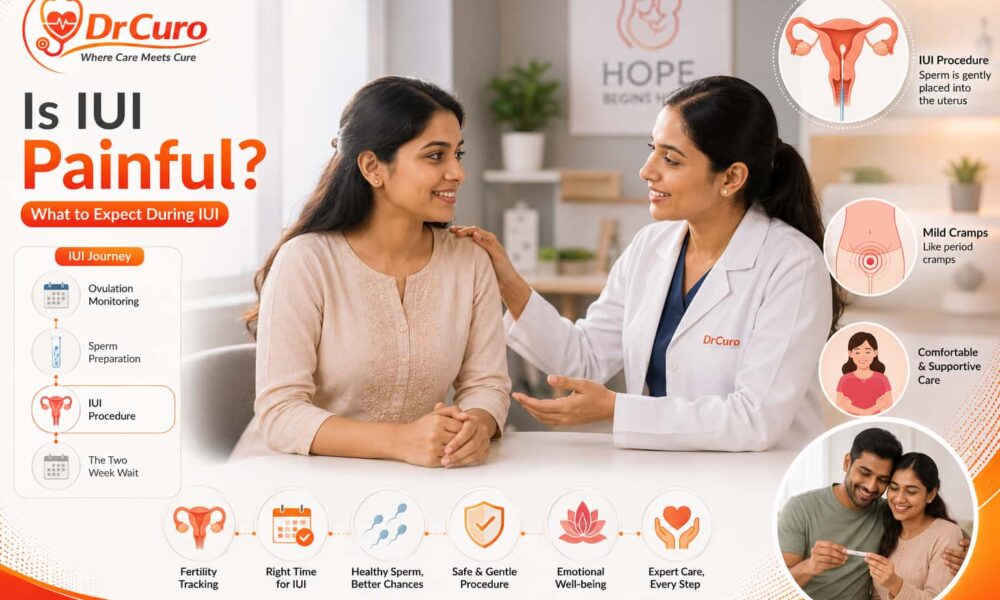
The moment most people hear the term intrauterine insemination, the first question that comes to mind is will it hurt?
It is one of the most commonly searched concerns around fertility treatments, often alongside queries like IUI treatment cost India.
Table Of Content
- First – What Exactly Is IUI?
- Stage 1: Ovulation Monitoring – Does It Hurt?
- Stage 2: Sperm Preparation – No Pain Here
- Stage 3: The IUI Procedure Itself – The Part Everyone Asks About
- So Is IUI Painful? The Honest Answer
- What Does IUI Pain Feel Like? Real Descriptions
- What Happens After the Procedure?
- The Two-Week Wait – The Emotional Pain Nobody Talks About
- Does IUI Get More Painful With Multiple Cycles?
- How to Reduce IUI Procedure Pain – What Actually Helps
- IUI vs IVF – Which Procedure Is More Painful?
- When IUI Is Not Recommended And What Comes Next
- Frequently Asked Questions (FAQs)
- Dr Curo Is With You – Before, During, and After
And it deserves a clear, honest answer not a vague “it varies from person to person” without real explanation.
At Dr Curo, we believe in giving you complete clarity. No sugar-coating. No unnecessary fear. Just the truth so you can walk into the process feeling prepared, calm, and confident.
This guide covers everything about IUI procedure pain — what you will feel, when you will feel it, why it happens, and what you can do to make the experience as comfortable as possible.
First – What Exactly Is IUI?
Before we talk about pain, let us quickly explain what IUI actually involves.
IUI stands for Intrauterine Insemination. It is a fertility treatment where washed, concentrated sperm is placed directly inside the uterus right near the fallopian tubes during the time of ovulation.
The goal is simple: reduce the distance the sperm has to travel to reach the egg, and increase the chances of fertilisation.
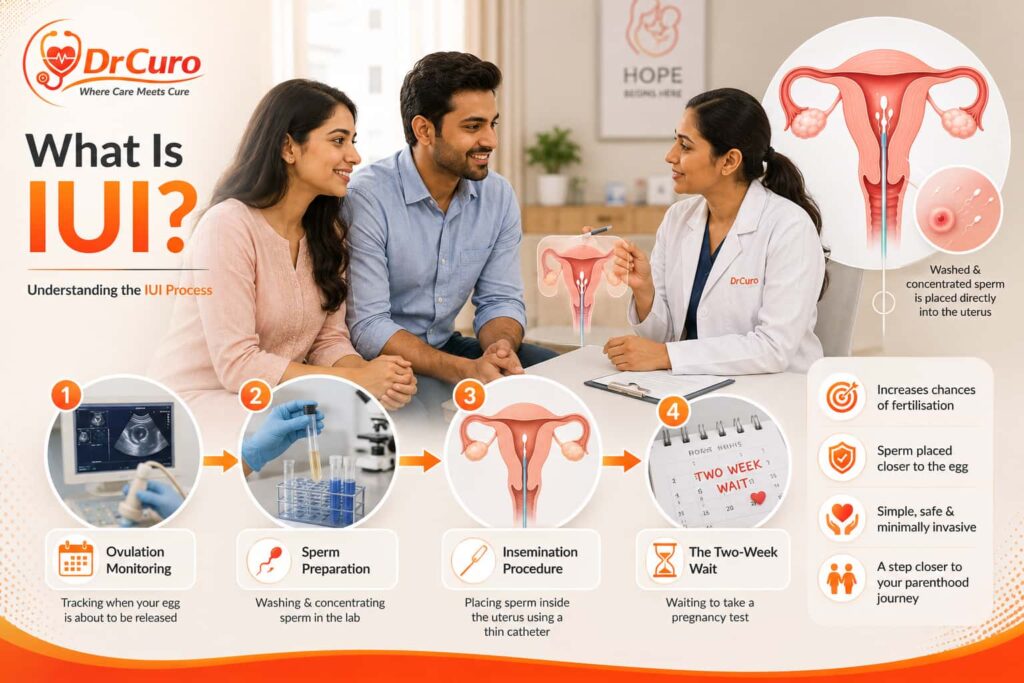
The full IUI process involves a few stages:
- Ovulation monitoring – tracking when your egg is about to be released
- Sperm preparation – washing and concentrating the sperm sample in the lab
- The insemination procedure – placing the sperm inside the uterus using a thin catheter
- The two-week wait – waiting to take a pregnancy test
Most people focus on the insemination step when they ask about IUI procedure pain. So let us go through each stage honestly.
Stage 1: Ovulation Monitoring – Does It Hurt?
Before IUI, your doctor will monitor your cycle to find the right window for the procedure.
This usually involves:
- Transvaginal ultrasounds – a small probe is gently inserted into the vagina to check the ovaries and uterus
- Blood tests – to check hormone levels like LH and oestrogen
- Ovulation trigger injection – if your doctor uses one, this is a small injection (similar to a vaccine shot) in the stomach or thigh
Does this part hurt?
The transvaginal ultrasound is mildly uncomfortable for some women – especially if you have never had one before. But it is not painful for most people. It takes only a few minutes.
The trigger injection may cause a brief sting at the injection site. Some women have mild soreness there for a day or so. That is all.
Overall discomfort level: Very mild 1 to 2 out of 10.
Stage 2: Sperm Preparation – No Pain Here
This part happens entirely in the lab. The sperm sample is washed and concentrated to select the most active, healthy sperm.
You do not feel anything during this stage. It is purely a lab process.
Stage 3: The IUI Procedure Itself – The Part Everyone Asks About
This is the main event. Here is exactly what happens, step by step:
Step 1: You lie on the examination table Just like a gynaecology appointment. Your legs go into stirrups. You are awake throughout – no anaesthesia or sedation is needed.
Step 2: The doctor inserts a speculum This is the same instrument used during a routine pap smear. It holds the vaginal walls open gently so the doctor can see the cervix. This may feel like pressure or mild discomfort similar to what you feel during a normal smear test.
Step 3: The catheter is guided through the cervix A thin, flexible tube (catheter) is carefully passed through the cervix opening and into the uterus. This is the step that causes the most sensation.
What does it feel like?
Most women describe it as:
- A mild cramping feeling similar to period pain
- A brief pinching or pressure sensation as the catheter passes through the cervix
- A feeling of pressure or fullness inside the uterus when the sperm is released
Step 4: The sperm is gently released The prepared sperm is slowly pushed through the catheter into the uterus. This takes only a few seconds. Most women feel mild pressure at this point.
Step 5: The catheter is removed This is quick and usually causes very little sensation.
The entire procedure takes 5 to 10 minutes from start to finish.
So Is IUI Painful? The Honest Answer
Here is the truth, based on real patient experience and what the medical research shows:
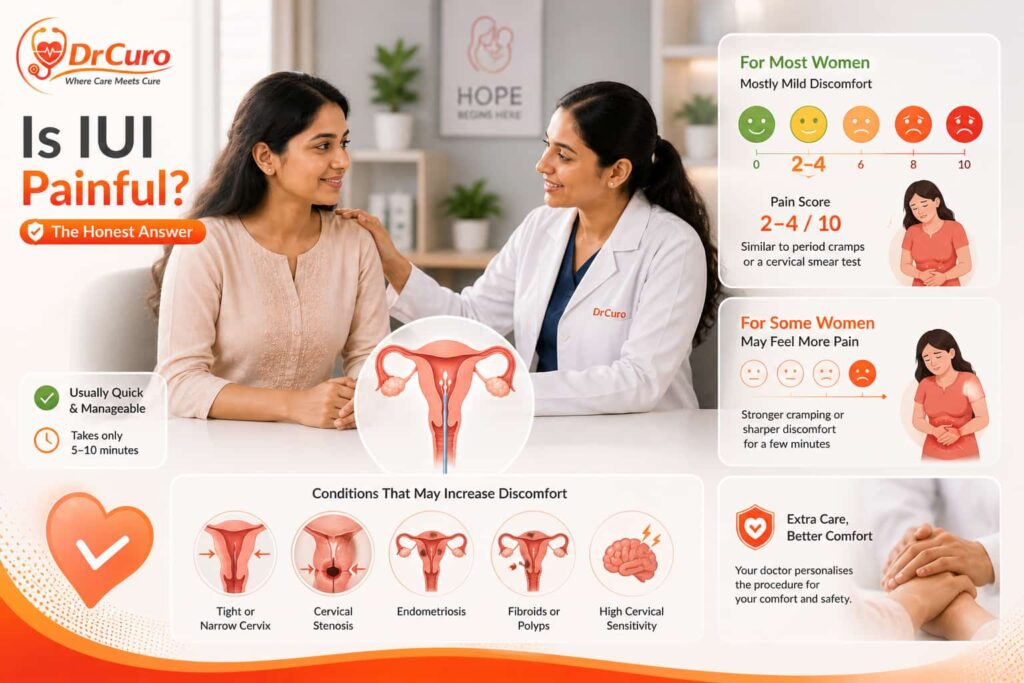
For most women, IUI is not painful. It is uncomfortable.
There is a difference between pain and discomfort. Pain is sharp, intense, and hard to manage. Discomfort is a mild, manageable sensation that passes quickly.
Most women rate IUI procedure pain at 2 to 4 out of 10. It is similar to period cramps or a cervical smear test.
However for some women, it is more painful.
This is honest and important to say. For women with:
- A tight or narrow cervix – passing the catheter may cause more cramping
- Cervical stenosis (narrowing of the cervix opening)
- Endometriosis
- Uterine fibroids or polyps
- High cervical sensitivity
the procedure can cause stronger cramping or sharper discomfort that lasts a few minutes.
This does not mean IUI is not right for you. It means your Dr Curo doctor needs to know about these conditions in advance so the procedure can be done with extra care.
What Does IUI Pain Feel Like? Real Descriptions
To help you understand what to actually expect, here are the ways women commonly describe the sensation:
| Description | How Common |
| Mild period-like cramping | Very common |
| Pressure or fullness in the lower abdomen | Very common |
| Brief pinching as catheter enters cervix | Common |
| Sharp sting for a few seconds | Less common |
| Significant cramping lasting 10–20 minutes | Less common |
| No sensation at all | Some women experience this |
Every body is different. But reading this table, you can see that the most common experience is mild and brief.
What Happens After the Procedure?
Once the IUI is done, you will usually be asked to rest on the table for 10 to 15 minutes. After that, you can get up, get dressed, and go about your day.
Common after-effects:
- Mild cramping for a few hours similar to period pain
- Light spotting small amount of blood or discharge; this is normal
- A feeling of bloating or heaviness in the lower abdomen
- Fatigue some women feel tired for the rest of the day
These are all normal and expected.
What is not normal and should be reported:
- Heavy bleeding
- Severe or worsening pain after you leave the clinic
- Fever or chills
- Foul-smelling discharge
- Pain that gets significantly worse over the next 24 hours
If you experience any of these, call your Dr Curo team immediately.
The Two-Week Wait – The Emotional Pain Nobody Talks About
The physical procedure may be over in 10 minutes. But the two weeks after IUI can be the hardest part emotionally.
During the two-week wait, many women experience:
- Anxiety – constantly analysing every symptom, wondering if it worked
- Symptom confusion – IUI side effects mimic early pregnancy symptoms, making it impossible to know what is what
- Hope and fear cycling together – hoping desperately while protecting yourself from disappointment
- Isolation – feeling like nobody around you understands what this wait feels like
This emotional experience is real. It is valid. And it is something Dr Curo takes seriously.
Our counselling team supports patients not just through the procedure – but through the waiting, the hoping, and the uncertainty that comes after.
Does IUI Get More Painful With Multiple Cycles?
This is a question many people do not think to ask before starting treatment.
The short answer: not necessarily.
For most women, each IUI procedure feels roughly the same. The body does not become more sensitive simply because you have had IUI before.
However, if a previous cycle resulted in any uterine irritation, or if you develop conditions like mild infection between cycles, sensitivity can temporarily increase.
The more important point is this: if your IUI cycles are consistently uncomfortable, tell your doctor. There are ways to adjust the approach different catheter types, different techniques – that can improve your comfort on subsequent cycles.
How to Reduce IUI Procedure Pain – What Actually Helps
You cannot eliminate all sensation. But you can make the experience significantly more comfortable.
Before the procedure:
- Take a mild painkiller 30–60 minutes before – Paracetamol or Ibuprofen (as recommended by your doctor) can reduce cramping significantly. This single tip alone makes a big difference for many women.
- Stay hydrated – being well-hydrated helps your body handle the procedure better
- Empty your bladder beforehand – a full bladder can increase discomfort
- Wear comfortable, loose clothing – you want to feel relaxed, not restricted
- Eat a light meal – do not go in on an empty stomach
- Communicate your anxiety to your doctor – a good doctor will slow down and talk you through every step if you ask them to
During the procedure:
- Breathe slowly and deeply – this actively reduces cramping by relaxing the pelvic muscles
- Do not hold your breath – tensing up increases the sensation of pain
- Ask your doctor to narrate each step – knowing what is coming next reduces anxiety significantly
- Squeeze a stress ball or hold your partner’s hand – distraction helps
- Focus on unclenching your jaw, shoulders, and stomach – your body tightens when it is anxious; consciously releasing that tension helps
After the procedure:
- Rest for the remainder of the day – not mandatory, but helpful
- Use a heat pad on your lower abdomen – gentle warmth helps with cramping
- Avoid strenuous exercise for 24 hours
- Drink plenty of fluids
IUI vs IVF – Which Procedure Is More Painful?
Many people who are comparing fertility treatments want to know how IUI and IVF compare in terms of pain.
| Factor | IUI | IVF |
| Procedure type | Non-surgical, no sedation | Surgical egg retrieval, sedation used |
| Pain level | Mild-2 to 4 out of 10 | Moderate – 3 to 5 out of 10 (managed with sedation) |
| Duration | 5-10 minutes | 20-30 minutes for egg retrieval |
| Recovery time | Hours | 1-2 days |
| Injections involved | Sometimes (trigger shot) | Yes – daily for 10–14 days |
| Emotional intensity | High | Very high |
IUI is significantly less invasive and less painful than IVF. This is one reason IUI is usually tried first before moving to IVF.
When IUI Is Not Recommended And What Comes Next
IUI is not the right treatment for everyone. Your Dr Curo doctor may recommend moving past IUI if:
- Both fallopian tubes are blocked
- Sperm count is very low (severe male factor infertility)
- Multiple IUI cycles have failed without a clear reason
- The woman is over 40 with low ovarian reserve
- There is severe endometriosis affecting the tubes
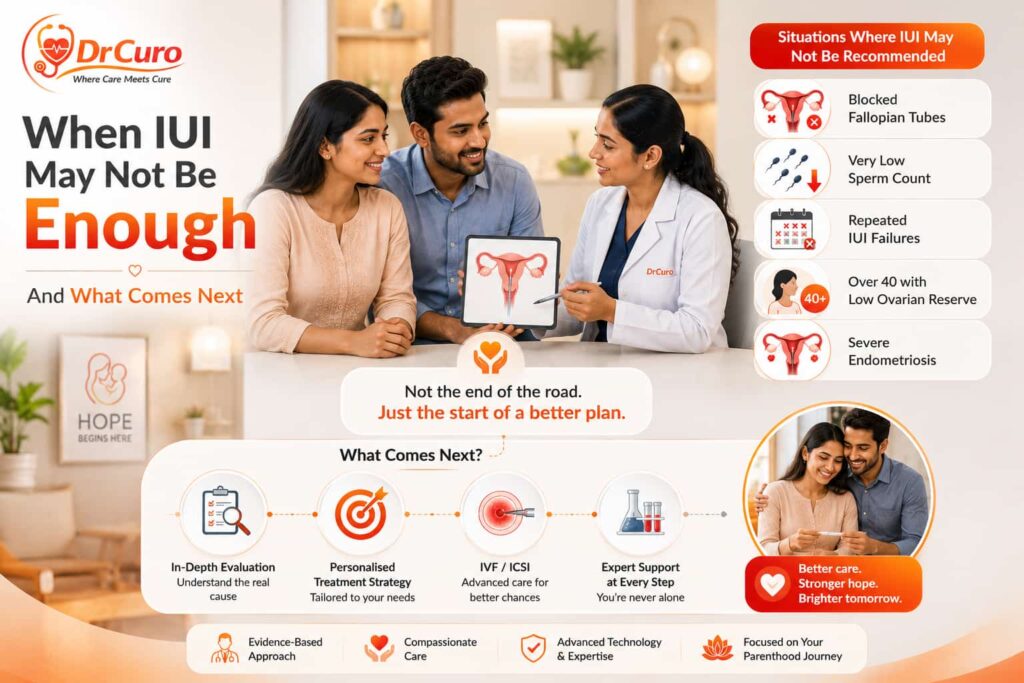
In these cases, IVF or other assisted reproduction techniques may be recommended. This is not a failure it is simply choosing the treatment that gives you the best chance.
Frequently Asked Questions (FAQs)
Q1. Is IUI procedure painful? For most women, IUI is mildly uncomfortable not painful. The sensation is most commonly described as period-like cramping that lasts a few minutes. Some women feel almost nothing. A smaller number experience stronger cramping, especially if they have cervical sensitivity or certain uterine conditions.
Q2. How long does IUI discomfort last? The procedure itself takes 5 to 10 minutes. Any cramping after typically resolves within a few hours. Light spotting may continue for a day.
Q3. Can I take a painkiller before IUI? Yes, taking Paracetamol or Ibuprofen 30 to 60 minutes before the procedure can help reduce cramping. Always confirm this with your doctor first as they may have specific recommendations for you.
Dr Curo Is With You – Before, During, and After
IUI procedure pain is real but it is manageable. And it does not have to be something you face feeling anxious and uninformed.
At Dr Curo, our team walks every patient through exactly what to expect before the procedure begins. We go at your pace. We answer every question. We do not rush you.
Because we know that when you feel informed and supported, your body responds differently and the experience is genuinely better.
Whether this is your first IUI or you have been through it before, Dr Curo is here to make your journey as comfortable, dignified, and hopeful as possible.
Talk to a Dr Curo fertility specialist today. Let us take the next step together.
Note: This article is for general educational purposes only. Individual experiences vary. Please consult a Dr Curo fertility specialist for personalised medical advice tailored to your specific situation.







No Comment! Be the first one.