





IUI for PCOS: Is It Effective?
PCOS is one of the most common reasons women struggle to conceive. It affects hormone balance, disrupts ovulation, and can make natural pregnancy more challenging. If you have PCOS and are exploring...
PCOS is one of the most common reasons women struggle to conceive. It affects hormone balance, disrupts ovulation, and can make natural pregnancy more challenging. If you have PCOS and are exploring fertility options, you’ve likely come across IUI as a recommended treatment and also started looking into the IUI treatment to understand what to expect.
Table Of Content
- First What is PCOS?
- What is IUI and How Does It Help PCOS?
- How is IUI Done for PCOS? Step by Step
- Step 1 – Tests and Diagnosis
- Step 2 – Ovulation Medicines
- Step 3 – Ultrasound Monitoring
- Step 4 – Trigger Injection
- Step 5 – Sperm Preparation
- Step 6 – The IUI Procedure
- Step 7 – The Two Week Wait
- Does IUI Treatment for PCOS Actually Work?
- IUI Success Rates for PCOS – What to Realistically Expect
- What Affects IUI Success in PCOS?
- IUI vs IVF for PCOS – Which One Do You Need?
- What Does IUI Treatment for PCOS Cost in India?
- Risks of IUI Treatment for PCOS
- Lifestyle Changes That Can Improve Your Results
- Frequently Asked Questions
- Final Thoughts
But does IUI really work for PCOS? And is it the right option for you?
This blog answers those questions in a clear, straightforward way. No complex medical jargon. No vague explanations. Just honest, practical information to help you understand how IUI works for PCOS and what it means for your chances, your treatment plan, and the overall IUI treatment cost India.
First What is PCOS?
PCOS stands for Polycystic Ovary Syndrome. It is a hormonal condition that affects the ovaries.
Here is what happens in simple terms:
- Your ovaries make many small follicles but do not release eggs regularly
- Your hormones especially insulin and androgens are out of balance
- Ovulation either happens very irregularly or does not happen at all
- Without regular ovulation, getting pregnant naturally becomes very hard
PCOS is very common. It affects roughly 1 in 5 women. And because ovulation is the main problem this is exactly what IUI treatment for PCOS is designed to fix.
What is IUI and How Does It Help PCOS?
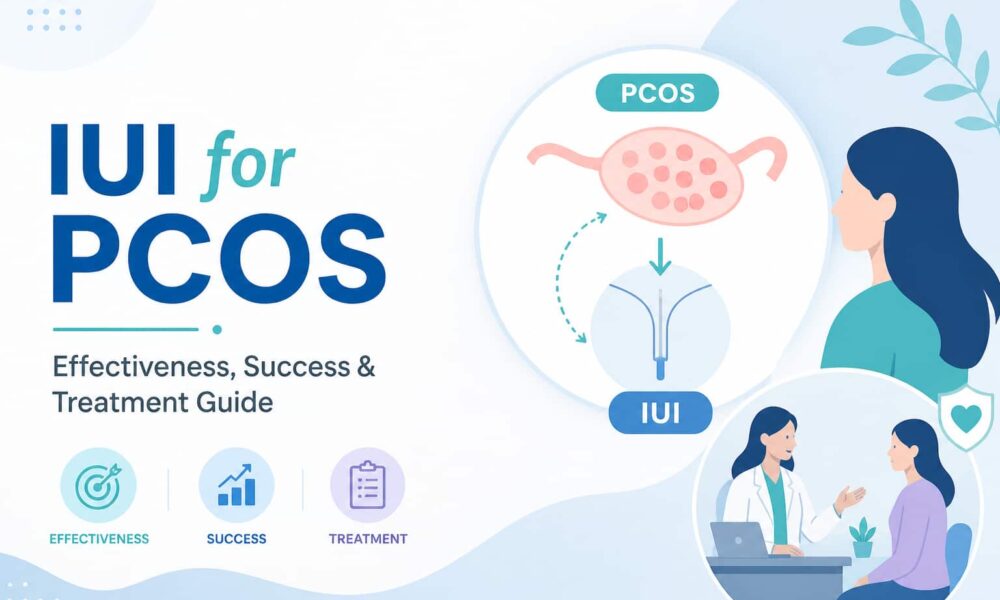
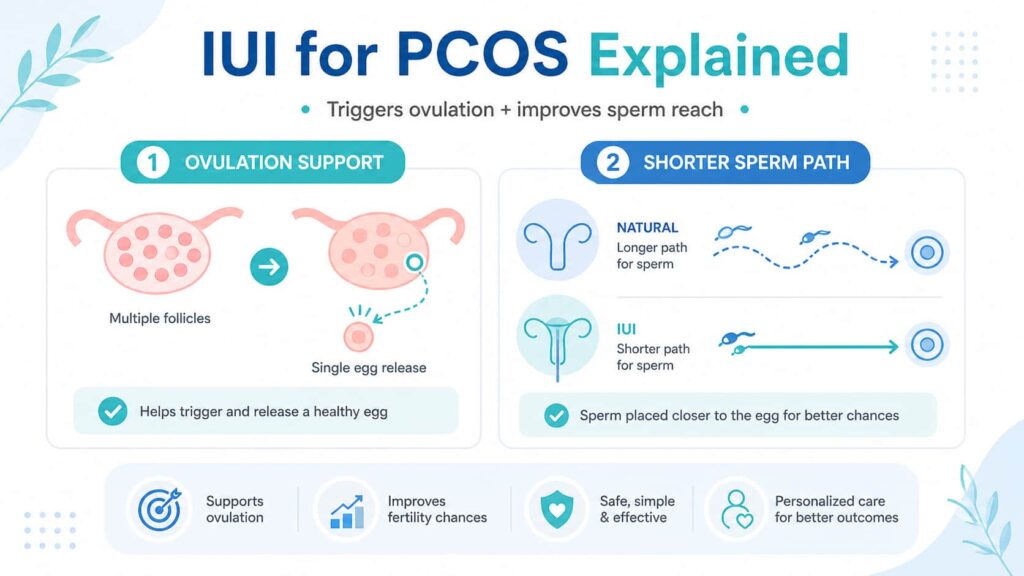
IUI stands for Intrauterine Insemination. It is a simple fertility procedure where prepared sperm is placed directly inside the uterus at the exact time of ovulation.
In natural conception, sperm has to travel a long way from the vagina, through the cervix, into the uterus, and up to the fallopian tubes. Many sperm do not make it.
IUI makes that journey much shorter. The sperm is placed directly inside the uterus closer to the egg at exactly the right moment.
For PCOS patients, IUI is almost always combined with ovulation medicines. These medicines help the ovaries release an egg. This is the most important part because in PCOS, the ovaries need that extra help to ovulate.
So IUI treatment for PCOS does two things together:
- Triggers ovulation with medicines
- Places sperm close to the egg at the right time
This is why it works so well for PCOS.
How is IUI Done for PCOS? Step by Step
Step 1 – Tests and Diagnosis
Before starting, your doctor will run some basic tests to understand your full fertility picture:
- Blood tests – LH, FSH, AMH, insulin, thyroid
- Ultrasound scan of your ovaries and uterus
- Semen analysis of your partner
- HSG test to check if your fallopian tubes are open
This step is very important. IUI only works if your tubes are clear and your partner’s sperm is healthy enough.
Step 2 – Ovulation Medicines
Since PCOS stops regular ovulation, medicines are given to stimulate the ovaries to grow and release an egg. This is called ovulation induction.
| Medicine | Type | How It Works |
| Letrozole (Femara) | Oral tablet | Lowers estrogen briefly to trigger ovulation – best for most PCOS patients |
| Clomiphene (Clomid) | Oral tablet | Stimulates follicle growth commonly used as first-line treatment |
| FSH Injections (Gonadotropins) | Injectable | Directly stimulates the ovaries used when tablets don’t work |
| Metformin | Oral tablet | Reduces insulin resistance used in PCOS patients with high insulin |
Your doctor will choose the right medicine based on your hormone levels, weight, and how your body responds.
Step 3 – Ultrasound Monitoring
Once you start medicines, you will come in for regular ultrasound scans usually every 2 to 3 days. These scans check how many follicles are growing and how big they are.
This step is especially important for PCOS patients. Because PCOS ovaries already have many small follicles, there is a risk of too many growing at once. Your doctor watches this carefully to keep you safe.
Step 4 – Trigger Injection
When one or two follicles reach the right size usually 18 to 20 mm a trigger injection is given. This injection causes the final release of the egg.
The IUI procedure is then timed precisely usually 34 to 36 hours after this injection.
Step 5 – Sperm Preparation
On the day of the IUI procedure, your partner gives a semen sample. This sample is cleaned and prepared in the lab. Only the best, most active sperm are selected and used.
Step 6 – The IUI Procedure
This is the main procedure. It is simple and quick.
| What | Details |
| How long it takes | 10 to 15 minutes |
| Pain level | Mild – similar to a pap smear |
| Anaesthesia needed | No |
| What happens | A thin soft tube is passed through the cervix and prepared sperm is gently placed into the uterus |
| After the procedure | Rest for 15 to 20 minutes, then go home |
No hospitalisation is needed. Most women go back to their normal routine the same day.
Step 7 – The Two Week Wait
After the IUI, you wait around 14 days before taking a pregnancy test. A blood test called the beta-hCG test confirms whether you are pregnant.
During this time:
- Take your prescribed progesterone medicine
- Avoid heavy exercise and stress
- Eat well, sleep well, and stay hydrated
- Do not test too early it can give a wrong result
This two-week wait can be emotionally hard. That is completely normal.
Does IUI Treatment for PCOS Actually Work?
Yes, IUI treatment for PCOS is one of the most effective first-line fertility treatments available for women with this condition.
Here is why it works so well for PCOS:
- PCOS patients usually have healthy fallopian tubes IUI needs open tubes to work
- The main problem in PCOS is ovulation and the medicines directly fix this
- Egg quality in younger PCOS patients is usually good eggs just need help being released
- Once ovulation is triggered and sperm is placed close to the egg conditions for fertilisation are strong
IUI Success Rates for PCOS – What to Realistically Expect
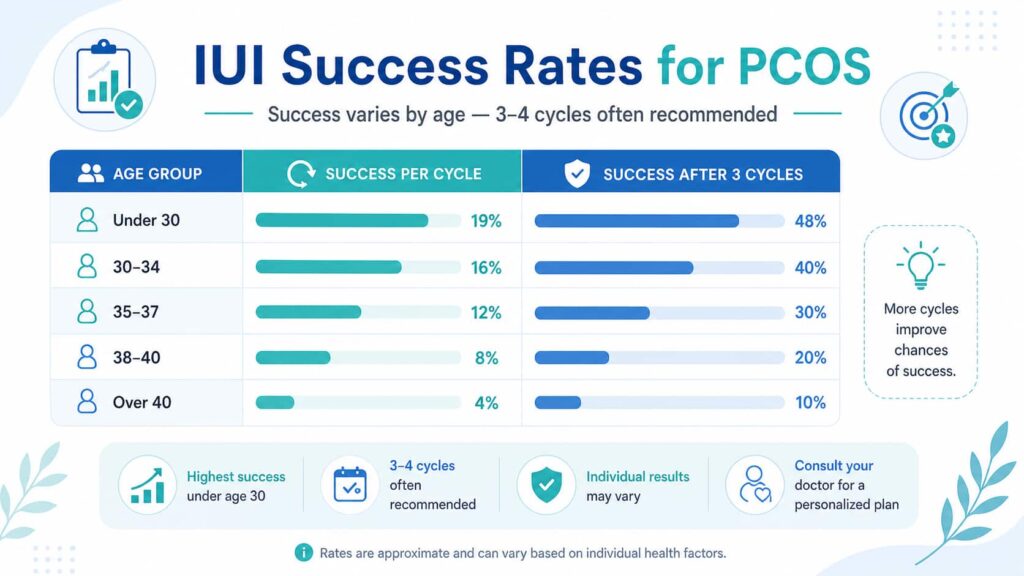
| Age Group | Success Rate Per Cycle | After 3 Cycles |
| Under 30 | 18-25% | 50-65% |
| 30-34 | 15-20% | 45-58% |
| 35-37 | 12-17% | 35-48% |
| 38-40 | 8 -13% | 25-35% |
| Over 40 | 5-8% | 15-22% |
These numbers are for stimulated IUI which is the standard for PCOS patients. Most doctors recommend doing 3 to 4 IUI cycles before considering IVF.
What Affects IUI Success in PCOS?
Not every PCOS patient will get the same result. Here are the main things that affect your outcome:
| Factor | Why It Matters |
| Age | Younger women have better egg quality and higher success per cycle |
| Weight | Being significantly overweight can reduce how well ovaries respond to medicines |
| Insulin resistance | High insulin levels affect egg quality treating it improves results |
| Sperm quality | IUI success also depends on your partner’s sperm count and movement |
| Tube health | Both fallopian tubes must be open for IUI to work |
| Medicine used | Letrozole usually gives better results than Clomid in PCOS patients |
| Number of follicles | 1 to 2 mature follicles is ideal more than 3 raises multiple pregnancy risk |
| Uterine lining | A lining of at least 7 to 8 mm is needed for implantation |
IUI vs IVF for PCOS – Which One Do You Need?
| IUI for PCOS | IVF for PCOS | |
| How invasive | Minimally invasive – no surgery | More invasive – egg retrieval under sedation |
| Cost per cycle | ₹10,000 – ₹30,000 | ₹1,00,000 – ₹2,50,000 |
| Success rate per cycle | 15 – 25% | 40 – 50% (under 35) |
| Best for | Mild to moderate PCOS with open tubes and good sperm | Severe PCOS, blocked tubes, or failed IUI cycles |
| Emotional burden | Lower | Higher |
| Recommended first step | Yes, for most PCOS patients | After 3 to 4 failed IUI cycles |
For most PCOS patients, IUI is the right first step. It costs less, is easier on your body, and works well for a large number of women. IVF is recommended only if IUI has not worked after 3 to 4 cycles or if there are other fertility problems involved.
What Does IUI Treatment for PCOS Cost in India?
| IUI Type | Approximate Cost Per Cycle |
| Stimulated IUI with Letrozole or Clomid | ₹12,000 – ₹20,000 |
| Stimulated IUI with FSH injections | ₹18,000 – ₹30,000 |
| Monitoring scans | ₹500 – ₹1,500 per scan |
| Trigger injection | ₹500 – ₹2,000 |
| Progesterone support | ₹1,000 – ₹3,000 |
| Pregnancy blood test | ₹500 – ₹1,500 |
For most PCOS patients, the total per-cycle cost falls between ₹15,000 and ₹35,000 depending on your city, clinic, and the medicines used.
Risks of IUI Treatment for PCOS
IUI is a safe procedure. But PCOS patients do carry a slightly higher risk for a few things:
| Risk | How Common | What It Means |
| OHSS (Ovarian Hyperstimulation Syndrome) | More common in PCOS | Ovaries become swollen and painful due to over-response to medicines monitored carefully |
| Multiple pregnancy | Low to moderate | If more than one egg is released, twins are possible monitoring reduces this risk |
| Mild cramping | Very common | Normal and temporary goes away within a day |
| Light spotting | Common | Normal after the catheter is inserted |
| Cycle cancellation | Possible | If too many follicles develop, the cycle may be cancelled to keep you safe |
Careful monitoring throughout the cycle keeps these risks low.
Lifestyle Changes That Can Improve Your Results
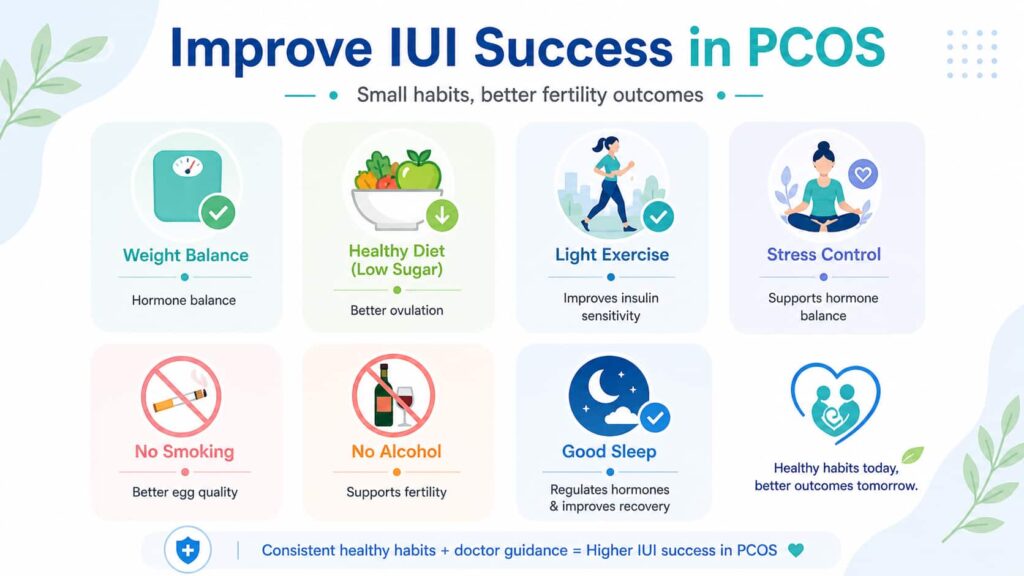
Small changes before and during your IUI cycles can genuinely improve your chances:
| What to Do | Why It Helps |
| Lose even 5–10% of body weight if overweight | Improves ovulation and hormone balance in PCOS |
| Eat less sugar and refined carbs | Reduces insulin resistance directly helps PCOS |
| Do light exercise daily | Improves insulin sensitivity and hormone levels |
| Manage stress | High stress hormones disturb reproductive hormones |
| Quit smoking | Smoking damages egg quality significantly |
| Avoid alcohol | Alcohol affects hormone levels and implantation |
| Sleep 7 to 8 hours every night | Poor sleep worsens insulin resistance in PCOS |
These are not just general health tips. For PCOS patients specifically, these changes can make a real difference to how your body responds to treatment.
Frequently Asked Questions
Q1. Is IUI treatment for PCOS effective? Yes. IUI treatment for PCOS is one of the most effective first-line fertility treatments for women with PCOS. When combined with ovulation induction medicines, it directly fixes the main fertility problem irregular or absent ovulation. Success rates per cycle range from 15 to 25% for PCOS patients under 35.
Q2. How many IUI cycles are needed for PCOS? Most doctors recommend 3 to 4 IUI cycles before moving to IVF. Some PCOS patients conceive in the first or second cycle. The right number for you depends on your age, hormone levels, sperm quality, and how your body responds to medicines.
Q3. Is Letrozole or Clomid better for IUI in PCOS? Research shows that Letrozole generally gives better ovulation rates and pregnancy results in PCOS patients compared to Clomid. Letrozole also has a lower risk of too many follicles developing at once making it safer for PCOS. Your doctor will recommend the right medicine based on your situation.
Q4. Can PCOS patients do natural cycle IUI? Technically yes but it is rarely recommended. The whole challenge with PCOS is unpredictable or absent ovulation. A natural cycle IUI cannot solve this. Stimulated IUI with ovulation medicines is almost always the more effective choice for PCOS patients.
Q5. When should a PCOS patient move from IUI to IVF? If 3 to 4 IUI cycles have not resulted in pregnancy or if there are additional problems like blocked tubes or severe male infertility your doctor will likely recommend moving to IVF. IVF has higher success rates per cycle and may be the right next step depending on your full fertility picture.
Final Thoughts
IUI treatment for PCOS is a genuine, affordable, and well-tolerated treatment that works for a large number of women with this condition. The key is combining it with the right ovulation medicines, careful monitoring, and a doctor who understands your specific PCOS profile.
If you have PCOS and are finding it hard to conceive, IUI is very likely a strong first option for you. It is less expensive than IVF, easier on your body, and for many women it is all they need.
Talk to a fertility specialist who takes the time to understand your hormones, your cycle, your weight, and your history and builds a plan specifically for you.
Note: Success rates mentioned are approximate and based on published research and general clinical data. Individual results vary. Please consult a fertility specialist for a personalised assessment of your situation.




No Comment! Be the first one.