







Coronary Artery Disease: Symptoms and Treatment
Coronary artery disease, often called CAD, is one of the most common heart problems in the world. Your heart is a muscle that works day and night, and like every muscle it needs a steady supply of...
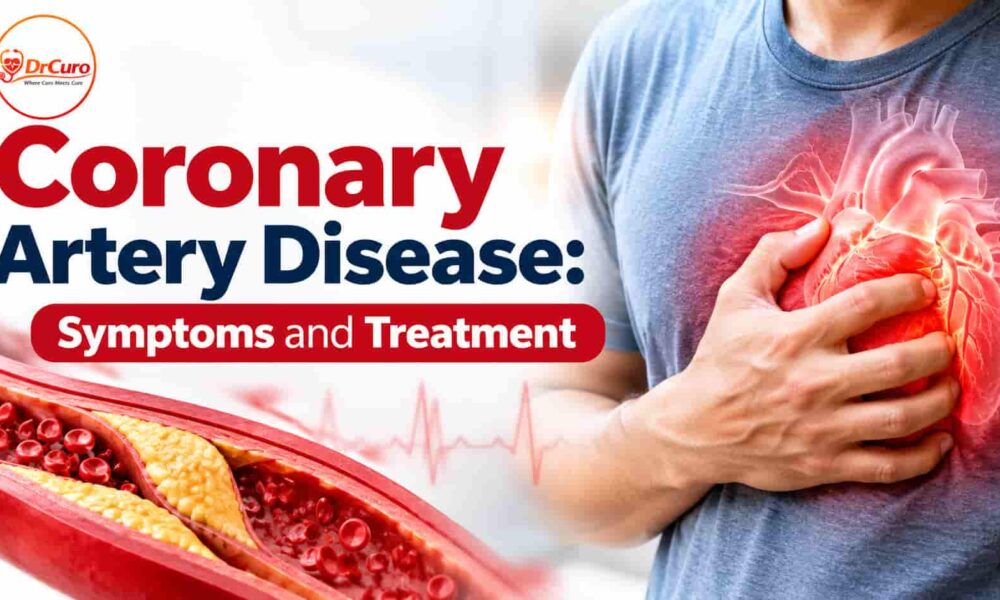
Coronary artery disease, often called CAD, is one of the most common heart problems in the world. Your heart is a muscle that works day and night, and like every muscle it needs a steady supply of blood and oxygen. This blood comes through special blood vessels called coronary arteries. When these arteries become narrow or blocked, the heart does not get enough blood, and this can cause chest pain, tiredness, breathlessness and, in serious cases, a heart attack. Many people live with CAD for years without knowing it, because the damage builds up slowly. The good news is that CAD can be managed well when it is found early and treated properly. In this blog, you will learn what CAD is, why it happens, what symptoms to watch for, how doctors find it, and which treatments can help.
Table Of Content
- What Is Coronary Artery Disease?
- What Causes Coronary Artery Disease?
- Risk Factors for Coronary Artery Disease
- Symptoms of Coronary Artery Disease
- What Does Angina Feel Like?
- Coronary Artery Disease in Women
- How Is Coronary Artery Disease Diagnosed?
- Treatment of Coronary Artery Disease
- 1. Lifestyle Changes
- 2. Medicines
- 3. Angioplasty and Stent
- 4. Coronary Artery Bypass Surgery
- 5. Cardiac Rehabilitation
- Treatment Options at a Glance
- How Can Coronary Artery Disease Be Prevented?
- When Should You Get Emergency Help?
- Coronary Artery Disease vs Heart Attack
- Frequently Asked Questions
- Conclusion
What Is Coronary Artery Disease?
Coronary artery disease is a condition in which the arteries that feed the heart become narrow or blocked. The main reason is a slow build-up of a sticky material called plaque inside the artery walls. Plaque is made of cholesterol, fat, calcium and other substances. This process is called atherosclerosis. As more plaque collects, the path for blood becomes smaller, just like a water pipe that slowly gets clogged from the inside. When the heart needs more blood, for example while climbing stairs, running or feeling stressed, the narrow arteries cannot deliver enough, and symptoms may appear. Sometimes the plaque cracks, and a blood clot forms on it. This clot can suddenly block the artery completely, and that is what causes a heart attack.
Common effects of CAD include:
- Less blood and oxygen reaching the heart muscle
- Chest pressure, tightness or discomfort
- Shortness of breath
- Feeling tired very quickly
- Heart attack in serious cases
- Uneven heartbeat (abnormal heart rhythm) in some people
What Causes Coronary Artery Disease?
CAD usually does not have just one cause. It grows slowly over many years because of several things working together. Too much “bad” cholesterol (LDL) in the blood is one of the biggest reasons, because it keeps adding to the plaque. High blood pressure puts extra force on the artery walls and slowly damages them. High blood sugar from diabetes harms blood vessels too. Smoking is especially harmful, because the chemicals in tobacco injure the artery lining and make plaque form faster. Lack of exercise, being overweight, eating too much oily, salty or processed food, and long-term stress also add to the risk. Age and family history play a part as well, but having a parent with heart disease does not mean you will definitely get it. Healthy habits and good control of other health problems can make a big difference.
Risk Factors for Coronary Artery Disease
Some risk factors cannot be changed, such as age and family history. Many others can be controlled with healthy habits and medical care. The table below shows the main ones.
| Risk Factor | How It Raises the Risk |
|---|---|
| High cholesterol | Extra LDL cholesterol builds plaque inside the arteries |
| High blood pressure | Slowly damages the artery walls |
| Diabetes | Harms blood vessels over time |
| Smoking and tobacco | Injures the artery lining and speeds up plaque build-up |
| Being overweight | Often leads to diabetes, high blood pressure and high cholesterol |
| Lack of physical activity | Causes weight gain and weakens heart health |
| Unhealthy diet | Too much oil, salt, sugar and processed food adds to the risk |
| Age | The risk goes up as you get older |
| Family history | Raises the chance of getting CAD |
| Long-term stress | Can lead to unhealthy habits and extra strain on the heart |
Symptoms of Coronary Artery Disease
CAD does not look the same in every person. In the early stages, many people feel completely normal. Symptoms often show up when the heart is working harder than usual, such as during exercise, climbing stairs, carrying heavy things or feeling very upset. The best-known symptom is angina, which is chest discomfort that happens when the heart muscle does not get enough blood. People describe it in different ways, and it can also spread to other parts of the upper body.
Chest discomfort may feel like:
- Pressure or tightness in the chest
- A heavy feeling, as if something is sitting on the chest
- Squeezing
- Burning
- Fullness in the chest
The discomfort may also spread to:
- The arm (usually the left, but it can be either)
- The shoulder
- The neck or jaw
- The back
- The upper stomach
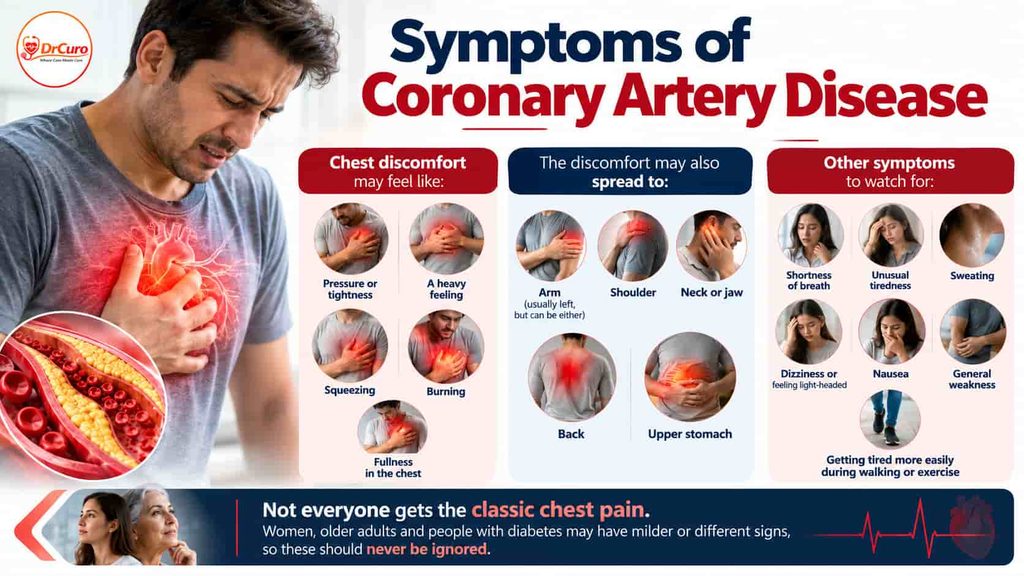
Other symptoms to watch for:
- Shortness of breath
- Unusual tiredness
- Sweating
- Dizziness or feeling light-headed
- Nausea
- General weakness
- Getting tired more easily during walking or exercise
Not everyone gets the classic chest pain. Women, older adults and people with diabetes may have milder or different signs, so these should never be ignored.
What Does Angina Feel Like?
Angina is a warning sign that your heart is not getting enough blood at that moment. It usually comes on when the heart has extra work to do, like walking fast, climbing stairs or dealing with stress. In many people, stable angina settles after a few minutes of rest or with the medicine their doctor has given them. But angina that is new, gets worse, comes on while resting, or lasts longer than usual can be a sign of a heart attack. This is an emergency, and you should not wait to see if it goes away.
Coronary Artery Disease in Women
Heart disease affects both men and women, but women often notice different symptoms, and these are sometimes mistaken for acidity, stress or simple tiredness. Because of this, many women get help late. Chest discomfort can still happen, but women may feel other things more strongly.
Symptoms more commonly noticed in women:
- Shortness of breath without any clear reason
- Unusual or heavy tiredness
- Nausea or an upset stomach
- Pain in the back, jaw or neck
- Dizziness
- Cold sweats
- Weakness
If something feels unusual for your body, it is always safer to get it checked.
How Is Coronary Artery Disease Diagnosed?
A doctor will first ask about your symptoms, your lifestyle, your past health problems and your family history. They will also examine you and check your blood pressure and heart rate. Depending on what they find, they may suggest one or more tests. Not everyone needs every test, and the choice depends on your symptoms and risk.
| Test | What It Does |
|---|---|
| Blood tests | Check cholesterol, blood sugar and other things linked to heart risk |
| ECG (electrocardiogram) | Records the electrical activity of the heart and can show heart problems |
| Echocardiogram | Uses sound waves to make a picture of the heart and show how well it pumps |
| Stress test | Checks how the heart works during exercise, or with medicine that makes the heart work harder |
| CT coronary angiography | Gives detailed pictures of the arteries and may show narrowing or plaque |
| Coronary angiography | Uses dye and X-rays to show exactly where and how severe the blockages are |
Treatment of Coronary Artery Disease
Treatment depends on how serious the disease is, what symptoms you have, your overall health and how much the arteries are blocked. The main goals are to improve blood flow, control symptoms, lower the chance of a heart attack and manage the factors that caused the problem. Your doctor may suggest lifestyle changes, medicines, a procedure, or a mix of these.
1. Lifestyle Changes
Healthy habits are the base of every CAD treatment plan. They do not replace medicines, but they work together with them and can lower your risk in a big way. Good heart care starts at home, with small steps that you can keep up every day.
Doctors often advise:
- Eating a heart-healthy diet with more vegetables, fruits, whole grains, pulses and nuts
- Cutting down on oily, fried and processed foods, and on saturated and trans fats
- Using less salt
- Keeping a healthy weight
- Staying active, as advised by your doctor
- Quitting smoking and all tobacco
- Limiting alcohol
- Managing stress through rest, hobbies, yoga or talking to someone you trust
- Sleeping well
- Going for regular check-ups
2. Medicines
Your doctor may prescribe medicines to control cholesterol, blood pressure, chest pain and the risk of blood clots. It is very important to take them exactly as advised. Never start, stop or change a heart medicine on your own, even if you feel better.
| Medicine Type | What It Helps With |
|---|---|
| Statins and other cholesterol medicines | Lower LDL (“bad”) cholesterol |
| Blood pressure medicines | Keep blood pressure under control |
| Antiplatelet medicines | Lower the chance of harmful blood clots |
| Beta-blockers | Reduce the heart’s workload and help control symptoms |
| Nitrates | Can relieve angina in suitable patients |
| Other heart medicines | Used based on each person’s needs |
3. Angioplasty and Stent
If an artery is badly narrowed or blocked, the doctor may suggest a procedure called angioplasty, also known as PCI. A thin, soft tube called a catheter is passed through a blood vessel, usually from the wrist or groin, up to the blocked artery. A tiny balloon at the tip is then inflated to open the narrow part. Often a small mesh tube called a stent is placed there to hold the artery open so blood can flow freely. Whether this is the right choice depends on where the blockage is, how severe it is and your general health.
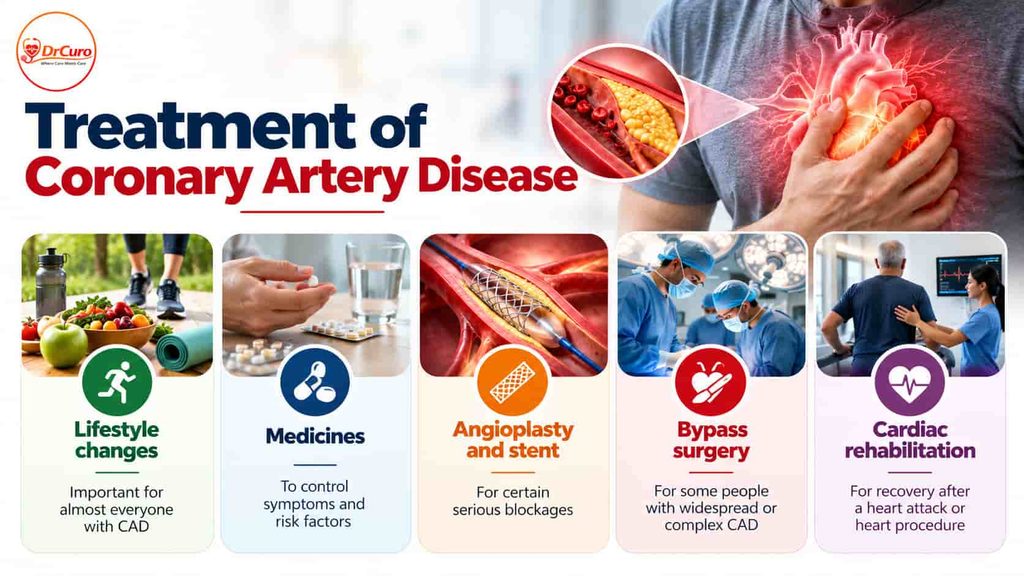
4. Coronary Artery Bypass Surgery
For some people, especially those with several badly blocked arteries, a surgery called coronary artery bypass grafting (CABG) may be the best option. In this surgery, the surgeon takes a healthy blood vessel from another part of your body, such as the leg, chest or arm, and uses it to make a new path for blood to reach the heart muscle, going around the blocked area. Your heart team will explain whether this is needed in your case.
5. Cardiac Rehabilitation
After a heart attack or a heart procedure, many people are advised to join a cardiac rehabilitation program. It is a supervised plan that includes safe exercise, diet guidance, stress management and education. It helps you regain strength, build confidence and lower the chance of future heart problems.
Treatment Options at a Glance
| Treatment | When It May Be Used |
|---|---|
| Lifestyle changes | Important for almost everyone with CAD |
| Medicines | To control symptoms and risk factors |
| Angioplasty and stent | For certain serious blockages |
| Bypass surgery | For some people with widespread or complex CAD |
| Cardiac rehabilitation | For recovery after a heart attack or heart procedure |
How Can Coronary Artery Disease Be Prevented?
Not every case of CAD can be prevented, because age and family history cannot be changed. But a large part of the risk is in your hands. Small habits that you keep up for years can protect your arteries far more than big changes that you drop after a few weeks.
Helpful habits include:
- Do not smoke or use tobacco in any form
- Keep your blood pressure under control
- Get your cholesterol checked regularly
- Check your blood sugar, especially if you have diabetes or a family history of it
- Keep a healthy weight
- Eat a balanced, home-style, low-salt and low-oil diet
- Exercise regularly, as your doctor allows
- Sleep well and manage stress
- Take your medicines on time
- Visit your doctor for regular check-ups
When Should You Get Emergency Help?
Chest pain should never be ignored when it is severe, new, unexplained or comes with other warning signs. A heart attack needs treatment as fast as possible, because every minute counts and heart muscle can get damaged quickly.
Call your local emergency number or go to the nearest hospital right away if you have:
- Severe or lasting chest pain or pressure
- Chest discomfort spreading to the arm, shoulder, jaw, neck or back
- Severe breathlessness
- Cold sweats
- Fainting or severe dizziness
- Sudden weakness
- Nausea or vomiting along with chest symptoms
Do not try to drive yourself, and do not wait for the symptoms to get worse. Try to note the time the symptoms began, because it helps the doctors decide on treatment.
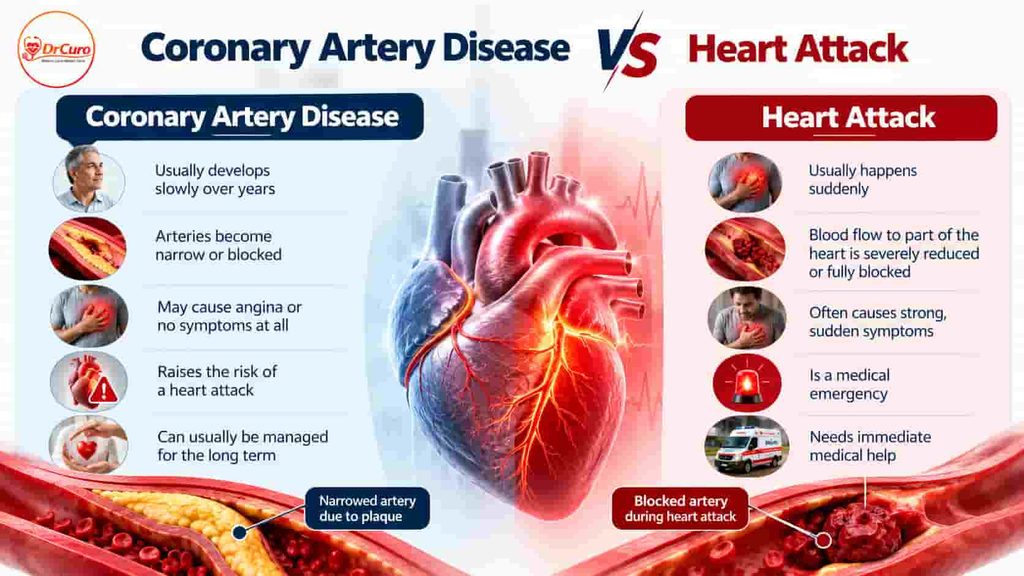
Coronary Artery Disease vs Heart Attack
These two terms are connected, but they are not the same. CAD is the long-term condition of narrowed arteries, while a heart attack is a sudden emergency that happens when blood flow to part of the heart is cut off.
| Coronary Artery Disease | Heart Attack |
|---|---|
| Usually develops slowly over years | Usually happens suddenly |
| Arteries become narrow or blocked | Blood flow to part of the heart is severely reduced or fully blocked |
| May cause angina or no symptoms at all | Often causes strong, sudden symptoms |
| Raises the risk of a heart attack | Is a medical emergency |
| Can usually be managed for the long term | Needs immediate medical help |
Frequently Asked Questions
Is coronary artery disease curable?
CAD is usually a long-term condition, which means it does not fully go away. However, it can be managed very well with healthy habits, medicines and, when needed, procedures. Early diagnosis and proper treatment lower the chance of serious problems, and many people with CAD live full and active lives.
Can coronary artery disease happen without symptoms?
Yes. Some people have CAD for a long time without any signs. This is why it is important to keep blood pressure, cholesterol, blood sugar, weight and smoking habits in check, and to go for regular check-ups, especially if you have risk factors.
Can young people get coronary artery disease?
The risk rises with age, but younger adults can get it too, especially if they smoke, have diabetes, high cholesterol, high blood pressure, are overweight or have a strong family history of heart disease.
Is chest pain always caused by coronary artery disease?
No. Chest pain can come from the heart, lungs, stomach, muscles and other causes. Still, new or unexplained chest pain should always be checked by a doctor, especially if it is strong or comes with breathlessness, sweating, dizziness or pain spreading to the arm or jaw.
Can lifestyle changes help with coronary artery disease?
Yes. Healthy eating, regular activity, quitting smoking, keeping a healthy weight and controlling blood pressure, cholesterol and blood sugar all help protect the heart and support your treatment.
Conclusion
Coronary artery disease grows quietly, but its effects can become serious if it is ignored. Warning signs such as chest discomfort, breathlessness, unusual tiredness or getting tired quickly during activity should push you to see a doctor in time. Looking after your cholesterol, blood pressure, blood sugar, weight, diet, activity and smoking habits is the best way to protect your heart for the long run. If you have symptoms or risk factors, speak with a qualified doctor instead of trying to diagnose yourself. DrCuro aims to share simple, reliable health information so that you can understand your heart better, spot warning signs early and make confident choices about getting medical care.


No Comment! Be the first one.