







IVF Injections: Types, Schedule & How to Manage Them
Introduction If you are preparing for IVF treatment, there is a good chance that the injections are the part you are most nervous about. Most couples who come for their first IVF cycle say the same...
Introduction
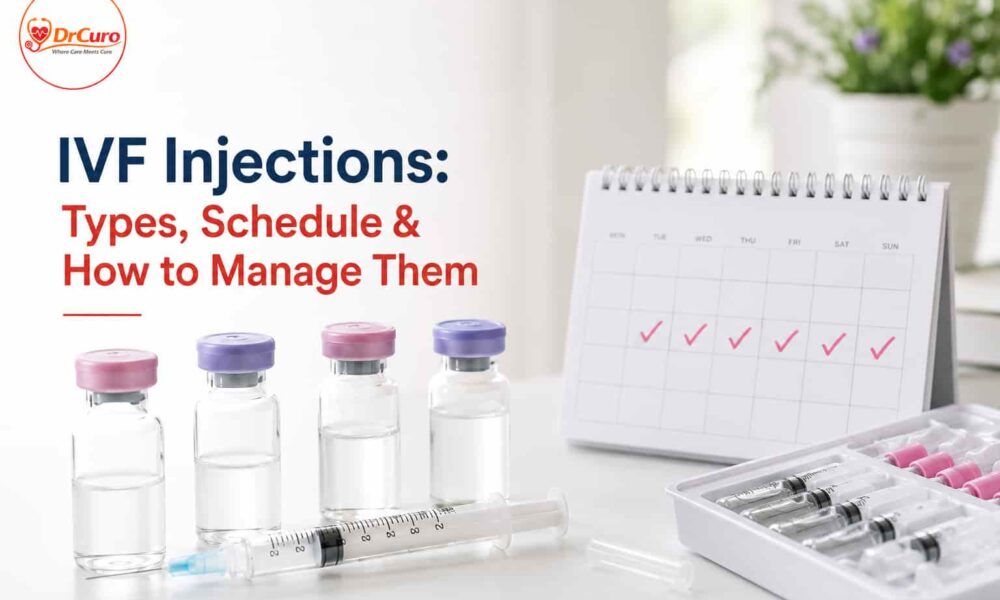
If you are preparing for IVF treatment, there is a good chance that the injections are the part you are most nervous about. Most couples who come for their first IVF cycle say the same thing the procedure itself feels less intimidating than the idea of daily injections at home, sometimes self-administered, over a period of nearly two weeks. That nervousness is completely understandable, and it almost always comes from not knowing what to expect.
Table Of Content
- Introduction
- Why IVF Injections Are Necessary
- The Four Stages Where IVF Injections Are Used
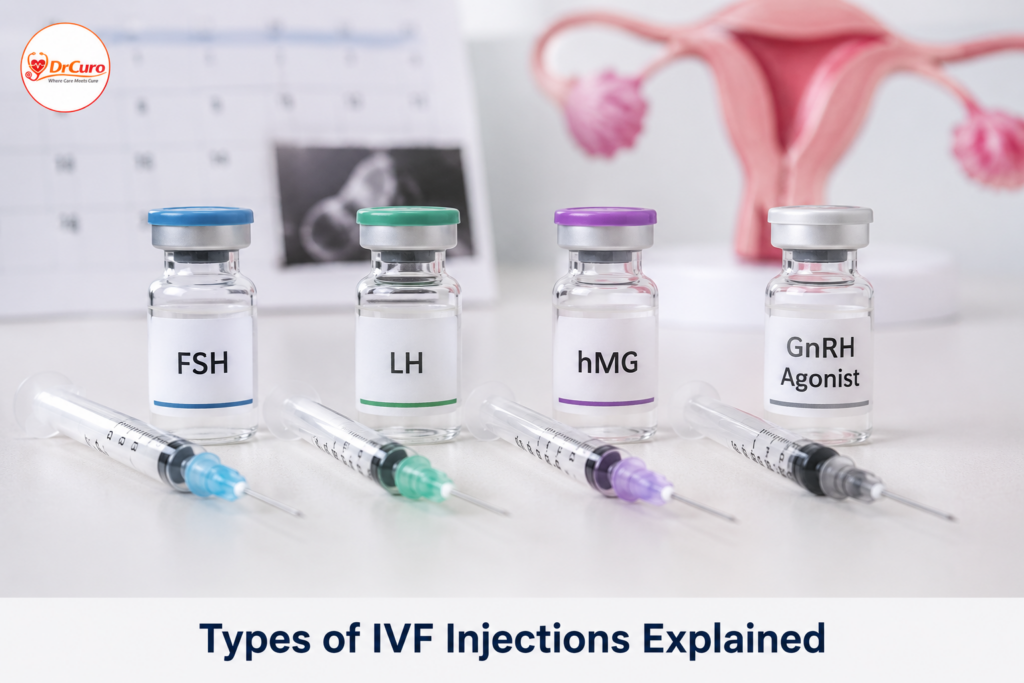
- Types of IVF Injections Explained
- 1. FSH (Follicle Stimulating Hormone) Injections
- 2. LH (Luteinizing Hormone) Injections
- 3. hMG (Human Menopausal Gonadotropin) Injections
- 4. GnRH Agonist Injections
- 5. GnRH Antagonist Injections
- 6. The Trigger Shot
- 7. Progesterone Injections
- A Realistic IVF Injection Schedule
- How to Manage IVF Injections at Home
- Side Effects and When to Be Concerned
- How Protocols Are Personalized at drcuro
- Emotional Side of IVF Injections
- Frequently Asked Questions
Here is the reality: IVF injections are not as frightening as they sound. The needles used are small. Most injections go just under the skin, not into muscle. The discomfort is usually described as a mild pinch or brief sting. And within a few days of starting, the vast majority of patients find that the process becomes routine just another part of the day, like taking a vitamin.
What makes IVF injections feel overwhelming is not the physical act of giving them. It is the uncertainty around why each one is needed, what it does inside your body, when it has to be given, and what happens if something goes wrong. This guide answers all of those questions clearly and honestly, in plain language. By the time you finish reading, IVF injections should feel like something you understand not something you fear.
Why IVF Injections Are Necessary
To understand why IVF requires so many injections, you first need to understand what IVF is trying to do that your body does not naturally do on its own.
In a natural menstrual cycle, your body selects one dominant follicle and matures one egg. That single egg is then released at ovulation. For IVF to work, doctors need to retrieve multiple mature eggs not one because not every egg will fertilize successfully, not every fertilized egg will develop into a healthy embryo, and not every embryo will implant. Having more eggs to work with gives the process more chances to succeed.
Your body will not produce multiple mature eggs on its own without help. IVF injections provide that help. They communicate with your ovaries using concentrated versions of the hormones your body already produces, pushing the ovaries to develop multiple follicles simultaneously rather than just one. Other injections then prevent your body from releasing those eggs too early, trigger final maturation at precisely the right moment, and support the uterine lining after embryo transfer.
Each injection in an IVF protocol has a specific job. None of them are optional extras. Removing any one of them from the process would compromise a different stage of the cycle. Understanding that each injection is purposeful not arbitrary is the first step toward feeling confident about the process.
The Four Stages Where IVF Injections Are Used
IVF injections are not given randomly throughout the cycle. They are organized into four distinct phases, each with a clear clinical purpose.
| Phase | Timing | Purpose |
| Ovarian Stimulation | Days 2–12 of cycle | Stimulate ovaries to grow multiple follicles |
| Ovulation Suppression | Days 5–12 (protocol dependent) | Prevent premature egg release |
| Trigger Shot | Day 10–14 (when follicles are ready) | Trigger final egg maturation before retrieval |
| Luteal Phase Support | After egg retrieval and embryo transfer | Support uterine lining and early pregnancy |
Each phase overlaps with the others in a carefully coordinated sequence. Your monitoring appointments the blood tests and ultrasound scans during stimulation allow your doctor to watch how your ovaries are responding and adjust the doses in real time if needed. The schedule is a plan, not a rigid timetable that cannot move.
Types of IVF Injections Explained
1. FSH (Follicle Stimulating Hormone) Injections
FSH injections are the backbone of almost every IVF stimulation protocol. They are usually the first injections you will start, typically on Day 2 or Day 3 of your cycle, and they continue daily for approximately 8 to 12 days depending on how your ovaries respond.
FSH is a hormone your pituitary gland naturally produces to stimulate follicle growth each month. During IVF, you receive concentrated doses of FSH to push your ovaries to develop not one follicle but many typically aiming for 8 to 15 follicles depending on your ovarian reserve and age. More follicles mean more eggs at retrieval, which means more embryos and a better statistical chance of a successful transfer.
The dose of FSH you receive is not standard. It is individualized based on your AMH level, your antral follicle count, your age, your body weight, and your response in previous cycles if you have done IVF before. A woman with a high ovarian reserve needs a lower dose than a woman with diminished reserve. This is why monitoring appointments matter your drcuro specialist is adjusting your FSH dose based on what your ovaries are actually doing, not what the textbook says they should do.
Common FSH medications you may be prescribed:
- Gonal-F (follitropin alfa)
- Puregon (follitropin beta)
- Fostimon (urofollitropin)
Typical side effects during FSH stimulation:
- Bloating and abdominal fullness as follicles grow
- Mild lower abdominal discomfort or pressure
- Breast tenderness
- Headaches
- Mood changes due to elevated estrogen levels
- Fatigue
These side effects are temporary and are directly related to your ovaries growing. They are, in a sense, proof that the injections are working. They typically resolve within a few days of egg retrieval.
2. LH (Luteinizing Hormone) Injections
LH is the second pituitary hormone involved in follicle development and egg maturation. While FSH drives follicle growth, LH supports the final stages of egg maturation inside those follicles. Some patients particularly those with low baseline LH levels, those who are older, or those who have had poor egg quality in previous cycles benefit from adding LH supplementation to their FSH protocol.
Not every IVF patient needs LH injections. Whether you need them depends on your hormone profile and how your body responds to FSH alone. Your doctor will make this decision based on your specific fertility history.
Common LH-containing medications:
- Luveris (lutropin alfa) — pure LH
- Pergoveris — combined FSH and LH in one injection
Adding LH to the protocol can sometimes improve egg quality in women who are poor responders or who have had poor fertilization rates in previous cycles. The evidence is strongest for women over 35 and those with diminished ovarian reserve.
3. hMG (Human Menopausal Gonadotropin) Injections
hMG is a naturally derived medication that contains both FSH and LH in a combined formulation. It was one of the original fertility medications used in IVF and continues to be used today, either as the primary stimulation medication or in combination with recombinant FSH.
hMG is particularly useful for patients who need both FSH and LH supplementation, as it delivers both in a single injection rather than requiring separate administrations. Some research suggests hMG may produce slightly better egg and embryo quality compared to FSH alone in certain patient groups, though results vary.
Common hMG medications:
- Menopur
- Merional
- Bravelle
4. GnRH Agonist Injections
GnRH agonist injections serve a specific and important purpose: they prevent your body from releasing its own LH surge, which would cause you to ovulate and release the follicles before your doctor can retrieve them. Losing eggs to premature ovulation before retrieval is one of the scenarios IVF protocols are specifically designed to prevent.
GnRH agonists work by initially causing a temporary surge in hormone production, followed by a sustained suppression of the pituitary gland’s output. This suppression is what prevents the natural LH surge from occurring during stimulation. In what is called the “long protocol,” GnRH agonist injections are started approximately one week before stimulation begins and continue alongside FSH throughout the stimulation phase.
Common GnRH agonist medications:
- Lupron (leuprolide acetate)
- Buserelin
- Nafarelin (sometimes given as a nasal spray rather than injection)
Side effects of GnRH agonists:
| Side Effect | Why It Happens | Duration |
| Hot flashes | Temporary estrogen suppression | Resolves once stimulation begins |
| Headaches | Hormonal fluctuation | Usually mild and short-lived |
| Mood swings | Hormonal suppression | Temporary |
| Fatigue | Low estrogen state | Resolves with stimulation |
| Vaginal dryness | Estrogen suppression | Temporary |
These effects are caused by the initial phase of hormonal suppression and typically improve significantly once FSH stimulation begins and estrogen levels start rising again.
5. GnRH Antagonist Injections
GnRH antagonists serve the same fundamental purpose as agonists preventing premature ovulation — but they work through a completely different mechanism and are now the more commonly used option in modern IVF protocols worldwide.
Unlike agonists, antagonists do not cause an initial hormone surge. They work immediately, blocking the GnRH receptors in the pituitary gland and stopping LH production within hours of the first dose. This means they are started later in the cycle typically around Day 5 or 6 of stimulation when follicles have already reached a certain size rather than weeks in advance like agonists.
The antagonist protocol is shorter, simpler, and associated with a significantly lower risk of ovarian hyperstimulation syndrome (OHSS) compared to agonist protocols. This makes it the preferred choice for women with PCOS, high AMH levels, or any history of OHSS.
Common GnRH antagonist medications:
- Cetrotide (cetrorelix)
- Orgalutran (ganirelix)
| Feature | GnRH Agonist Protocol | GnRH Antagonist Protocol |
| When started | ~1 week before stimulation | Day 5–6 of stimulation |
| How it works | Suppresses after initial flare | Immediate suppression |
| Duration | Longer (3–4 weeks total) | Shorter (8–12 days total) |
| OHSS risk | Higher | Lower |
| Best for | Standard/low responders | PCOS, high responders |
| Flexibility | Less flexible | More flexible scheduling |
6. The Trigger Shot
The trigger shot is arguably the most time-critical injection in the entire IVF process. It is given as a single dose when your follicles have reached the appropriate size typically when the lead follicles are approximately 17–18mm in diameter and its job is to trigger the final maturation of the eggs inside those follicles.
Egg retrieval is scheduled precisely 34 to 36 hours after the trigger shot. This timing is not approximate it is exact. If the trigger is given too early, the eggs will not be mature enough to fertilize. If it is given too late, the follicles may have already ruptured and the eggs will be lost. The trigger shot must be taken at the exact time your clinic specifies, even if that time is in the middle of the night.
Types of trigger shots:
| Type | Medication | Best Used For |
| hCG trigger | Ovitrelle, Pregnyl | Standard IVF patients |
| GnRH agonist trigger | Buserelin, Lupron | High OHSS risk patients |
| Dual trigger | Both hCG + GnRH agonist | Poor egg maturity in previous cycles |
Women at high risk of OHSS are often given a GnRH agonist trigger instead of the standard hCG trigger, as it reduces the OHSS risk significantly while still achieving adequate egg maturation.
Critical rules for the trigger shot:
- Take it at the exact time your doctor specifies set multiple alarms
- Do not take it earlier or later, even by an hour, without calling your clinic first
- If you vomit within 30 minutes of an oral trigger (some are given as injections, some as nasal sprays), contact your clinic immediately
- Store it according to instructions some require refrigeration, others do not
7. Progesterone Injections
After egg retrieval, your body needs progesterone support to prepare the uterine lining for embryo implantation and to sustain early pregnancy. The egg retrieval process removes the follicles that would normally produce progesterone after ovulation, so your body needs external supplementation.
Progesterone support typically begins 1 to 3 days after egg retrieval and continues for several weeks after a positive pregnancy test often until the 10th to 12th week of pregnancy when the placenta takes over progesterone production. This is one of the most important and longest-running parts of the IVF medication protocol, and stopping it too early can result in miscarriage.
Forms of progesterone used in IVF:
| Form | Method | Common Brands | Notes |
| Oil-based injection | Intramuscular (into muscle) | Progesterone in oil | Most effective absorption; injection site soreness common |
| Water-based injection | Subcutaneous (under skin) | Prolutex | Less painful than oil-based |
| Vaginal gel | Inserted vaginally | Crinone | No injection needed; local delivery |
| Vaginal suppository | Inserted vaginally | Utrogestan, Endometrin | Convenient but may cause discharge |
| Oral capsules | Swallowed | Utrogestan | Sometimes used as supplement |
Many IVF protocols use a combination of forms for example, vaginal progesterone plus intramuscular injections to maximize uterine levels. Side effects of progesterone support:
- Injection site soreness, redness, or hardness (with intramuscular injections)
- Fatigue and drowsiness
- Breast tenderness
- Bloating
- Mood changes
- Vaginal discharge (with vaginal forms)
Rotating intramuscular injection sites and applying a warm compress after the injection can significantly reduce soreness over time.
A Realistic IVF Injection Schedule
This is a representative IVF cycle using an antagonist protocol the most commonly used approach in modern fertility treatment. Your schedule may differ based on your protocol, response, and clinic preferences.
| Day | What Happens | Injections |
| Day 1–2 | Baseline scan and blood tests | None — assessment only |
| Day 2–3 | Stimulation begins | FSH injection starts |
| Day 5–6 | Follicle monitoring scan | FSH continues; antagonist injection added |
| Day 7–8 | Second monitoring scan | FSH + antagonist continue; dose adjusted if needed |
| Day 9–10 | Third monitoring scan | FSH + antagonist; trigger shot timing assessed |
| Day 10–14 | Trigger shot given at exact specified time | Single trigger injection |
| Day 12–16 | Egg retrieval (34–36 hours after trigger) | No injections on day of retrieval |
| Day 13–17 | Progesterone support begins | Progesterone injections and/or suppositories |
| Day 18–21 | Embryo transfer (Day 3 or Day 5 embryo) | Progesterone continues |
| Day 28–32 | Pregnancy blood test | Progesterone continues until result |
| If positive | Progesterone continues | Until Week 10–12 of pregnancy |
How to Manage IVF Injections at Home
Managing daily injections at home is one of the aspects of IVF that worries couples the most before they start, and one of the things they feel most confident about within a week of beginning. Here is what actually makes the difference.
Set a consistent daily time and stick to it. Hormone levels work best when maintained steadily, and missing or delaying injections by several hours can affect your follicle development. Pick a time that works every day evening after dinner is popular and set multiple phone alarms as backup. Never rely on memory alone.
Create a dedicated injection station. Keep everything you need in one place: medications, syringes, needles, alcohol swabs, a sharps disposal container, and a written copy of your schedule. Hunting for supplies when you are already anxious about an injection makes everything harder. Organization removes one layer of stress entirely.
Rotate your injection sites systematically. If you are injecting into the abdomen, alternate sides left one day, right the next and vary the exact spot slightly each time. Injecting repeatedly into the same area causes bruising, hardness, and increased soreness. A mental map of where you have injected helps, or mark it on a simple body diagram.
Use ice strategically. Applying an ice cube or cold pack to the injection site for 30 to 60 seconds before injecting can numb the skin and reduce the pinch. Some people find this helpful; others find it unnecessary. Try it and see what works for you. A warm compress after the injection (especially after progesterone injections) helps the medication absorb and reduces site soreness.
Do not adjust doses on your own. This sounds obvious but it happens. If an injection is painful, if you feel like you are over-responding, if you think you gave the wrong dose call your clinic. Do not compensate by taking more or less the next day. Even small deviations in FSH dosing can affect your follicle development.
What to do if you miss an injection:
- Do not panic and do not double-dose the next injection
- Call your clinic immediately, even if it is outside normal hours most fertility clinics have an on-call line for exactly this situation
- The on-call specialist will advise whether the missed dose can be taken late or whether the schedule needs adjusting
- Document what happened so your monitoring scan results can be interpreted in context
Side Effects and When to Be Concerned
Most side effects of IVF injections are expected, temporary, and manageable at home. However, some symptoms require immediate medical attention.
| Symptom | Likely Cause | Action Required |
| Mild bloating and abdominal fullness | Normal response to follicle growth | Expected — monitor |
| Headaches and fatigue | Hormonal changes | Expected — rest and hydrate |
| Mood swings and irritability | Elevated estrogen or suppression | Expected — communicate with partner |
| Injection site redness or mild bruising | Normal injection response | Rotate sites; warm compress |
| Significant rapid weight gain (2+ kg in 24–48 hours) | Early OHSS warning sign | Call clinic immediately |
| Severe abdominal pain and distension | Possible OHSS | Seek urgent medical care |
| Shortness of breath | Severe OHSS | Go to emergency immediately |
| Injection site swelling, warmth, or hardness that worsens | Possible infection | Contact clinic |
Ovarian Hyperstimulation Syndrome (OHSS) is the most significant potential complication of IVF stimulation. Modern protocols particularly antagonist protocols with GnRH agonist triggers have reduced the incidence of severe OHSS dramatically. At drcuro, monitoring is structured specifically to catch early OHSS warning signs before they escalate, including mid-cycle dose adjustments and the option to freeze all embryos rather than proceeding to a fresh transfer if OHSS risk is elevated.
How Protocols Are Personalized at drcuro
No two IVF patients are the same, which means no two IVF injection protocols should be identical either. The medications your friend took during her IVF cycle may be completely different from what you need different drugs, different doses, different timing, different protocol structure. Using someone else’s experience as a reference point for your own treatment is one of the most common sources of unnecessary anxiety.
At drcuro, protocol decisions are based on:
- AMH level and antral follicle count — to estimate ovarian reserve and calibrate FSH dose
- Age — affects both expected response and egg quality considerations
- BMI — influences medication absorption and dosing
- Previous IVF history — if you have done IVF before, your response data from previous cycles is the most accurate predictor of how you will respond again
- Diagnosis — PCOS, endometriosis, poor ovarian reserve, and unexplained infertility each point toward different protocol choices
- OHSS risk — high-risk patients receive antagonist protocols, lower trigger doses, and often a freeze-all strategy
The goal of personalization is not complexity for its own sake. It is making sure the right medication reaches the right ovary in the right amount at the right time because that is what gives each cycle the best possible chance.
Emotional Side of IVF Injections
The physical side of IVF injections is, for most people, more manageable than they expected. The emotional side is harder and less discussed.
Daily injections are a daily reminder that you are going through something difficult. Each injection represents hope, but also uncertainty. Some days the routine feels empowering you are doing something active toward your goal. Other days it feels exhausting, isolating, and frightening, especially when you do not know yet whether any of it will work.
A few things that genuinely help:
- Tell your partner specifically how they can help — holding your hand, preparing the supplies, being present during the injection. Vague emotional support is less useful than a concrete role.
- Join a peer community — online or in-person fertility support groups connect you with people who understand what the two-week wait feels like, what it feels like to give yourself an injection at 11pm, and what it feels like when a cycle fails. That shared understanding is genuinely valuable.
- Give yourself permission to have bad days — not every day of an IVF cycle needs to be managed with positivity. Some days are hard. Acknowledging that without catastrophizing it is a skill worth developing.
- Stay informed but set limits on research — understanding your treatment helps. Going down a three-hour Google rabbit hole at midnight about implantation failure statistics does not. Know the difference.
Frequently Asked Questions
1. How many injections will I need in total during IVF? It varies by protocol, but most patients give themselves approximately 20 to 40 injections across a full IVF cycle — roughly one to three per day during stimulation, plus daily progesterone support after transfer. The number sounds large but the routine becomes manageable quickly.
2. Can I really give these injections to myself? Yes, and the majority of IVF patients do. Your clinic will train you before you start, and modern injection pens (used for FSH medications like Gonal-F and Puregon) are specifically designed for easy self-administration. Intramuscular progesterone injections are slightly more challenging some couples prefer a partner to administer these.
3. What if I am genuinely needle-phobic? Tell your clinic before you start. There are options some medications have nasal spray alternatives, vaginal progesterone avoids injections entirely, and some clinics offer nurse-administered injections. Needle phobia is not a barrier to IVF, but it does need to be planned around.
4. Do IVF injections affect my eggs negatively? No. The injections stimulate your ovaries to mature eggs that would otherwise have been lost in that cycle. They do not create new eggs or damage the eggs that develop.
5. Why does the trigger shot have to be so precisely timed? Egg retrieval is scheduled exactly 34 to 36 hours after the trigger. If retrieval happens too early, the eggs are not yet mature enough to fertilize. If it happens too late, the follicles may have already ruptured spontaneously and the eggs are gone. The trigger shot starts a biological countdown that cannot be paused.
6. How long do I continue progesterone injections after embryo transfer? If the pregnancy test is negative, progesterone is stopped and a withdrawal bleed follows within a few days. If the test is positive, progesterone continues typically until week 10 to 12 of pregnancy, when the placenta takes over its own progesterone production.


No Comment! Be the first one.