







Why IVF Fails: Top Reasons, Warning Signs & How to Improve Your Chances
Introduction IVF fails more often than it succeeds and that is the clinical reality every couple needs to understand before beginning treatment. Globally, IVF success rates per cycle range from...
Introduction
IVF fails more often than it succeeds and that is the clinical reality every couple needs to understand before beginning treatment. Globally, IVF success rates per cycle range from roughly 40–50% for women under 35, and drop to below 15% for women above 42. That means even under optimal conditions, the majority of first IVF attempts do not result in a live birth. Despite this, most couples enter IVF underprepared for failure, and when a cycle does not work, they are left with one urgent question: Why?
Table Of Content
- Introduction
- The Most Significant Reasons Why IVF Fails
- 1. Chromosomal Abnormalities in Embryos
- 2. Poor Egg Quality
- 3. Sperm DNA Fragmentation
- 4. Uterine and Endometrial Problems
- 5. Endometriosis
- 6. Poor Ovarian Response to Stimulation
- 7. Recurrent Implantation Failure
- 8. Lifestyle Factors — What the Evidence Actually Shows
- 9. Hidden Medical Conditions
- What to Do After a Failed IVF Cycle
- Summary: Why IVF Fails — Quick Reference
- Conclusion
- Frequently Asked Questions
The answer is rarely straightforward. IVF failure is almost never caused by a single factor. It is typically the result of multiple overlapping variables biological, genetic, hormonal, and sometimes lifestyle-related that interact in ways that are not always predictable in advance. At drcuro, we work with couples not just to treat infertility but to understand it. That means examining every potential reason why IVF might fail before a cycle begins, not only after one has already ended in disappointment.
This guide covers the most clinically significant reasons why IVF fails, what the evidence actually shows, and what can realistically be done to improve your chances in future cycles.
What Does IVF Failure Actually Mean?
IVF failure is not one single event. It can occur at several distinct stages of the process, and identifying where the failure happened is the first step toward understanding why it happened.
| Stage of Failure | What Happens | Clinical Term |
| Ovarian stimulation | Ovaries don’t produce enough mature eggs | Poor Ovarian Response (POR) |
| Fertilization | Eggs retrieved but sperm fails to fertilize | Fertilization Failure |
| Embryo development | Fertilization occurs but embryo stops developing | Embryo Arrest |
| Implantation | Good embryo transferred but doesn’t implant | Implantation Failure |
| Early pregnancy | Implantation occurs but pregnancy is lost | Biochemical Pregnancy / Miscarriage |
Each failure point has different causes, different diagnostic pathways, and different solutions. Understanding where in the process things went wrong is essential before deciding how to approach the next cycle.
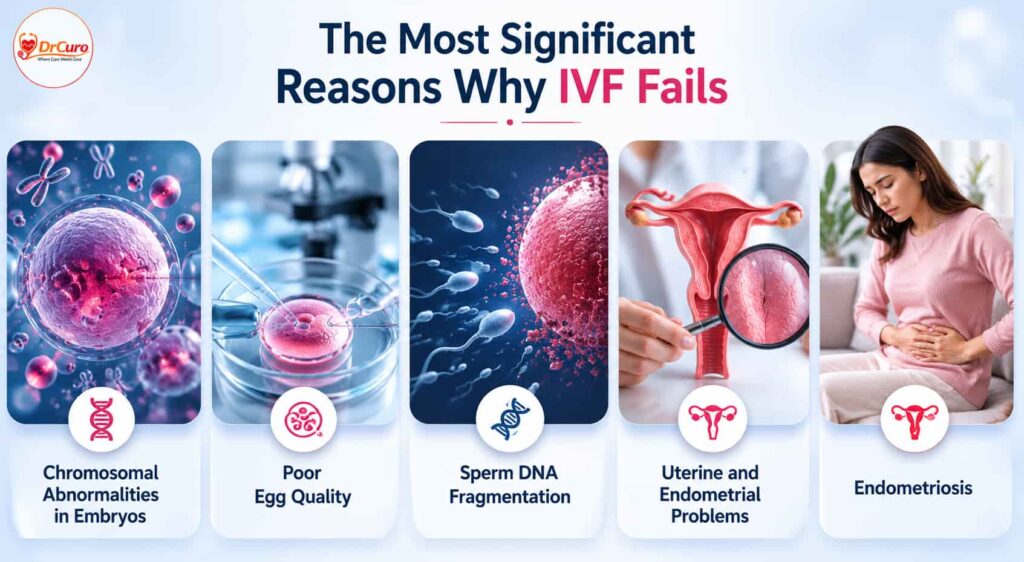
The Most Significant Reasons Why IVF Fails
1. Chromosomal Abnormalities in Embryos
If there is one factor that dominates IVF failure across all age groups, it is chromosomal abnormality in the embryo. Research consistently shows that 50–70% of human embryos carry chromosomal errors an abnormal number of chromosomes that makes successful implantation biologically impossible. These embryos may look morphologically perfect in the laboratory. They may grade well on visual assessment. And then they fail to implant, or they implant briefly and result in early miscarriage. This is not a treatment error. It is a fundamental biological reality of human reproduction.
Chromosomal abnormality rates increase sharply with maternal age, which is the core reason age remains the strongest single predictor of IVF success. It is not simply about having fewer eggs as you get older it is specifically about the chromosomal integrity of those eggs.
| Maternal Age | Approximate Rate of Chromosomally Abnormal Embryos |
| Under 35 | ~50% |
| 35–37 | ~60% |
| 38–40 | ~70–80% |
| Over 42 | ~90%+ |
What can be done:
- Preimplantation Genetic Testing for Aneuploidies (PGT-A) screens embryos for chromosomal errors before transfer
- Only chromosomally normal embryos are selected for transfer, improving implantation rates
- PGT-A does not create better embryos it identifies which ones have the highest chance of success
- Most beneficial for women over 37, those with recurrent implantation failure, and those with recurrent miscarriage
2. Poor Egg Quality
Egg quality is the second major driver of IVF failure and one of the least reversible factors in fertility treatment. Egg quality refers to the developmental competence of an egg its ability to fertilize normally, divide properly, and produce a chromosomally healthy embryo. Quality declines with age because of cumulative oxidative damage to the mitochondria inside the egg, which serve as the energy source powering early embryo development.
What makes this particularly challenging is that egg quality cannot be directly measured before retrieval. Tests like AMH (Anti-Müllerian Hormone) and Antral Follicle Count tell you about egg quantity how many eggs your ovaries are likely to produce but reveal nothing about quality. A woman can have a high AMH and still produce poor-quality eggs if she is older or has significant oxidative stress.
Signs that suggest poor egg quality:
- Low fertilization rate despite normal-looking sperm
- Embryos that stop developing before reaching blastocyst stage (Day 5)
- Repeated IVF failure with no identifiable uterine cause
- Recurrent miscarriage in previous pregnancies
- Very few eggs reaching maturity despite adequate ovarian response
What can be done:
- Begin optimizing egg health at least 3 months before IVF egg maturation takes approximately 90 days
- CoQ10 supplementation is the most studied antioxidant for egg quality improvement
- Stop smoking completely it accelerates ovarian aging more than almost any other lifestyle factor
- Maintain a healthy BMI both obesity and being underweight disrupt hormonal balance
- Minimize exposure to environmental toxins where possible
- Follow your drcuro specialist’s individualized supplementation plan
3. Sperm DNA Fragmentation
Low sperm count and poor motility are well-recognized fertility problems. What receives far less attention yet has growing clinical significance is sperm DNA fragmentation. This refers to breaks or damage in the genetic material carried by the sperm. A sperm with high DNA fragmentation can still fertilize an egg. The embryo may even begin developing normally in the early stages. But the underlying DNA damage undermines embryo development beyond a certain point, increases miscarriage risk significantly, and reduces the probability of successful implantation.
The critical problem is that standard semen analysis does not assess DNA fragmentation. A man can receive a “normal” semen analysis result and still have high fragmentation levels that are silently contributing to repeated IVF failure. This is one of the most underdiagnosed contributors to unexplained IVF failure.
| Sperm Problem | Detected by Standard Analysis? | Impact on IVF |
| Low count | Yes | Reduces fertilization chance |
| Poor motility | Yes | Reduces fertilization chance |
| Abnormal morphology | Yes | Reduces fertilization chance |
| DNA fragmentation | No | Impairs embryo development, raises miscarriage risk |
What can be done:
- Request a Sperm DNA Fragmentation Index (DFI) test if IVF has failed without a clear explanation
- Quit smoking it is one of the most significant causes of elevated DNA fragmentation
- Avoid prolonged heat exposure to the scrotum (hot baths, saunas, laptops on lap)
- Treat varicocele if present this is a surgically correctable cause of high fragmentation
- Antioxidant supplementation (Vitamin C, Vitamin E, selenium, CoQ10) can reduce fragmentation levels over approximately 3 months
- ICSI is standard in most IVF protocols and helps with fertilization, but does not eliminate the downstream effects of fragmented DNA
4. Uterine and Endometrial Problems
Even a chromosomally normal, high-quality embryo cannot implant successfully if the uterine environment is not receptive. Uterine abnormalities account for a meaningful proportion of implantation failures, and most of them are both detectable and treatable before IVF begins making pre-IVF uterine evaluation one of the highest-value steps in the preparation process.
At drcuro, uterine evaluation is a standard part of every pre-IVF workup, not an optional investigation. Transferring a good embryo into an unprepared or abnormal uterus is one of the most preventable causes of IVF failure.
| Uterine Condition | How It Causes IVF Failure | Treatment Before IVF |
| Endometrial polyps | Physically disrupts implantation site | Hysteroscopic removal |
| Submucosal fibroids | Distorts uterine cavity, impairs implantation | Surgical removal |
| Intrauterine adhesions | Reduces functional endometrial surface | Hysteroscopic adhesiolysis |
| Thin endometrium (<7mm) | Insufficient lining for embryo attachment | Estrogen therapy, blood flow improvement |
| Hydrosalpinx | Toxic fluid leaks into uterine cavity | Surgical correction before IVF |
| Congenital abnormalities | Structural barrier to implantation | Assessed case by case |
What can be done:
- Undergo saline infusion sonography (SIS) or diagnostic hysteroscopy before your first IVF cycle
- Do not skip uterine evaluation even if a previous cycle showed a normal uterus conditions can develop between cycles
- Ensure endometrial thickness is monitored during stimulation and at the time of transfer
- Discuss hydrosalpinx treatment specifically if you have a history of tubal disease
5. Endometriosis
Endometriosis affects an estimated 10% of women of reproductive age, and its impact on IVF is multifactorial which is precisely why it deserves separate consideration from other uterine conditions. Unlike a polyp or fibroid, endometriosis doesn’t interfere with IVF at a single point. It affects egg quality, ovarian reserve, embryo quality, and endometrial receptivity simultaneously. Women with severe endometriosis (Stage III–IV) have consistently lower IVF success rates than those without the condition, though IVF remains one of the most effective fertility treatment options for this group.
The inflammatory environment that endometriosis creates causes oxidative stress that damages developing eggs, lowers fertilization rates, impairs embryo development, and reduces the implantation potential of the endometrium all at once. Endometriomas (ovarian cysts caused by endometriosis) add another layer of complexity because their surgical removal, while sometimes necessary, can itself reduce ovarian reserve.
How endometriosis affects IVF at each stage:
- Ovarian stimulation: Endometriomas reduce functional ovarian tissue, leading to fewer eggs retrieved
- Egg quality: Inflammatory cytokines and oxidative stress in the follicular fluid damage egg development
- Embryo quality: Lower egg quality directly translates to lower embryo quality
- Implantation: Elevated inflammatory markers in the uterine environment impair embryo attachment
- Early pregnancy: Higher miscarriage rates compared to patients without endometriosis
What can be done:
- Discuss pre-IVF suppression therapy with your specialist GnRH agonist treatment in the months before IVF may improve outcomes for moderate-to-severe endometriosis
- Carefully weigh the risks and benefits of operating on endometriomas before IVF surgery can help the uterine environment but may reduce egg numbers
- Ensure endometriosis is diagnosed and staged accurately before starting IVF, not discovered incidentally during a failed cycle review
6. Poor Ovarian Response to Stimulation
IVF requires controlled ovarian stimulation to produce multiple mature eggs. Poor Ovarian Response (POR) defined as retrieving fewer than 3–4 mature eggs despite maximal stimulation severely limits the number of embryos available and therefore reduces the statistical probability of having a viable embryo to transfer. It is more common in women with diminished ovarian reserve, those over 38, and those who have had previous ovarian surgery.
Poor response is not always predictable. Some women with relatively normal AMH levels still respond poorly, while others with low AMH respond adequately. This is why individualized stimulation protocols matter far more than following a generic dosing approach.
Factors that increase the risk of poor ovarian response:
- Low AMH or low Antral Follicle Count (AFC)
- Age above 38
- Previous ovarian surgery (including endometrioma removal)
- Prior history of poor response in a previous IVF cycle
- Smoking history
- Genetic factors affecting ovarian aging
What can be done
- Ensure your stimulation protocol is genuinely individualized not a default protocol applied to every patient
- Consider DHEA supplementation for 3–6 months before IVF if diminished ovarian reserve is confirmed (discuss with your specialist)
- Mini-IVF or modified natural cycle IVF may be appropriate in very poor responders where conventional stimulation yields minimal benefit
- Luteal phase stimulation or double stimulation (DuoStim) can sometimes retrieve additional eggs in the same menstrual cycle
7. Recurrent Implantation Failure
Recurrent implantation failure (RIF) typically defined as failure to achieve pregnancy after transfer of three or more good-quality embryos is one of the most diagnostically challenging scenarios in reproductive medicine. The embryo quality is confirmed, the uterus looks normal on imaging, and still implantation does not occur. This accounts for a subset of IVF failures that requires a more investigative approach.
The causes of RIF are multiple and often overlapping, which is why a single test rarely gives the complete answer.
| Potential Cause | Diagnostic Test | Treatment Approach |
| Displaced implantation window | ERA (Endometrial Receptivity Analysis) | Personalized transfer timing |
| Thrombophilia | Blood clotting panel (Factor V, APS) | Anticoagulation therapy |
| Elevated uterine NK cells | Endometrial biopsy | Immunotherapy (specialist-guided) |
| Chromosomally abnormal embryos | PGT-A | Transfer only normal embryos |
| Microbiome imbalance | EMMA/ALICE endometrial testing | Targeted antibiotic/probiotic protocol |
| Thin or unreceptive endometrium | Monitoring + ERA | Protocol adjustment |
What can be done:
- Do not repeat the same protocol after three failed transfers without a proper RIF workup
- ERA testing is particularly useful when transfers have consistently failed despite good embryo quality
- Thrombophilia screening should be standard in RIF investigation
- Immunological treatments exist but evidence quality varies approach with appropriate skepticism and specialist guidance
8. Lifestyle Factors — What the Evidence Actually Shows
Lifestyle is simultaneously the most discussed and most misunderstood contributor to IVF failure. It tends to be overstated in consultations because it is within patient control, and quietly dismissed by patients who don’t want to hear it. Neither approach serves couples well. The honest position is that certain lifestyle factors have meaningful, evidence-backed impact on IVF outcomes and others are largely myth.
Lifestyle factors ranked by strength of evidence:
| Factor | Evidence Strength | Impact on IVF |
| Smoking (both partners) | Strong | Accelerates ovarian aging, raises DNA fragmentation, reduces implantation rates |
| Obesity (BMI >30) | Strong | Reduces ovarian response, impairs endometrial receptivity, raises miscarriage risk |
| Being underweight (BMI <18.5) | Moderate | Disrupts hormonal balance, reduces ovarian response |
| Alcohol (heavy use) | Moderate | Reduces egg quality, impairs embryo development |
| Chronic sleep deprivation | Moderate | Elevates cortisol, disrupts reproductive hormones |
| Chronic stress | Weak (direct causation) | Indirectly affects compliance, sleep, and cortisol |
| Diet quality | Emerging | Mediterranean-style diet associated with better outcomes |
| Moderate exercise | Weak | General health benefit; extreme exercise may be harmful |
What can be done:
- Stop smoking completely not “cut down” at least three months before IVF begins
- Achieve a BMI between 18.5 and 29.9 before starting treatment where possible
- Avoid alcohol during an active IVF cycle
- Prioritize sleep 7–8 hours consistently during stimulation and the two-week wait
- Do not feel obligated to eliminate all stress, but do build in practical stress management to protect sleep and treatment adherence
9. Hidden Medical Conditions
Several systemic health conditions can quietly undermine IVF success without being obvious from symptoms alone. These are frequently missed when pre-IVF workups are superficial.
Key conditions and their IVF impact:
| Condition | How It Affects IVF | What to Check |
| Subclinical hypothyroidism | Impairs implantation, raises miscarriage risk | TSH (target <2.5 mIU/L for fertility) |
| Antiphospholipid syndrome | Impairs placentation, causes recurrent loss | APS antibody panel |
| Uncontrolled diabetes | Affects egg quality, embryo development | HbA1c, fasting glucose |
| Hyperprolactinemia | Disrupts ovulation and luteal phase | Prolactin levels |
| Autoimmune thyroid disease | Raises miscarriage risk even with normal TSH | Anti-TPO, anti-thyroglobulin antibodies |
| Chronic endometritis | Subclinical uterine infection impairs implantation | Endometrial biopsy (CD138 staining) |
At drcuro, pre-IVF screening includes thyroid function, autoimmune markers, and metabolic assessment as standard because these are modifiable factors that directly influence outcomes and are too often overlooked in rushed workups.
What to Do After a Failed IVF Cycle
A failed IVF cycle is not a dead end, but it is only useful if it is analyzed systematically. Repeating the same protocol without investigation is one of the most common and most costly mistakes couples make after a failed cycle.
A structured post-cycle review should cover:
- How many eggs were retrieved, and was the stimulation protocol truly optimized?
- What was the fertilization rate, and was ICSI used?
- Did embryos reach blastocyst stage, or did they arrest early?
- Was the embryo transferred genuinely high quality, or was transfer done despite suboptimal embryo grade?
- Was the uterus recently and thoroughly evaluated?
- Has sperm DNA fragmentation been tested?
- Is PGT-A appropriate for the next cycle given the patient’s age and history?
- What has changed in lifestyle or health status since the last cycle?
The couples who eventually succeed with IVF including after multiple failures almost always do so because something specific was identified and changed, not because they simply tried again with the same approach and got lucky.
Summary: Why IVF Fails — Quick Reference
| Category | Main Causes | Key Action |
| Embryo | Chromosomal abnormalities | Consider PGT-A testing |
| Egg | Age-related quality decline, oxidative stress | Optimize 3 months before IVF |
| Sperm | DNA fragmentation (often undetected) | DFI testing, lifestyle change |
| Uterus | Polyps, fibroids, thin lining, hydrosalpinx | Pre-IVF hysteroscopy/SIS |
| Endometriosis | Affects egg, embryo, and implantation | Staging and individualized protocol |
| Ovarian response | Poor stimulation outcome | Individualized protocol |
| Implantation | Displaced window, immune, thrombophilia | ERA, clotting panel, immune workup |
| Lifestyle | Smoking, obesity, alcohol | Address minimum 3 months before IVF |
| Hidden conditions | Thyroid, APS, diabetes, endometritis | Thorough pre-IVF screening |
Conclusion
IVF fails for reasons that are biological, genetic, physiological, and sometimes still incompletely understood even by reproductive specialists. What couples can control is the quality and thoroughness of their evaluation, how well known risk factors are addressed before treatment begins, and how systematically failed cycles are reviewed before attempting again.
At drcuro, the approach to IVF is built on one principle: understanding why a cycle might fail before it does is always more valuable than trying to explain why it did fail afterward. Every couple’s fertility situation is different, and the path forward after a failed cycle depends entirely on what that specific cycle revealed. With the right workup, the right protocol adjustments, and a clear-eyed understanding of what the evidence does and does not support, many couples who have experienced IVF failure go on to achieve the pregnancies they were working toward.
The question is never whether to continue. It is always how to continue smarter.
Frequently Asked Questions
1. How common is IVF failure on the first attempt? Very common. Depending on age and diagnosis, 50–70% of first IVF cycles do not result in a live birth. A first-cycle failure does not predict what future cycles will produce.
2. Can I get pregnant after multiple failed IVF cycles? Yes. Many couples succeed after three or more cycles particularly when the protocol is meaningfully adjusted based on what previous cycles revealed rather than simply repeated.
3. Is chromosomal testing of embryos always recommended? Not universally. PGT-A adds the most value for women over 37, those with recurrent implantation failure, and those with a history of recurrent miscarriage. Whether the benefit justifies the cost in your specific situation is a conversation to have with your specialist.
4. Does stress directly cause IVF failure? The direct causal evidence is weak. Chronic stress does not reliably cause implantation failure, but it has indirect effects on sleep, cortisol levels, and treatment compliance that matter. Manage it for overall wellbeing, not because it is the primary cause of failure.
5. How long should I wait between IVF cycles? A minimum of one full menstrual cycle is typically recommended for physiological recovery. The more important question is how long it takes to complete the post-cycle investigation and any protocol changes — rushing into the next cycle before understanding what went wrong in the last one is rarely the right move.
6. What is the first thing to do after a failed IVF cycle? Request a detailed cycle review — not reassurance. You should leave that appointment with a specific hypothesis about what may have contributed to failure and a concrete plan for what will be different in the next attempt.


No Comment! Be the first one.