







IVF Age Limit for Women: What Medical Guidelines Actually Say (And What Doctors Won’t Tell You Upfront)
If you’ve ever searched “IVF age limit for women” late at night, you already know how overwhelming and contradictory the answers can feel. One website says 50 is completely possible. Another warns...
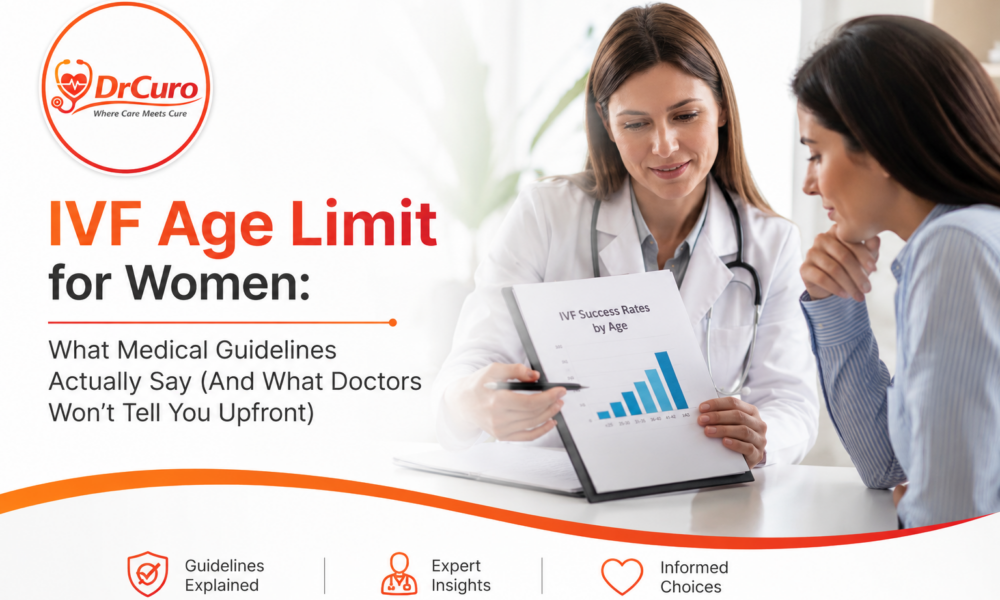
If you’ve ever searched “IVF age limit for women” late at night, you already know how overwhelming and contradictory the answers can feel. One website says 50 is completely possible. Another warns that 35 is already too late. Clinics often give unclear responses, leaving you more anxious and confused than before.
Table Of Content
- Why Age Matters in IVF — The Biology First
- What Medical Guidelines Say About IVF Age Limit for Women
- ICMR Guidelines (India)
- ASRM Guidelines (USA)
- ESHRE Guidelines (Europe)
- What This Means Practically
- IVF Success Rates by Age: The Numbers You Need to See
- IVF Under 35: Does Age Work in Your Favor?
- IVF Between 35 and 40: The “Advanced Maternal Age” Zone
- IVF Between 40 and 45: What’s Realistic?
- IVF After 45: What You Must Know
- IVF After 50: The Medical and Ethical Reality
- Factors That Matter More Than Just Your Age
- Should You Freeze Your Eggs Now? (Age-Specific Advice)
- Questions to Ask Your Fertility Doctor About IVF Age
- The Emotional Side Nobody Talks About Enough
- Summary: IVF Age Limits at a Glance
- Final Word from Dr Curo
This blog cuts through the noise with clear, honest information about age, fertility, and what the reality of Reproductive Medicine and IVF treatment in India actually looks like today.
At Dr Curo, we believe every woman deserves honest, medically accurate information not sales pitches wrapped in medical language. So here’s the real picture of IVF age limits, broken down by biology, medical guidelines, and what actually affects your chances.
Why Age Matters in IVF — The Biology First
Before we talk about limits, you need to understand why age is a factor at all.
Women are born with all the eggs they’ll ever have roughly 1 to 2 million at birth. By puberty, that number drops to around 300,000. By the mid-30s, both the quantity and quality of eggs decline significantly. This process is called ovarian aging, and it’s the core reason IVF success rates change with age.
It’s not just about getting pregnant. It’s about:
- Egg quality (chromosomal integrity)
- Ovarian reserve (how many eggs remain)
- Uterine receptivity (how well an embryo can implant)
- Risk of miscarriage
- Risk of chromosomal conditions like Down syndrome
IVF can help bypass some of these barriers but it cannot fully reverse biological aging. That’s the honest truth most people don’t say clearly enough.
What Medical Guidelines Say About IVF Age Limit for Women
There is no single universal law that bans IVF after a specific age. However, several major medical bodies have issued guidelines that most reputable clinics follow.
ICMR Guidelines (India)
The Indian Council of Medical Research (ICMR) recommends that IVF using a woman’s own eggs should not be performed in women above 50 years of age. For donor egg IVF, most clinics in India follow a soft limit of 45–50 years, with individual assessment required.
ASRM Guidelines (USA)
The American Society for Reproductive Medicine does not set a strict upper age limit but advises that:
- Women over 40 should be counseled about significantly reduced success rates with own eggs
- Women over 45 face very low chances with own eggs and should be strongly advised to consider donor eggs
- Women over 50 should undergo thorough cardiovascular and obstetric risk assessment before proceeding
ESHRE Guidelines (Europe)
The European Society of Human Reproduction and Embryology recommends individualized assessment for women over 45, with particular attention to pregnancy-related health risks including hypertension, gestational diabetes, and cardiac stress.
What This Means Practically
Most ethical clinics worldwide use 45 as a working upper limit for own-egg IVF and 50 as the outer limit for donor-egg IVF, with exceptions made case by case after full medical review.
IVF Success Rates by Age: The Numbers You Need to See
This is where the conversation gets real. Success rates drop with age and that decline is steeper than most people expect.
Using Own Eggs (Fresh Embryo Transfer):
| Age Group | Approximate Live Birth Rate per Cycle |
| Under 35 | 40–50% |
| 35–37 | 30–40% |
| 38–40 | 20–30% |
| 41–42 | 10–15% |
| 43–44 | 5–10% |
| 45 and above | Less than 5% |
Using Donor Eggs:
| Age Group | Approximate Live Birth Rate per Cycle |
| Under 40 | 45–55% |
| 40–44 | 40–50% |
| 45–49 | 35–45% |
| 50–54 | 30–40% (with strict medical screening) |
The reason donor egg success rates stay higher is that the egg quality is coming from a younger donor, typically aged 21–30. The recipient’s uterus, if healthy, can still carry a pregnancy successfully well into her 40s.
IVF Under 35: Does Age Work in Your Favor?
Yes — significantly. Women under 35 have the highest IVF success rates because:
- Egg quality is at its peak
- Ovarian reserve is typically higher
- Response to stimulation medications is better
- Miscarriage rates are lower
- Chromosomal abnormalities in embryos are less common
However, being young doesn’t guarantee success. Conditions like PCOS, endometriosis, blocked tubes, or male factor infertility can affect IVF outcomes at any age. IVF success is never just about age it’s about the full clinical picture.
IVF Between 35 and 40: The “Advanced Maternal Age” Zone
The term “advanced maternal age” begins at 35 and while it sounds alarming, it doesn’t mean IVF is off the table. Many women in this age range have successful IVF cycles.
What changes at 35+:
- Doctors will likely recommend Preimplantation Genetic Testing (PGT) to screen embryos for chromosomal abnormalities before transfer
- More monitoring cycles may be needed
- Ovarian stimulation protocols may be adjusted
- Success may take more than one cycle
The key is not to delay unnecessarily. If you’re 36 and thinking “I’ll try naturally for one more year,” that year matters biologically. Consulting a fertility specialist at 35 rather than 38 gives you more options and time.
IVF Between 40 and 45: What’s Realistic?
This is the zone where honest conversation is most important and where many clinics fail their patients by either being falsely encouraging or dismissive.
The reality at 40–45:
- Own-egg IVF is still possible but success rates drop sharply after 42
- Egg freezing done before 35 pays off enormously here if you froze eggs earlier, your effective “IVF age” is the age at which you froze
- Donor egg IVF becomes a serious, highly effective option
- Medical screening for pregnancy-related risks becomes more thorough
- The emotional weight of this decision is significant and deserves proper counseling support
At Dr Curo, we don’t push women toward donor eggs prematurely, nor do we withhold that recommendation when biology clearly points in that direction. The goal is always the right information at the right time.
IVF After 45: What You Must Know
IVF after 45 using own eggs is technically possible but medically uncommon due to extremely low success rates. Most reputable clinics will advise against it not to be discouraging, but because pursuing multiple failed cycles at this stage has physical, emotional, and financial costs that deserve honest weighing.
Donor egg IVF after 45 is a different story. Many women in their late 40s and early 50s carry healthy pregnancies using donor eggs. However, medical screening must include:
- Cardiac evaluation
- Blood pressure monitoring
- Thyroid and metabolic panel
- Uterine assessment
- Psychological counseling
- Discussion of obstetric risks unique to older mothers (preterm labor, placenta previa, gestational hypertension)
This is not gatekeeping it is responsible medicine. Pregnancy at 47 is not the same physiological experience as pregnancy at 32, and any clinic that treats them identically is not giving you proper care.
IVF After 50: The Medical and Ethical Reality
Some countries and clinics permit IVF up to age 50–55 under specific conditions. In India, ICMR guidelines allow it up to 50. In some parts of Europe and the US, there is no legal cap, though professional guidelines discourage it without thorough evaluation.
The honest position:
- Pregnancy after 50 carries significantly elevated risks for both mother and child
- Live birth rates even with donor eggs decline after 50
- Maternal mortality risk increases with age
- Long-term parenting health considerations matter and deserve honest discussion
If you’re exploring this option, the most important thing is to find a clinic that will give you full information — not just a “yes” to get your business.
Factors That Matter More Than Just Your Age
Age is one variable. Here are others that significantly shape your IVF outcome:
Ovarian Reserve (AMH levels) Anti-Müllerian Hormone (AMH) is one of the most reliable markers of remaining egg supply. A 39-year-old with a healthy AMH may respond better to IVF than a 34-year-old with low AMH. This is why blanket age rules miss the full picture.
Antral Follicle Count (AFC) This is an ultrasound measurement of the follicles visible in your ovaries at the start of a cycle. It predicts how many eggs can potentially be retrieved.
Uterine Health Fibroids, polyps, a thin endometrial lining, or previous surgeries can all affect implantation regardless of age.
Partner’s Sperm Quality Even the best egg quality can’t fully compensate for severely compromised sperm. Male factor infertility is a variable in approximately 40–50% of all infertility cases and is often underaddressed.
Previous Pregnancy History Having carried a pregnancy before, even one that didn’t result in a live birth, gives doctors valuable information about your fertility profile.
Lifestyle and Health BMI, thyroid function, blood sugar, sleep, stress, smoking, and alcohol use all affect IVF outcomes at every age.
Should You Freeze Your Eggs Now? (Age-Specific Advice)
Egg freezing, also called oocyte cryopreservation, is one of the most powerful fertility preservation tools available today. Here’s the straightforward guidance:
- Under 30: Ideal time. High quality, high quantity, maximum future flexibility.
- 30–34: Still excellent. This is the sweet spot for women who know they want children but aren’t ready yet.
- 35–37: Still meaningful but time-sensitive. Don’t wait another year. Act now if you’re considering it.
- 38–40: Possible but outcomes are more uncertain. Discuss honestly with a specialist.
- Over 40: Egg freezing with own eggs gives diminishing returns. Donor egg planning or embryo freezing (if you have a partner or are using donor sperm) may be more effective.
Questions to Ask Your Fertility Doctor About IVF Age
Most people walk into fertility consultations underprepared. These questions will get you real answers:
- What is my current AMH level and what does it mean for my IVF chances?
- What is my antral follicle count from my latest ultrasound?
- What is your clinic’s live birth rate (not just pregnancy rate) for women my age using own eggs vs. donor eggs?
- How many cycles do you realistically recommend before reassessing?
- At what point would you recommend switching from own eggs to donor eggs?
- What obstetric risks are specific to my age and health history?
- Do you offer psychological support as part of the IVF process?
A good clinic answers all of these clearly. Vague or dismissive answers are a red flag.
The Emotional Side Nobody Talks About Enough
IVF at any age is emotionally demanding. But the experience at 42 carries a particular weight the sense of time pressure, the grief of “why didn’t I start sooner,” the complicated feelings around donor eggs, and the fear that this might be the last chance.
That weight is real. It deserves acknowledgment, not just medical management.
At Dr Curo, we believe fertility care must include emotional support not as an afterthought, but as an integral part of the process. Because the goal isn’t just a successful cycle. It’s a woman who feels informed, supported, and respected throughout one of the most personal journeys of her life.
Summary: IVF Age Limits at a Glance
| Age | Own Egg IVF | Donor Egg IVF | Key Consideration |
| Under 35 | Best success rates | Rarely needed | Ideal window |
| 35–40 | Good, declining | Optional | PGT recommended |
| 40–43 | Moderate, declining | Highly recommended | Honest counseling needed |
| 43–45 | Low success rates | Strongly recommended | Full risk discussion |
| 45–50 | Very low / not advised | Possible with screening | Thorough medical review required |
| 50+ | Not recommended | Case-by-case basis | Significant risk assessment |
Final Word from Dr Curo
The IVF age limit for women is not a single number. It’s a combination of your biological age, ovarian reserve, uterine health, overall medical profile, and personal circumstances. What matters most is that you get accurate, personalized information not generic reassurance or unnecessary alarm.
If you’re wondering whether IVF is still an option for you, the best thing you can do right now is get tested. An AMH test and an ultrasound can tell you more in one appointment than a hundred articles online.
Dr Curo is here to give you that clarity with honesty, care, and no judgment.
Disclaimer: This article is for informational purposes only and does not constitute medical advice. Please consult a qualified fertility specialist for personalized guidance.






No Comment! Be the first one.